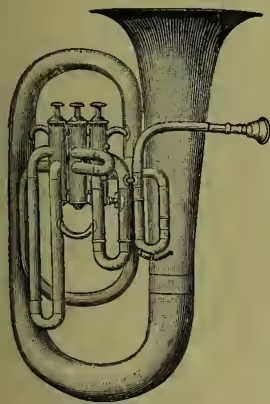
Saxhorn, the name of a series of brass wind musical instruments invented by Antoine or Adolphe Sax (1814-94), born at Dinant in Belgium, who settled in Paris in 1842, taught instrumental music, and died in poverty. By inventing Saxhorns and Saxophones he greatly influenced military music over the world. The saxhorn consists of a conical tube opening out to a wide bell, is sounded through a cupped mouthpiece, and is provided with valves or pistons on a principle similar to the Cornet (q.v.). Saxhorns are made in several sizes, the principal being the soprano in F, Eb, and D; the contralto in C and Bb; the tenor or althorn in F and Eb; the baritone and euphonium in C and Bb; the bass or bombardon in F and Eb; and the contra-bass or contra-bombardon in Bb. These have all the usual open harmonic notes of their respective tubes (see HARMONICS, HORN, &c.), the pistons providing the intermediate tones and semitones. The series have a very wide compass, stated by the inventor as more than five octaves. They are all more or less like the one (the euphonium) shown in the figure, except the contra-bombardon, which, on account of its size and weight, is usually made circular, so as to go round the shoulders of the performer. Their number and variety supply all the different parts required by a brass band, and in many places very efficient bands are entirely composed of them. From the fact that their fingering is all alike, a performer, having mastered one, can by a little practice play with equal facility on any of the others. This has tended in great measure to supersede the older instruments, which, from their diversity of fingering, had to be studied separately. This result has also been helped by the short-service system in the British army, where, as the maximum time during which the services of the men can be claimed is so short, the simpler the instrument the sooner they can be taught, and consequently the better return for the trouble of teaching them.
Their compass, richness, and flexibility of tone render them peculiarly suitable for military music, and their form renders them easy to play either on the march or on horseback. The euphonium and bombardon are, however, the only two which have found a place in the orchestra. See BAND.