Sea-urchins (Echinoidea), a class of Echinoderms. In the more typical genera, such as Echinus, the body is symmetrical and nearly globular; others, such as Spatangus, are heart-shaped; and others, such as Clypeaster, are shield-shaped and flattened. In all cases the body is walled in by continuous plates of lime, which, though capable of independent growth, are rigidly connected, except in Echinothuridæ, which have plastic shells, as the extinct Palæo-echinoidea seem also to have had.
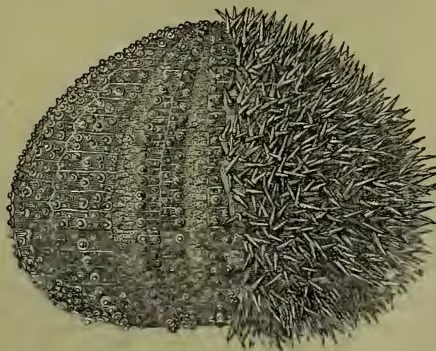
In a typical sea-urchin, such as Echinus esculentus or Strongylocentrotus lividus, the body is a slightly flattened sphere, covered with movable spines. The food-canal begins in the middle of the lower surface, and ends at the opposite pole in the middle of an 'apical disc,' which consists of a central plate surrounded by five 'ocular' and five 'genital' plates. The ocular plates bear eye-specks; the genital plates bear the openings of the genital ducts, but one of the five is modified as a madreporic plate through which fluid enters and leaves the water-vascular system. From pole to pole extend ten meridians—each a double row of calcareous plates which fit one another firmly. Five of these meridians—in line with the ocular plates—are known as ambulacral areas, for through holes in their plates the locomotor tube-feet are extruded; the other five meridians, alternating with the former and in line with the genital plates, are called inter-ambulacral areas, and bear spines, not tube-feet. The bases of the spines fit over ball-like knobs, on which they are moved by muscles. There are also two peculiarly modified forms of spines—the minute pedicellariae, with three snapping-blades mounted on a soft stalk, and small globular spheridia which seem to be sensitive to chemical changes in the water. The pedicellariae have been seen removing pieces of seaweed and the like from the surface of the shell. In front of the mouth project the tips of five teeth which work against one another, grasping and grinding small particles. They are fixed in five large sockets, and along with fifteen other pieces form 'Aristotle's lantern,' a complex, somewhat lantern-like masticating mill, of which Aristotle took notice. The limy skeleton is formed in the mesoderm, and outside of it there is a delicate ciliated ectoderm with a network of nerve-fibres and some ganglion cells. Inside the shell, lining the spacious body-cavity, there is again ciliated epithelium.
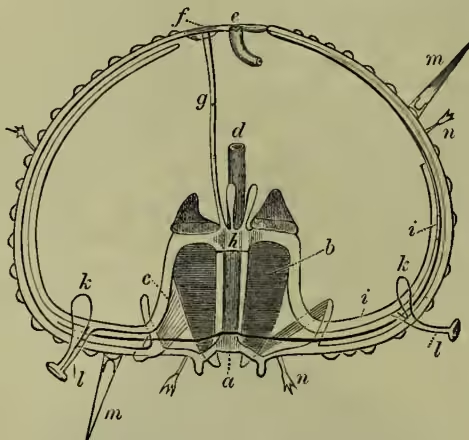
The nervous system consists of a ring around the mouth, with a radial branch up each ambulacral area, and of the superficial network. The tube-feet, pedicellariae, and spines are all under nervous control, while the eye-specks, the spheridia, and the tube-feet adjoining the mouth are especially sensitive. The alimentary canal passes through Aristotle's lantern, coils round the inside of the shell, and ends in the apical disc. The body-cavity contains a fluid with floating brown cells apparently of some significance in respiration.
The water-vascular system is of use in locomotion, and perhaps also in excretion. From the apical madreporic plate a 'stone-canal' extends through the body to a circular vessel round the upper end of the lantern; this circular vessel gives off five radial vessels, from which the tube-feet are supplied. When filled with fluid the tube-feet become tense and are pressed against the surface of the rock; when the fluid flows back they adhere firmly, and the sea-urchin drags itself towards the attachment. There is a blood-vascular system, but it is difficult to trace. Respiration seems to be discharged in part by the body-cavity fluid, in part by ten hollow outgrowths on the area round about the mouth.
The sexes are separate and resemble one another. The reproductive organs are five spongy masses lying beneath the apical disc. The eggs are fertilised externally by spermatozoa waited from another sea-urchin; and the free-swimming larva out of which the adult develops, as in other Echinoderms, by a remarkable indirect metamorphosis, is called a Pluteus, and has a quaint form, a little suggestive of a many-legged painter's easel. A few sea-urchins—e.g. Hemiaster—carry their young about with them among their spines.
Most sea-urchins live off rocky coasts; not a few shelter themselves in holes in the rocks; many deep-sea forms are known. Most are very sluggish, moving slowly by means of their tube-feet, in some cases slightly helped by their spines, in other cases perhaps hindered. They feed in part on seaweeds, mostly on organisms and organic matter found in mud and other deposits. Many look as if they were falling victims to their constitutional tendency towards the deposition of lime, for there is hardly any part of the body which may not become limy, and in some of the flattened forms the body-cavity is much restricted by cross beams of lime.
Among other Echinoderms, the Echinoids may be placed near Asteroids (starfishes) on the one hand, and near Holothuroids (sea-cucumbers) on the other, while they have without doubt affinities with the extinct Cystoids, which occupy a central position among the classes. The sea-urchins are often classified as follows:
- 1. PALEO-ECHINOIDEA.—Extinct forms, apparently with plastic shells, occurring first in Lower Silurian rocks.
- 2. DESMOSTICHA.—Regular and symmetrical forms, such as Echinus, Strongylocentrotus, Cidaris (with very long spines), Diadema (with numerous diffuse eyes), Cyanosoma urens (with poisonous spines), Echinothuridae (with flexible shells).
- 3. CLYPEASTROIDEA.—Shield-shaped and often flattened forms, with the end of the food-canal outside the apical disc—e.g. Clypeaster.
- 4. PETALOSTICHA.—Heart-shaped forms, with excentric mouth, without masticating organs, with the end of the food-canal away from the apical disc, with irregular ambulacral areas—e.g. Spatangus.
The ovaries of Echinus esculentus are sometimes eaten, but otherwise the sea-urchins hardly come into touch with human life.