Seal, the name commonly applied to all the Pinnipedia except the Morse or Walrus (q.v.). The Pinnipedia have many of the essential characters of the Carnivora (dogs, cats, lions, bears, &c.), in which order they are, therefore, classified. They may accordingly be described as carnivorous mammals adapted to a marine existence. They are not, however, so completely marine as the Cetacea, but pass part of their lives and perform certain functions—viz. the reproductive—on shores or on ice-fields. The structural peculiarities of the Pinnipedia are the following: The brain-case is smooth and rounded, the face small and short. The supraorbital processes are largely developed. The external ear is wanting altogether or very small. The skin is well covered with hair, which takes the form of fur in some species. The limbs are modified to form paddles for swimming, but still are capable of use in climbing out of the water and moving somewhat clumsily on land. The upper divisions of the limbs are shorter than the lower, and do not project beyond the skin of the body. There are five toes on each limb, and all are united together by strong webs extending to the extremities. The inner toe of the fore-foot is largest, the rest gradually decreasing, while in the hind-foot the inner and outer toes are both very long, and the intermediate ones somewhat shorter. The nails are straight, and may be reduced in number or wanting. The incisor teeth are pointed, and vary in number in the different genera. The molars and premolars are similar, and have not more than two fangs. There is a short, small tail, which is united beyond its middle to the hind-legs by the skin. The toes, particularly those of the hind-feet, are capable of being spread out very widely in swimming, so as to give great propulsive power.
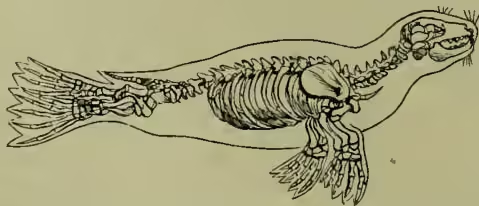
The movements of seals in the water are very rapid and graceful; on land they are very peculiar, even the fore-feet in the Phocidae being little used, but the body contracted by an upward bending of the spine, and so thrown forward by a succession of jerks; in which way, however, a seal makes its escape very rapidly from an assailant. The flexibility of the spine in seals is very remarkable, and depends on the very large intervertebral cartilages, formed of fibrous concentric rings. The muscles, which are connected with the spine on all sides, are of great strength. Seals have a remarkable habit of swallowing large stones, for which no probable reason has yet been conjectured. Their stomachs are very often found to be in part filled with stones. The stomach is quite simple; the gullet (œsophagus) enters it at the left extremity; the cæcum is short, the intestinal canal long.
The respiration of seals is extremely slow, about two minutes intervening between one breath and another, when the animal is on land and in full activity. A seal has been known to remain twenty-five minutes under water. Their slowness of respiration, and power of suspending it for a considerable time, is of great use, as enabling them to pursue their prey under water. The fur of seals is very smooth, and abundantly lubricated with an oily secretion. There is in some species an inner coating of rich fur, through which grow long hairs, forming an outer covering. Another adaptation to aquatic life and cold climates appears in a layer of fat immediately under the skin—from which Seal Oil is obtained—serving not only for support when food is scarce, but for protection from cold, and at the same time rendering the whole body lighter. The nostrils are capable of being readily and completely closed, and are so whilst the seal is under water; and there is a similar provision for the ears; whilst the eye, which is large, exhibits remarkable peculiarities, supposed to be intended for its adaptation to use both in air and water. The face is provided with strong whiskers, connected at their base with large nerves. Seals produce their young only once a year; sometimes one, sometimes two, at a birth. Not long after their birth the young are conducted by the mother into the sea. Many of the species are polygamous. Terrible fights occur among the males.
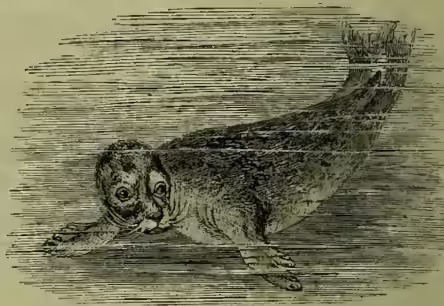
Seals are very much on their guard against the approach of man where they have been much molested; but where they have been subjected to no molestation they are far from being shy, and approach very close to boats or to men on shore, as if animated by curiosity. They are much affected by musical sounds. A flute is said to attract seals to a boat, where they have not learned caution from sore experience; and the ringing of the church bell at Hoy, in Orkney, has very often caused the appearance of numerous seals in the little bay. Seals possess all the five senses in great perfection. The common seal and some of the other species are very intelligent; but there is considerable difference in this respect among the species. The common seal and some others have often been tamed, and are capable of living long in domestication if freely supplied with water. They become very familiar with those who attend to them, are very fond of caresses and of notice, recognise their name like dogs, and readily learn many little tricks, of which advantage has been taken for exhibitions.
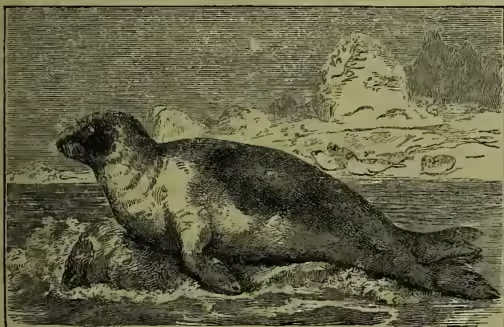
Seals, excluding the walrus, are divided into the two families Phocidae, which have no external ears, and Otariidae, which possess distinct though small representatives of these organs. The Otariidae are, however, considered by modern specialists to be more closely related to the Walrns (Trichecidæ) than to the Phocidæ, notwithstanding the great tusks and peculiar dentition of the former. The Otariidæ, like the walrns, are capable of standing on all four legs, the hind-limbs being turned forward in walking on land, while in the Phocidæ the hind-limbs are trailed behind both on shore and in the water, and cannot be used to support the body when the animal is on land. The Earless Seals are commonly supposed to be monogamous, and, excepting the Sea-elephants, exhibit little difference in size between the sexes. They bring forth their young on shore or on ice-floes, but do not resort to special breeding-places nor remain for any length of time out of the water. The Eared Seals (the Phocidæ), on the other hand, are polygamous, and resort with invariable regularity to particular breeding-grounds, where they remain for months till the calves are able to travel; then they all depart and become pelagic for the rest of the year. The males are much larger than the females. The Common Seal (Phoca or Callocephalus vitulina) occurs on British coasts, and extends southward to the Mediterranean. It is common on the north-western shores of Europe and eastward along the arctic shores. It is very common in Greenland and on the arctic shores of North America, its southern limit on the western side of the Atlantic being New Jersey. On the east side of the Pacific it extends from southern California to Behring Strait, and probably occurs also on the western shores of the North Pacific. This species is always found on shores and not on ice-floes. It is hunted in Newfoundland and Greenland for its skins, which are much valued, though the covering is hair, not fur, and for its oil and flesh; but its numbers are not very great. The Harp-seal (P. grælandica), so called from a crescent-shaped dark stripe on each side of the back in the adult, ranges through the arctic regions of the Atlantic, and is said to occur also in the North Pacific, in Kamchatka. It is very abundant in Newfoundland and Greenland, and numerous on the arctic coasts of Europe—e.g. Finnmark, Spitzbergen, and Nova Zembla. This species is very gregarious, and breeds on ice-floes in spring. Enormous numbers are killed annually for the sake of their oil and skins. The Harp-seal has been taken on British coasts. It grows to 8 or 9 feet in length, but its ordinary length is about 6 feet. The Bearded Seal (Phoca barbata) is another species of the North Atlantic which occurs on British coasts; it reaches 9 or 10 feet in length. The Ringed Seal (P. hispida) also occurs as a straggler on British shores, but normally lives on the arctic shores of both hemispheres. It is not of great commercial value, but is highly prized by the Greenlanders and Eskimos, who depend largely on its skin, oil, and flesh. It is a small species. Seals occur in large numbers in the Caspian and Aral Seas, where they are regularly hunted by the Cossacks. The species of this region is distinguished under the name P. caspica. Another species, P. siberica, occurs in Lake Baikal, which consists of perfectly fresh water, and is situated at a great elevation above sea-level. Halichærus grypus, the Gray Seal, is confined to the coasts of Europe, occurring on the shores of Scandinavia, Ireland, and Scotland; it reaches a length of 8 feet. In Denmark, since 1890, an effort has been made to exterminate the seals, in the interests of the fisheries, and a reward of three kroner per head paid for all killed (810 in the first ten months).
The distribution of the Phocidæ extends to the tropics. Monachus albiventer, called the Monk Seal, inhabits the shores of the Mediterranean, and of Africa as far south as Madeira. Another species of the same genus, M. tropicalis, exists in the West Indies, where it was formerly abundant, though now rare. Cystophora cristata, the Crested or Hooded Seal, has a remarkable dorsal dilatation of the nose, which can be inflated with air or depressed as the animal pleases; when distended, it extends backwards towards the top of the head. This species has the same geographical range as the Greenland or Harp Seal, but is not so numerous or so highly valued. Allied to the Crested Seal is the great Sea-elephant, which owes its name to its size and to the elongation of its nose, which forms a short curved proboscis. The males of this species reach a length of 20 feet, while the females never much exceed 10 feet. The Sea-elephant or Elephant-seal (q.v.; Macrorhinus leonina) lives on the antarctic islands and ice-fields, and is hunted for its blubber and skin. Another species of Sea-elephant (M. angustirostris) occurs in the northern hemisphere, having been formerly abundant on the coasts of California and western Mexico; it is now scarce. Other species of Phocidæ in the antarctic regions, called Sea-leopards, are Stenorhynchus leptonyx and Leptonyx weddellii.
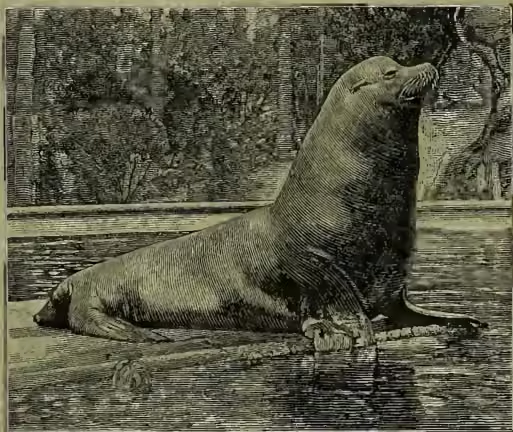
(From a Photograph by Gambier Bolton F.Z.S.)
The second family of Pinnipedia commonly called seals, the Otariidæ, are frequently distinguished as Sea-lions and Sea-bears, names corresponding to differences in their hairy covering; the former carry only long coarse hair, while the latter have in addition a short and soft, delicate fur, beyond which the coarse hairs project. It is this fur which, under the name of seal-skin, is so highly valued in commerce. Sea-lions are sometimes distinguished as hair-seals, and Sea-bears as fur-seals; but the former name would apply equally well to all the Phocidæ.
The Otariidæ are about equally represented in the arctic and antarctic regions. By Dr J. E. Gray a large number of genera were distinguished, but recent students of the species unite them under one or two genera. The Sea-lions are as follows: Eumetopias (Otaria) stelleri, the Northern Sea-lion, inhabits both shores of the Northern Pacific from California and Japan northwards, and breeds on the Aleutian and other islands in the Behring Sea. The male is about 16 to 18 feet in length, and the female about half that size. Otaria jubata, the southern Sea-lion, inhabits the west coast of South America, the islands in the neighbourhood of Cape Horn, and the Falkland Islands. Zalophus Gillespii, the Californian Sea-lion, is considerably smaller than E. stelleri.
Of the Fur-seals there are two genera, one belonging to the northern hemisphere, Callorhinus, the other to the southern, Arctocephalus. Of the former there is but one species, the celebrated northern Fur-seal, Callorhinus ursinus, which during 1885-92 became the subject of such complicated diplomatic controversy between the United States, the British Empire, and European nations. This seal is entirely confined to the North Pacific, no fur-seal existing in the North Atlantic. The habits of the northern fur-seal have been very thoroughly investigated by Henry W. Elliott, an American naturalist. This species breeds annually on two of the Pribylov Islands in the Behring Sea, and on two of the Commander Islands farther west, and it breeds nowhere else. The seals arrive on these islands in June and July, the males in the former month, the females in the latter, and they leave them with their young about the middle of September, not returning till the following year. During the breeding time they remain on the low-lying land bordering the sea. In 1870, after the transfer of Alaska from Russia to the United States, the Pribylov Islands were leased by the United States government to the Alaska Commercial Company for twenty years, and this company also rented the Commander Islands from Russia. The company were allowed to take not more than 100,000 seals from the Pribylov Islands per annum, and the seals killed were exclusively young males, not breeding males or any females. The company paid to the government 50,000 per annum as rent, and in addition a tax of 2 on each skin shipped from the islands. The value of fur-seal skins shipped from the territory and sold in the London market during the first twenty-three years of American occupation is reported to have reached nearly 33,000,000. In 1890 a new lease of the islands under similar conditions was granted to the North American Fur-sealing Company. In the earlier part of the year the vast herds of these seals, on their way to the breeding-grounds, pass the coast of Washington Territory and British Columbia, and were there hunted at sea in former times by the Indians. But British and American schooners now employ the Indians, and kill very large numbers. The schooners, both of these and of other European nations, also pursue the seals in Behring Sea. It was the attempt of the United States government to assume exclusive rights over the Behring Sea which gave rise to the diplomatic controversy. The killing of the seals in the ocean has developed to such an extent that it is feared the careful regulation of the slaughter on the breeding islands will not be sufficient to prevent the extermination of the species. In 1880 the total number of fur-seal skins taken by the pelagic hunting was 19,150, valued at 172,350, but the number had increased to 43,779 in 1890. In the summer of 1891 the British government and that of the United States agreed to submit the dispute to arbitration and to send a joint commission of experts to the seal islands to examine into the question, the killing of seals being meanwhile strictly limited. The court of arbitration, comprising representatives from Britain, United States, France, and Sweden and Norway, met at Paris in 1893, settled the questions in dispute, and agreed upon a series of articles regulating the seal-taking. The principal species of fur-seals in the Antarctic Ocean are the following: Arctocephalus nigrescens may be said to belong to the South Pacific, though it extends also into the South Atlantic. At the beginning of the 19th century this species was abundant on nearly all the islands off the west coast of South America from Cape Horn to the equator, and was killed in large numbers at Juan Fernandez, Mas-a-Fuera, St Felix, St Ambrose Islands, and the Galápagos. It was also abundant at the South Shetlands, Falkland Islands, South Georgia, Sandwich group, Kerguelen, and Heard Island. But at the present time these seals have been exterminated in most of these places, and are scarce in the remainder. Some are still obtained at the South Shetlands; and on Lobos Island at the mouth of the La Plata there is a small 'rookery,' protected by the government of the Argentine Republic. Fur-seals were also formerly abundant on islands off the west coast of Africa from the Cape of Good Hope northward. The seal in this region has been distinguished as a separate species under the name Arctocephalus pusilla. It is almost extinct at the present day. Fur-seals were also abundant formerly on Stewart's Island, Antipodes Island, and others to the southeast of New Zealand, but are now scarce. The skins of the fur-seal was at first imported into England for tanning, the wool and hair being scraped off together. It was in 1796 that Thomas Chapman invented a method for 'extracting by the root the whole of the inconceivable quantity of coarse hair that grows intermingled amongst the fur on the skin of the South Sea seal.'
A brief survey of seal-hunting as an industry is necessary to supplement the few indications given in the above account of the species. The largest 'seal-fishery' in the North Atlantic is that of the ice-fields to the east of Newfoundland and Labrador. The vessels engaged in this industry almost all belong to Newfoundland, some being sailing-ships and some steamers. There are somewhat more than a hundred vessels fitted out every year for seal-hunting. The season begins about the middle of March, and lasts for about two months. The crews land on the ice, and kill the young seals which are not old enough to escape easily by clubbing them with a 'gaff,' and then take off the skins, with the fat adhering to them, and carry them to the ships. The annual catch is about 500,000, valued at £425,000. The skins used for leather, and the oil made from the fat, are among the most important exports of Newfoundland. Seal-hunting on the West Greenland coast is mostly carried on by natives, and the meat, skins, and oil used for their own consumption. Fleets of sealers from Great Britain, Germany, and Norway annually visit the neighbourhood of Spitzbergen and Jan Mayen. The industry at Nova Zembla and in the White Sea, as well as in the Caspian, is carried on by Russian subjects. The hunting of southern fur-seals and sea-elephants in the antarctic was formerly more extensively carried on by American and English vessels than it is now. The method here is to land men on the islands when the surf allows, the vessels returning afterwards to take them off with their booty. The animals are killed with club and knife, or with the rifle. At the present day the total product from the antarctic regions is only a few thousand skins and barrels of oil. The fur-seal hunting in the North Pacific has already been mentioned. On the Pribylov and Commander Islands only the young males up to six or seven years of age, called 'holluschickie,' are killed. These young males are not allowed by the older males to breed, and they haul up on shore occasionally apart from the breeding-grounds. The native servants of the company drive them from the sea to killing-grounds near their villages, and slaughter them by blows on the head with clubs. The 'pelagic' sealers have of course a different method. The Indian hunters leave the schooners in boats, and paddle up to the seals as they sleep at the surface of the sea, and spear them. The barb of the spear is loose, and attached to a line, so that the seal cannot escape or be lost: if the animal is not killed by the spear, he is hauled in when exhausted, and clubbed on the head. This mode of hunting is, as before mentioned, carried on off the coasts of Washington Territory and British Columbia and northwards to Behring Sea.