Seal (Lat. sigillum, Fr. seau), an impression on wax or other soft substance made from a die or matrix of metal, a gem, or some other material. The stamp which yields the impression is sometimes itself called the seal. In Egypt seals were in use at an early period, the matrix generally forming part of a ring (see GEM, RING). Devices of a variety of sorts were in use at Rome, both by the earlier emperors and private individuals. The emperors, after the time of Constantine, introduced bullæ or leaden seals, and their use was continued after the fall of the western empire by the popes, who attached them to documents by cords or bands. On the earlier papal seals are monograms of the pope; afterwards the great seal contained the name of the pope in full and a cross between the heads of St Peter and St Paul, while the papal privy-seal, impressed not on lead but on wax, known as the Seal of the Fisherman, represents St Peter fishing. In the 9th and 10th centuries we find Charlemagne, the Byzantine emperors, and the Venetian doges occasionally sealing with gold, and we have an instance as late as the 16th century of a gold seal appended to the treaty of the Field of the Cloth of Gold, between Henry VIII. and Francis I.
The most complete series of royal seals is that of the kings of France, beginning with the Merovingian dynasty. Seals were not much used in England in Anglo-Saxon times, but they came into general use after the Norman Conquest. The earliest regular great seal is that of Edward the Confessor, modelled on the contemporary French pattern. On the royal great seals was the king in armour on a caparisoned horse galloping, his arms being shown on his shield after the period when arms came into use; and the reverse represented the king seated on a throne. The great seals of Scotland begin with Duncan II. in the end of the 11th century, and have also for subject the king on horseback; the countersal, with the seated figure, being used first by Alexander I., and the earliest appearance of the arms of Scotland being on the seal of Alexander II. In both countries there were also the privy-seals with the royal arms only.
Ecclesiastical seals first appear in the 9th century, and attained great beauty in the 13th and 14th. They are of the pointed oval form known as Vesica piscis, and have for subjects a figure of the bishop, sometimes of the Trinity, the Virgin, or a patron saint, seated under an elaborate architectural canopy. The arms of the bishop are often added.
(Crambe maritima).
Under the Norman monarchs of England sealing became a legal formality necessary to the authentication of a deed; and from the 13th century onwards the seals of all persons of noble or gentle birth represented their armorial ensigns. The seal was generally appended to the document by passing a strip of parchment or a cord through a slit in its lower edge; and the ends being held together, the wax was pressed or moulded round them a short distance from the extremity, and the matrix impressed on it. Occasionally the seal was not pendant, but the wax was spread on the deed. The coloured wax with the impression was sometimes imbedded in a mass of white wax forming a protective border to it. In England a seal is still an essential to all legal instruments by which real estate is conveyed; but since subscription has also become necessary the practice of sealing has degenerated into a mere formality. The custom was gradually introduced of covering the wax with white paper, on which the impression was made, and latterly wafers have been considered a sufficient substitute for seals. In Scotland, where sealing is not now required (see DEED), every freeholder was obliged by statutes of Robert III. and James I. to have his seal of arms; and among the Scottish armorial seals of the 14th and 15th centuries are some of wonderful beauty of execution. In most of
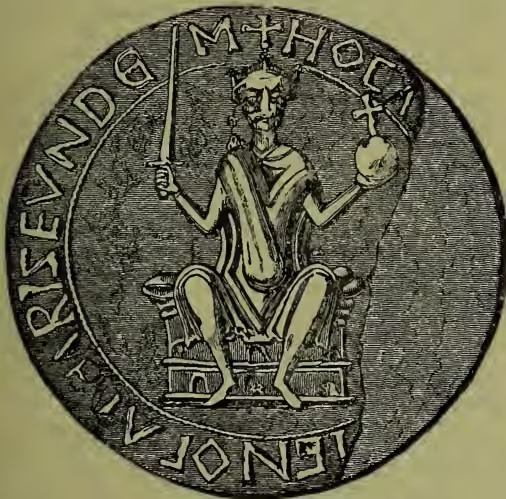
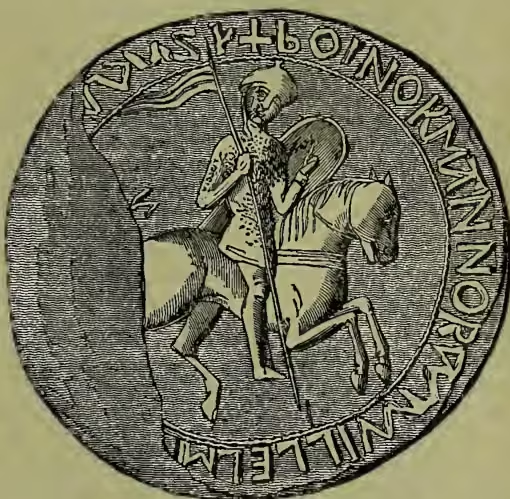
the states of the American union neither wax, wafer, nor anything corresponding to a seal is required for deeds.
The use of corporate seals by towns and boroughs dates as far back as the 12th century. The earlier corporate seals bear the town gates, city walls, or some similar device; the use of corporate arms did not begin till the later half of the 14th century. The study of mediæval seals is of great importance and interest in connection with many branches of archaeology, including heraldic and genealogical investigations. Seals are still customarily appended to various kinds of formal and official documents, ecclesiastical, academic, masonic, &c.
The Great Seal, the specific emblem of sovereignty, is appended only to the most important class of public documents, such as writs for summoning parliament, treaties, and official acts of state. A new one is made for each new sovereign (or on occasion of a change of arms or style), the old one being solemnly broken. The original custodian of the English seal was the Lord Chancellor (q.v.), but by-and-by the seal was frequently put into the charge of a special official called the Lord Keeper (q.v.). Since 1757 the Chancellor is the only keeper of the Great Seal; though the seal may be put into Commission, and entrusted for the time to Lords Commissioners. It was long a rule that the Great Seal should not be used for any document without prior authority under the Privy-seal (see below). When in 1642 the Lord Keeper (Littleton) joined Charles I. at York, he carried the Great Seal with him; whereupon the parliament (illegally, no doubt) ordered a new one to be made. Charles II. had one made for himself after his father's death. James II. on his flight threw the Great Seal into the Thames opposite Lambeth, but it was soon recovered. At the union with Scotland it was provided there should be only one Great Seal for Great Britain; but a seal is provided to be used in Scotland for grants concerning offices, commissions, and private rights in that kingdom only. This seal is commonly called, for brevity, the Great Seal of Scotland, and is now held ex officio by the Secretary of State for Scotland. No special provision was made after the union with Ireland.
The Privy-seal is the seal appended to grants which are afterwards to pass the Great Seal, and to documents of minor importance which do not require the Great Seal. The officer who has the custody of the Privy-seal was at one time called the Keeper, and afterwards the Lord Privy-seal. The Lord Privy-seal is now the fifth great officer of state, and has generally a seat in the cabinet. His office is conferred under the Great Seal during pleasure. Since the reign of Henry VIII. the Privy-seal has been the warrant of the legality of grants from the crown, and the authority for the Lord Chancellor to affix the Great Seal. Such grants are styled letters-patent, and the office of the Lord Privy-seal is one of the departments through which they must pass to secure their validity. Until recently all letters-patent for the grant of appointments to office under the crown, of patents of invention, charters, naturalisations, pensions, creation of honours, pardons, &c. required to pass from the Signet Office to the Privy-seal Office, in the form of Signet bills, verified by the Signet Seal and superscription; and on the Privy-seal being attached to them they were forwarded to the Lord Chancellor, by whom the patents were completed in the office of the Great Seal. By the Act 47 and 48 Vict. chap. 30, it is now unnecessary for any instrument to be passed under the Privy-seal, a warrant under the royal sign-manual duly countersigned being sufficient authority for passing any instrument under the Great Seal. There is a Privy-seal in Scotland, which is used to authenticate royal grants of personal or assignable rights. Rights such as a subject would transmit by assignation are transmitted by the sovereign under the Privy-seal. Several other minor seals are still in use in Scotland; the Quarter Seal, known also as the Testimonial of the Great Seal, pertaining to the Director of Chancery; the Signet, mainly used in initiating proceedings in the Supreme Court; and various Seals of Court.
See also the articles BULL, GEM, RING, DEED; and A. B. Wyon, Great Seals of England (1888).