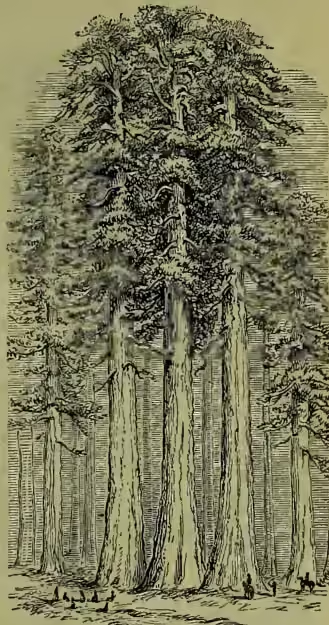
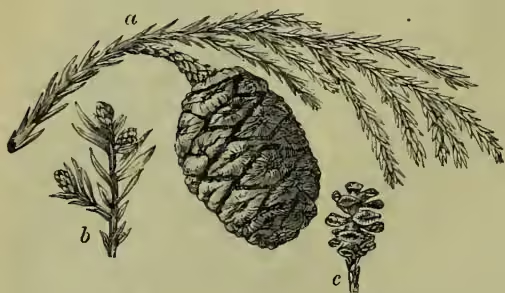
Sequoia, a small genus (two species) of evergreen coniferous trees belonging to California. S. gigantea, better known in Britain as Wellingtonia, in other countries as Washingtonia and Gigantabies, is the 'Mammoth Tree' of California. Sequoia is a Latinised form of the name of the famous Cherokee chief, Sequoyah (see CHEROKEES). The mammoth tree, which is surpassed in height only by the Eucalyptus (q.v.) of Australia, was discovered by Douglas in 1831, though its existence was recorded by Menzies in 1796; it was introduced into Britain in 1853 by Lobb. The tree, though found at elevations varying from 4000 to 7000 feet above sea-level, affects only sheltered valleys, in which it occurs in groves intermixed with other trees. The most remarkable of these groves is in Calaveras county; only less remarkable is that of Mariposa near the Yosemite Valley. The 'Mammoth Grove' of Calaveras consists of from 90 to 100 trees of gigantic proportions. One of the most notable is named 'Mother of the Forest.' It rises to the height of 327 feet, but is dead and barkless, though it girds 75 feet near the base. The bark, about 18 inches thick, was removed in sections by Mr G. L. Trask to the height of 116 feet (causing the death of the tree), and fitted up as it came from the tree in the Crystal Palace, Sydenham, to illustrate the proportions of the mammoth tree; this erection was destroyed by fire in 1866. Near by the 'Mother' lies prostrate the trunk of the 'Father of the Forest,' which girds at the ground 110 feet. In falling the trunk had broken over at the height of 300 feet. At that point the girth is 40 feet, and taking the average taper of the surrounding trees, this dead giant may reasonably be computed to have exceeded 400 feet at the time of its fall. Inside the fallen trunk there is a tunnel 35 feet long, and from 8 to 10 feet high. The 'Pioneer's Cabin,' a cavity in the trunk of another giant in this grove, is large enough to accommodate a numerous party at dinner. The 'Three Graces' (see fig. 1), growing within a few feet of each other, became famous for their symmetry and beauty; they attain almost equally to the height of 265 feet. The age of these larger specimens is variously estimated at from 2000 to 3000 years; such estimates, however, based as they are on the enumeration of the concentric rings of the trunk, are not to be implicitly relied upon, particularly in the case of evergreen trees. The timber of the mammoth tree is reddish in colour when matured, non-resinous, and odorous, the fibre short, porous, and brittle; it is not regarded as durable. In Britain, when planted in rich alluvial soil in well-sheltered positions, it is found to rival the Larch or any of the more rapid growing timber-trees in the production of timber in a given time. The tree is hardy enough to resist the severest frost likely ever to be experienced in Britain, but will not endure wind, especially that from the north and east. There are several varieties in commerce, the result of cultivation—viz. S. g. pendula and S. g. aurea, which cannot be said to be in either case improvements on the faultless cone-like symmetry of growth which characterises the typical form. S. sempervirens, the other species, is the Redwood or Bastard-tree of the Californian settlers, a handsome tree also of gigantic proportions. Though apt to assume a rusty appearance in winter in Britain, the effect of wind, the tree is perfectly hardy, and grows with great rapidity when planted in good soil and in sheltered places. The timber is light, beautifully grained, and durable, but splits with remarkable facility; so that though very useful to the Californian settlers for fences, &c., it is not good for purposes of carpentry. Both species are prized as ornamental trees, and no collection of choice conifers can be regarded as complete without them. See CONIFERÆ.