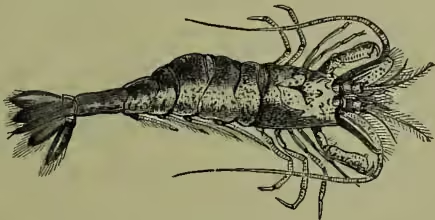
Shrimp (Crangon), a genus of crustaceans, of the order Decapoda, allied to lobsters, crayfish, and prawns. The form is elongated, tapering, and arched as if hunch-backed. The beak is very short, affording a ready distinction from prawns. The forceps are comparatively small. The whole structure is very delicate, almost translucent; and the colours are such that the shrimp may readily escape observation, whether resting on a sandy bottom or swimming through the water. For the change in colour on boiling, see PIGMENTS, Vol. VIII. p. 174. The quick darting movements, like short leaps, betray them to any one who looks attentively into a pool left by the retiring tide on a sandy shore. When alarmed they bury themselves in the sand by a peculiar movement of their fanlike tail. The Common Shrimp (C. vulgaris) is very abundant on British and other European coasts wherever the shore is sandy. It is about 2 inches long, of a greenish-gray colour, dotted with brown. It is in great esteem as an article of food, and is generally taken by a net in the form of a wide-mouthed bag, stretched by means of a short cross-beam at the end of a pole, and pushed along by the shrimper wading to the knees. Sometimes a net of larger size is dragged along by two boats. The Skeleton-shrimp or Spectre-shrimp is a small crustacean of the family Caprellidae (as Caprella linearis). The Brine-shrimp (q.v.) is the subject of a separate article. The Fresh-water Shrimp is treated at GAMMARUS.