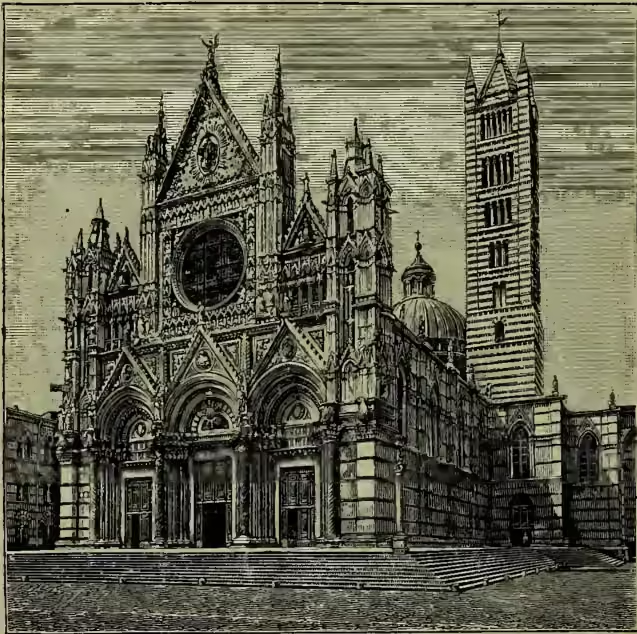
Sienna (Ital. Siena), a Tuscan city 60 miles by rail S. of Florence, with many mediæval features, such as its walls and citadel. The chief architectural glory of Sienna is her cathedral, one of the finest examples of Gothic work in Italy. It was begun early in the 13th century; in 1339 it was intended to build a vastly larger church, of which the existing cathedral should have been only one transept. But after the plague of 1348 the idea was abandoned, and only ruined walls indicate the ambitious design. The magnificent west front of three arches was not finished until 1380; it is partly pointed, partly round-arched, and is enriched with red, white, and black marbles, gilding, and many sculptures. A fire did considerable damage to the exterior in 1890. A lofty square campanile stands on the south side. The art treasures of the interior embrace the wonderful octagonal pulpit by Niccolo Pisano (1268), similar to the one at Pisa; the marble mosaic floor of the cathedral, from designs by Buoninsegna and Beccafumi; the series of frescoes commemorative of the life of Pope Pius II., by Pinturicchio, in the Piccolomini Library, where also are preserved several choir books splendidly illuminated by Siennese artists; the celebrated font (1428), with bas-reliefs by Donatello, Della Quercia, and other sculptors, in the church of San Giovanni, situated beneath the cathedral. The churches of Sant' Agostino, the Servites, San Domenico, and some others contain pictures by Sodoma, Matteo di Giovanni, and other Siennese artists. The greatly venerated church of St Catharine (q.v., a native of this city) stands on the site of her former dwelling-house; and not far away is the fountain of Fontebranda, celebrated by Dante. The municipal palace, a magnificent edifice of brick in the Pointed Gothic style, begun in 1288 and finished in 1309, is adorned on the exterior by a lofty tower (1325), and contains numerous paintings by Siennese artists. There are several noble palaces, like the Piccolomini, Tolomei, Monte de' Paschi, Loggia del Papa, some dating from the 13th century, and some now put to various public uses. The more noteworthy of the public institutions are the university, with faculties of medicine and law (less than 180 students), founded in 1203; the state archives and the town library; and an Institute of Fine Arts (1816), sheltering in its gallery many fine pictures by masters of the Siennese school, the principal of whom are Buoninsegna, the brothers Lorenzetti, Simone di Martino, Matteo di Giovanni, Peruzzi, Sodoma (Bazzi), and Beccafumi. The city has also given birth to a host of other illustrious men, as Aeneas Piccolomini (Pope Pius II.), Gigli (a scholar and a humorist), Bernardino Ochino, the two Socini (founders of Socinianism), and the architects
Agnolo, Agostino, and Della Quercia. Every July (2d) and August (16th) celebrated horseraces are held in the market-place, being the survival of still more widely celebrated popular festivals of the middle ages. The inhabitants, 28,500 in 1892, weave silk, manufacture cloth and hats, and carry on an active trade in wine and olive-oil. Sienna is the seat of an archbishop.
Shortly before or after the establishment of the Roman empire Sienna was made a Roman colony under the name of Scena Julia. After the empire was broken up the city soon formed itself into a free republic, governed by consuls, and grew so much in power and prosperity that it became the head of the Ghibelline towns in Central Italy. During this period (the 12th and 13th centuries) it had a dangerous rival in Florence, but inflicted a crushing defeat upon the Florentine militia at Montaperto in 1260. A century later, however, when hard pressed by Florence, the Siennese put themselves (1399) under the protection of the Duke of Milan. Nevertheless hostilities were frequently renewed with their powerful rival during the 15th century. Between 1487 and 1512 the virtual ruler of Sienna was Pandolfo Petrucci, called the Magnificent, who aimed at founding a dynasty in his native city similar to that of the Medici in Florence; but his descendants were not the men to realise his ambitions, and in 1524 the people, to escape from the dominion of the Petrucci, put themselves under the suzerainty of the Emperor Charles V. Yet soon afterwards the city revolted and called in the French to its aid; but it and its ally were defeated and Sienna itself besieged (1555) and taken. The emperor then gave it to Cosimo de' Medici (1557), who annexed it to Florence, and subsequently incorporated it in the grand-duchy of Tuscany (q.v.).—The province of Sienna has an area of 1477 sq. m. and a pop. (1889) of 222,104.—For Sienna Earth, see BURN'T SIENNA.