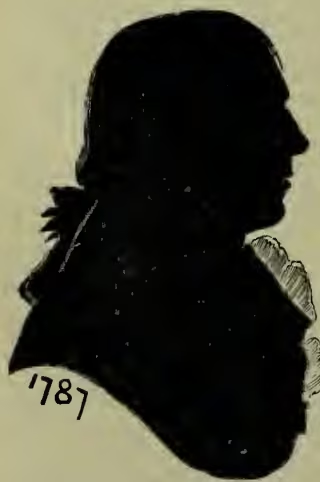
Silhouette, a profile or shadow-outline filled in of a dark colour, the shadows and extreme depths being sometimes indicated by the heightening effect of gum or some other shining material. This species of design was known among the ancients, and was by them carried to a high degree of perfection, as the monochromes on Etruscan vases amply testify; but the name silhouette is quite modern, dating from about the middle of the 18th century, though the art itself seems to have been practised in England prior to 1745. It was taken from Etienne de Silhouette (1709-67), the French minister of finance for four months in 1759, who, to replenish the treasury, exhausted by the costly wars with Britain and Prussia, and by excessive prodigalities, inaugurated numerous reforms and the strictest economy of expenditure. His earliest reforms were admirable; his later ones, however, were so capricious, shortsighted, and unsuccessful that he fell utterly from favour, and his name became a byword for invidious parsimony; any mode or fashion that was plain and cheap was styled à la Silhouette; and profiles made by tracing the shadow projected by the light of a candle on a sheet of white paper, the rest of the figure being filled up in black, have continued to bear the name. Although without merit as a work of art, the silhouette presents a clear and well-marked profile, and the Pantagraph (q.v.) used to be frequently employed to obtain profiles of a reduced size direct from the human features. Profiles cut out of black paper with scissors also receive the name of silhouettes; and akin to these are the 'silhouette illustrations' to Faust, A Mid-summer Night's Dream, &c., by the Prussian Paul Konewka (1840-71), or those to our own article HORSE in Vol. V. p. 794. It should be added that Littré derives the use of the word otherwise: quoting from the Journal Officiel of 1869 a statement that one of M. de Silhouette's chief amusements after his fall was making such shadow-portraits, and that his château of Bry-sur-Marne had the walls of several of its rooms adorned with pictures of this sort. M. de Silhouette was at an earlier date secretary and chancellor to the Duke of Orleans, and was one of the three commissioners appointed in 1749 to delimit the frontiers of the French and British possessions in Acadia. He wrote a number of works, and published three translations from the English of Bolingbroke, Pope, and Warburton respectively. See a long correspondence in Notes and Queries for 1882-83.