Skin. The skin forms a complete covering for the outer surface of the body, and consists of two distinct layers, of which the outer is termed the epidermis, cuticle, or scarf-skin, and the inner the corium or cutis vera. Moreover, the skin contains certain structures termed 'tactile corpuscles,' by means of which the properties of bodies are revealed to the sense of touch; and associated with the skin there are such accessory organs as hair, nails, sebaceous glands, and sweat-glands.
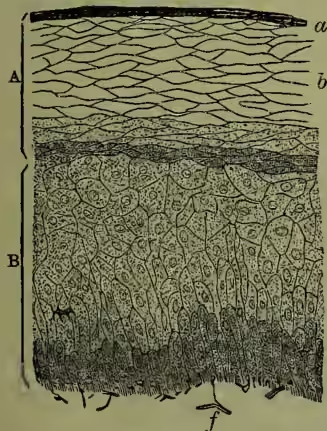
The epidermis is non-vascular, and forms a protective covering for the cutis vera. It varies in thickness from th to th of an inch, being ment granules are found, and the tawny colour of the skin. A section of the epidermis of a Negro's leg, showing the cells of the horny and mucous layers, will be found at Epidermis (q.v.). If a large portion of the epidermis be removed, the process of repair is slow, and proceeds from the edges of the wound, but recovery is quicker if any of the deeper cells of the layer remain. Skin-grafting aims at transplanting small portions of healthy epidermis—including its deeper layers—to denuded surfaces, and when the grafts take root the raw surface is much more speedily covered because the healing process spreads from each graft (see RHINOPLASTIC OPERATIONS). Nails and Hair (q.v.) are growths of the epidermis.
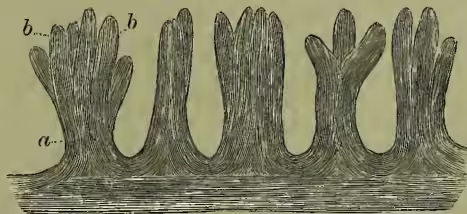
The cutis vera, corium, or trunc skin is a vascular and sensitive structure, everywhere covered by the epidermis. It rests on a layer which in most places contains fat—the panniculus adiposus—and to this layer the corium is sometimes loosely, sometimes firmly, attached. In structure the true skin consists of an interlacing network of white fibrous tissue with a mixture of elastic fibres. On its deep aspect the meshes are more open, and contain lumps of fat. In this way the corium gradually blends with the subcutaneous layer, and so its thickness is not definite, but is generally regarded as varying from th to th of an inch. Wherever hairs occur bundles of muscular fibres are found. The outer surface of the corium is characterised by furrows, which also affect the epidermis. The largest furrows are found opposite the flexures of joints. Finer furrows may be seen on the backs of the hands; while on the skin of the palms and soles ridges with intervening furrows form patterns which are characteristic of each individual. These patterns are permanent, and do not materially change from infancy to adult life (Galton). The latter furrows are due to the fact that the outer surface of the corium is beset with small elevations termed papillæ (fig. 2). These are most fully developed where touch is finest, and they fit into corresponding depressions on the under surface of the epidermis. The deeper layers of the corium are plentifully supplied with blood-vessels, which form a fine network of capillaries from which loops pass into most of the papillæ. Fine nerves are also supplied to the corium for distribution to the 'touch corpuscles' found in certain papillæ. As a rule papillæ with touch corpuscles have no capillary loop, and thus we distinguish 'vascular' and 'tactile' papillæ. The hair-follicles also receive nerves, and fine varicose nerve-fibrils pass into the deeper layers of the epidermis. Sebaceous glands, found wherever hairs are present, pour their secretion into hair-follicles at a short distance from the mouth, unless the hair be small, when the gland may open on the surface of the skin, and the hair project through its duct. Being outgrowths of the hair-follicles they are accessory structures to the epidermis, although the body of the gland is lodged in the corium. They are specially abundant in the scalp and face—some of the largest being found on the side of the nose. Their secretion consists of the fattily degenerated and disintegrated cells which line their interior (see ACNE).
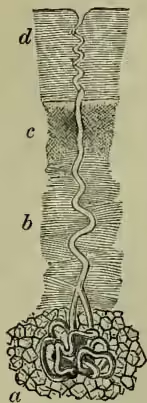
Sweat-glands are found at various depths beneath the corium. Each gland is a coiled-up tube, of which the duct is that part leading in a corkscrew manner through the corium and epidermis to the surface. These glands are also outgrowths of the epidermis, and they are lined by epithelial cells. They are most numerous where there is no hair, but they occur everywhere in connection with the skin. Krause states that 2800 open on a square inch of skin from the palm; half as many on a similar area on the back of the hand; fewer on the surface of the forehead; 1100 on breast and forearm; while from 400 to 600 are found on the square inch of the lower limbs and back of the trunk. The sweat is naturally alkaline, although it may be found acid owing to the presence of fatty acids derived from the decomposition of sebum. In prolonged sweating the secretion becomes neutral and again alkaline. It is colourless, of a saltish taste, and its odour, which is due to volatile fatty acids, varies with different parts of the body. Coloured sweat is among the phenomena of nervous affections, and instances of blue and bloody sweats are on record. In jaundice the sweat may contain bile-pigment.
Ceruminous glands are found in the auditory passage, and have such a close resemblance to sweat-glands that the former may be regarded as modifications of the latter. They yield an adhesive bitter secretion—the wax—which protects the drum of the ear from insects, dust, &c.
The most important function of the skin, Touch (q.v.), is separately treated. Regarded as a protective covering, the skin possesses the combined advantages of toughness, resistance, flexibility, and elasticity; the connective framework being the part which mainly confers these properties, although the epidermis co-operates with it. The subcutaneous layer of fat, and the modifications of epidermis in various forms, as hairs, wool, feathers, scales, &c., serve for the preservation of warmth, and occasionally (when they occur as claws, talons, &c.) as means of offence or defence. The skin is the seat of a twofold excretion—viz. of that formed by the sudoriparous glands and that formed by the sebaceous glands. The fluid secreted by the sudoriparous glands is usually formed so gradually that the watery portions of it escape by evaporation as soon as it reaches the surface; but in certain conditions, as during strong exercise, or when the external heat is excessive, or in certain diseases, or when the evaporation is prevented by the application of a texture impermeable to air, as, for example, oiled silk, or the material known as mackintosh, or india-rubber cloth, the secretion, instead of evaporating, collects on the skin in the form of drops of fluid. When it is stated that the sweat contains urea, lactates, extractive matters, &c., and that the amount of watery vapour exhaled from the skin is, on an average, lb. daily, the importance of the sudoriparous glands as organs of excretion will be at once manifest. Moreover, there is reason to believe, from the experiments of Scharling, Gerlach, and others, that the importance of the skin as a respiratory organ is far from inconsiderable, very appreciable quantities of carbonic acid being exhaled hourly by the external surface of the body. In the amphibia, in which the skin is thin and moist, the cutaneous respiration is extremely active; and that the respiratory function of the skin in the higher animals is also considerable is proved not only by measuring the excreted carbonic acid, but by the fact that if the skin is covered by an impermeable varnish, or if the body is enclosed, all but the head, in a caoutchouc dress, animals soon die, as if asphyxiated, their heart and lungs being gorged with blood, and their temperature before death gradually falling many degrees.
The skin is, moreover, an organ of absorption: mercurial preparations, when rubbed into the skin, have the same action as when given internally. Thus potassio-tartrate of antimony, rubbed into the skin in the form of ointment or solution, may excite vomiting, or an eruption extending over the whole body. The effect of rubbing is probably to force the particles of the matter into the orifices of the glands, where they are more easily absorbed than they would be through the epidermis. It has been proved by the experiments of Madden, Berthold, and others, that the skin has the power of absorbing water, although to a less extent than occurs in thin-skinned animals, such as frogs and lizards. This fact has a practical application. In severe cases of dysphagia—difficult swallowing—when not even fluids can be taken into the stomach, immersion in a bath of warm water, or of milk and water, may assuage the thirst. Sailors, also, when destitute of fresh water, find their urgent thirst allayed by soaking their clothes in salt water.
The diseases of the skin are classified at DISEASES; the more important affections are noticed in special articles. See also ALBINOS, BATH, NERVOUS SYSTEM. The colour of the skin as a means of distinguishing race is dealt with at ETHNOLOGY. Peculiarities in the skins of various animals are treated in the articles on those animals (HIPPOPOTAMUS, RHINOCEROS, &c.). For skins as articles of commerce, see FURS, LEATHER. For the stuffing of animals, see TAXIDERMY.
SKIN-CASTING is a popular term for processes which vary not a little in degree and even in nature. In most cases the outer layer of the epidermis tends to die away, and is separated off either very gradually and in small pieces at a time, or in large shreds, or in a continuous slough (see SNAKES). The moulting of feathers and the casting of hair are analogous. In the moulting or 'ecdysis' of Crustaceans and other Arthropods, what is cast is the cuticle—a product of the underlying epidermis. See CRAB, CRAYFISH, CRUSTACEA.