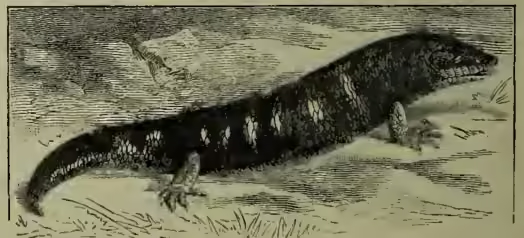
Skink (Scincus officinalis), an African lizard, which lives in sandy places, and burrows with great rapidity. It is from six to eight inches long, generally of a reddish-dun colour, with darker transverse bands, a wedge-shaped head, and four rather strong limbs. For ages it has been in great repute for imaginary medicinal virtues; it was largely imported on this account into ancient Rome, and is still in high esteem in the East, dried skinks finding a ready sale in many places, as Cairo and Alexandria. There is almost no disease for which skink-powder has not been supposed to be a cure. The Skink is typical of the family Scincidae, of which Eunectes with well-developed legs, Seps with very weak legs, Nessia with rudimentary legs, Acontias with no legs are representative genera. In many there are well-developed bony scutes beneath the rounded scales. See LIZARDS.