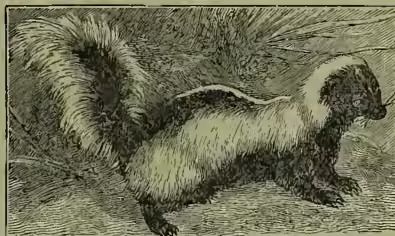
Skunk (Mephitis), a genus of small carnivorous quadrupeds of the family Mustelidæ. The body is elongated, and usually much arched; the tail long, and thickly covered with long, fine hair; the head small, with thick, blunt snout; the legs short, and the paws comparatively large, with five incompletely divided toes. The general colour is black and white. The power, characteristic in some degree of all the Mustelidæ, of forcibly discharging the fetid secretion of the Anal Glands (q.v.) is in the skunks enormously developed. All the species are American, and, as they differ little in habit, the Common Skunk (M. mephitica) may be taken as typical of the whole genus. The common skunk—an animal about the size of a cat—has fur of a glossy black; on the forehead is a patch of white diverging into two lines which extend the whole length of the back and meet again in the beautiful bushy tail. The under surface of the tail is also white, and, as it is usually carried erect or laid over against the body, the white is regarded by some naturalists as a 'warning colour.' Thus Mr Belt writes: 'The skunk goes leisurely along, holding up his white tail as a danger-flag for none to come within range of its nauseous artillery.' The common skunk is found throughout North America, but is most abundant in the Hudson Bay region. It chiefly frequents high-lying, bushy, or even rocky districts and the banks of rivers, remaining concealed in its burrow by day, but emerging at dusk in search of the worms, insects, birds, and small mammals which form its food. Its movements are slow and leisurely. It never attempts to run away if pursued, for, feeble and defenceless as it looks, it is most efficiently protected by the possession of a nauseous fluid, the discharge of which neither man nor beast will wittingly provoke. Should an unwary intruder venture too near, the skunk turns its back, erects its tail, and, by means of a muscular contraction, ejects the contents of its anal pouches with a force which carries them to a distance of from 8 to 10 feet. So penetrating is the evil odour of this fluid that it is perceptible a mile off, and has been known to cause nausea in persons within a house with closed doors from which the animal was a hundred yards distant; and so persistent is it that clothes defiled by it can only be purified by prolonged hanging in smoke. It is said that the fluid has irritating properties which excite severe inflammation of the eyes, and cases are cited of Indians who have thus lost their eyesight. The skunk is hunted for its fur, which is in considerable demand; but the hunter must be careful to avoid alarming the animal, and thus causing it to discharge its obnoxious fluid. Skunks usually raise from six to ten young in a season. If taken young they are easily tamed and make pretty pets, for they are cleanly in habit and rarely emit their offensive secretion save when provoked. The Long-tailed Skunk (M. maerura) is found in central and south Mexico, and a much smaller species (M. putorius), with four white stripes, ranges from the southern states to Yucatan and Guatemala.