Snakes (Ophidia) form one of the classes of reptiles, and are readily known by their shape, being limbless and much elongated. To some extent the shape may be an adaptation to the habit of creeping through crevices and among dense herbage; for, apart from snakes, it is seen in other animals which crawl through obstacles or underground, in limbless lizards (e.g. Amphisbaena and Anguis), in the amphibian Cæcilians, in various eel-like fishes, and in worms.
General Habit and Structure.—As regards habitat we distinguish tree-snakes, usually green in colour, of slender body, and of active habits; the water-snakes, including the non-poisonous freshwater forms, such as the British Grass Snake and the tropical Anaconda, and the very venomous sea-snakes (Hydrophidæ), whose flattened tail, apical nostrils, &c. are adaptations to their mode of life; the burrowing snakes (Typhlopidae), with rigid cylindrical bodies, narrow mouths, and no specialised ventral shields; and the majority, which may be called ground-snakes.
The scales covering the body are formed from folds of skin. In each species of snake they have a definite arrangement, which is greatly relied on in the more detailed classification. This is especially true of the shields on the head, which are usually named after the underlying bones—parietals, frontals, nasals, &c.; thus between the nasal scale (on which the nostril opens) and the pre-orbital (in front of the eye) there is in harmless snakes a loreal scale, which is one of their characteristics. Most important in the life of the animal are the strong ventral scales or shields, for each of these is attached to a pair of ribs and helps to grip the ground. As they correspond in number to the vertebrae, they are also diagnostic of species. The number of vertebrae in snakes is often great, in some pythons amounting to more than four hundred. They form a uniform series, distinguishable only into pre-caudals and caudals, and all the pre-caudals except the first bear ribs. The bodies of the vertebrae are concave in front and have well-developed articular processes.
The skull is highly specialised. The bones which form the brain-case proper are firmly united, but most of the others are movable. Thus, 'when the snake opens its mouth for the purpose of striking its prey, the digastric muscle, pulling up the angle of the mandible, at the same time thrusts the distal end of the quadrate bone forward. This necessitates the pushing forward of the pterygoid, the result of which is twofold: firstly, the bending of the pterygo-palatine joint; secondly, the partial rotation of the maxillary upon its lacrimal joint, the hinder end of the maxillary being thrust downward and forward. In virtue of this rotation of the maxillary, through about a quarter of a circle, the dentigerous face of the maxilla looks downward, and even a little forward, instead of backward, and the fangs are erected in a vertical position' (Huxley). The halves of the lower jaw are connected in front by an elastic ligament, and this, combined with the mobility of the quadrates and squamosals, makes it possible for the snake to swallow its relatively large prey.
The teeth of snakes are short, conical, and sharp, and are fused to the bones which bear them. The upper teeth may occur on the maxillæ, palatines, pterygoids, and rarely on the pre-maxillæ; the lower teeth are borne as usual by the dentaries. In the most venomous snakes, such as vipers and rattlesnakes, the maxillary teeth are few, and each is folded so as to form a tubular or grooved fang. The specialised fang is connected by a gradual series of forns with the ordinary teeth.
As to the appendicular skeleton, no snake has any trace of anterior limbs or girdle, and only a few—the pythons, boas, Typhlopidae, and Tortrices—have any rudiment of a pelvis. The pythons and Tortrices have short rudiments of hind-limbs terminated by claws.
While the nervous system of snakes differs from that of other reptiles only in small details, such as the absence of a differentiated spinal accessory or eleventh cranial nerve, the sense-organs are in many respects peculiar. The eyelids, apparently absent, are in reality fused as a transparent screen in front of the eye, as is the case in Geckos and some other lizards. The eyes are often very small, and the sense of sight seems often to be dim. As the common simile 'as deaf as an adder' suggests, the sense of hearing is also dull; there is no external ear and no tympanic cavity. The nostrils lie at the apex of the snout; the sense of smell seems sufficiently acute to guide the snakes to their prey and to their mates. In finding the latter they are aided by the peculiar, sometimes musk-like odour characteristic of snakes. Of a sense of taste they have little need, for they swallow their prey whole, nor are the usual gustatory organs present. It is not too much to say that the most developed sense-organ is the tactile tongue, with which snakes feel their way and test everything which they touch.
The internal structure of snakes presents several peculiarities in adaptation to the elongated shape of the body. Thus, the stomach is long but not broad, the lobes of the liver are also elongated, there is in most cases only one lung, the kidneys are not opposite one another, and so on. The elasticity of the food-canal is an adaptation to the swallowing of relatively large booty, and during this often slow process the larynx is slunted forward into the mouth so that respiration is not seriously impeded. Although boas, rattlesnakes, and some others have paired lungs, most snakes have only one, usually with a rudiment of the other. There are often auxiliary air-sacs on the windpipe, and the posterior part of the lung is rather a reservoir for air than an actual breathing organ. Apart from the characteristic hiss, produced by the forcible expulsion of air, most snakes are dumb, but some boas are said to whine, and a few others make peculiar sounds, of which the rattling of the rattlesnakes is best known. In having a three-chambered heart and a circulation of mixed blood in the greater part of the body snakes resemble lizards and tortoises. No urinary bladder is developed.
The Poison-apparatus.—The poison-gland characteristic of the venomous snakes is not a new structure, but merely a specialised salivary gland, and it is interesting to notice that a similar modification occurs in the poisonous Mexican lizard Heloderma. From the gland, which lies on each side behind the eye, and is about the size of an almond in the cobra, a duct extends to the base of the fang, down which the venomous juice flows when the snake bites its victim. The fangs are folded teeth, each an open groove, as in the sea-snakes, or a closed tube, as in the vipers. It is of course clearly to be understood that the 'sting of the serpent' is a poisonous bite. Stretching over the poison-gland is the membranous origin of the masseter muscle which works the lower jaw, and by means of this and other somewhat complex arrangements the poison-gland is automatically compressed when the snake opens its mouth to strike. But the opening of the mouth also brings about the erection of the fangs, which are
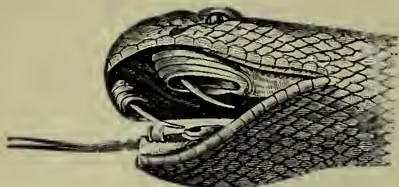
Open mouth of a venomous snake, showing the fangs half-hidden in their sheaths. (After Nuhu.) recumbent and ensheathed when not in use. Behind each functional fang is a series of reserve fangs, and if a fang be broken the foremost of the reserves is shunted forward, and becoming fixed to the maxilla replaces the one which has been lost.
The juice formed in the specialised glands and forced out along the fangs is a clear viscid fluid with an acid reaction, and with poisonous properties which vary according to the species
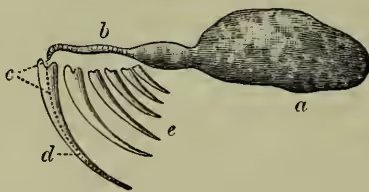
Dissection showing the poison-gland, a; its duct, b; the tubular fang, c, d; the reserve fangs, e. (After Nuhu.) and also with the vigour of the snake. It may be kept for months or even years without losing its virulence. Injected through the fangs into the blood of a victim, it tends to paralyse the nerve-centres. It has most effect on birds and mammals, less on cold-blooded animals, such as fishes. An injection of the blood of a venomous snake may also prove fatal. Several venomous snakes are unaffected by their own venom, and Fayer states that Cobras and Daboias may bite one another with impunity. He also notices that the 'sweepers' and Dhomies' who attended his elaborate experiments in India were wont to eat the animals which had been fatally bitten. In 1843 Lucien Bonaparte discovered in the poison of the adder (Pelias berus) a substance which he called 'viperine,' but this seems practically identical with the ptyaline of ordinary saliva, and we are still far from understanding why the juice of the poison-gland should have its peculiar properties.
Food.—Snakes are almost always carnivorous; and, as is suggested by the nature of their teeth, which are not adapted for mastication, they swallow their booty intact. Mammals, birds, reptiles, amphibians, fishes, molluscs, and insects are all eaten by snakes, and there are many forms with strange preferences—e.g. for milk and eggs. In the egg-eating African snake—Rachiodon—the teeth are rudimentary, but the inferior spines of the anterior vertebrae project on the dorsal wall of the gullet and break the egg-shells. In many cases the prey is relatively large—larger indeed than the normal size of the mouth and gullet—and the process of swallowing is tedious. In the python, for instance, there is a slow continuous action of jaws and teeth; the victim is firmly held by one side of the mouth while the other side is protruded and its teeth implanted further forward, and so on alternately on each side. Meanwhile the mobile bones of the skull are being stretched to the utmost, and the victim is covered with saliva which makes the passage down the elastic gullet somewhat easier. After a heavy meal the snake often lies dormant for a time, after which it may cast its slough.
Movements.—Owen has said of snakes that they can 'outclimb the monkey, outswim the fish, outleap the zebra, outwrestle the athlete, and crush the tiger;' yet all without limbs. The muscular system is very strongly developed, and the long ribs associated with most of the vertebrae serve instead of legs. The serpent 'literally rows on the earth, with every scale for an oar; it bites the dust with the ridges of its body.' On a very smooth surface—on glass, for instance—it can make no headway, but in normal conditions the edges of the anterior ventral scales are fixed against the roughnesses of the ground, the ribs are drawn together first on one side then on the other, the body is thus wriggled forward to the place of attachment, the hind part fixes itself, the front part shoots out, an anterior attachment is again effected, and thus the snake glides onwards. But this scarcely suggests the swiftness or the beauty of what Ruskin calls 'one soundless, causeless march of sequent rings, and spectral procession of spotted dust, with dissolution in its fangs, dislocation in its coils. Startle it; the winding stream will become a twisted arrow; the wave of poisoned life will lash through the grass like a cast lance.' Were it not for many fanciful pictures it would scarcely be necessary to say that without any support snakes are not able to raise the anterior part of their body more than a short distance from the ground.
Sloughing.—It is well known that a snake periodically 'casts its skin,' leaving behind it a continuous 'slough.' The same process occurs in lizards, and to a less extent in some other animals. What is cast is the external layer of the epidermis, and its continuity depends on the fact that the scales are simply folds of skin. As to the physiology of the process, although a complete explanation has not yet been given, it is evident that the outer layer of the skin tends to die away, and that the continued growth of the animal makes sloughing necessary. The number of sloughings in a year varies with the species of snake and also with the age and health of the individual. Cobras have been observed to slough as often as once a month, but this seems to be unusually often. Before sloughing snakes are often almost blinded by the change in the skin over the eyes, and at this time they are said to be very irritable. In getting rid of its slough the snake gets its head free first, and the outer layer is turned inside out from before backwards.
Reproduction.—The sexes are almost always quite like one another externally, save that the females are always larger. The internal organs of reproduction are paired, but those of the right side are often the larger and lie in front of those on the left. The male has a double copulatory organ, sometimes covered with spines or hooks. The eggs, fertilised within the oviducts, are more or less oblong in shape, and are surrounded by a leathery envelope, 'for the rupture of which the embryos are provided with an egg-tooth, a special development like that of the chick.' Most snakes are oviparous, but, as among lizards, viviparous forms occur, such as the British Adder (Pelias or Vipera berus). It is said that Geoffroy Saint-Hilaire and Florent Prévost 'succeeded in making the (normally oviparous) Common Grass Snake viviparous by depriving it of water and maintaining a suitable surrounding temperature;' and it may be that some viperine snakes and the Boa Constrictor, which have borne their young alive in captivity, are oviparous in natural conditions of life. Of the python it is recorded that the mother coils herself around the laid eggs and broods over them, the temperature within the coils rising as high as 96° F.
Classification.—Snakes may be thus classified :
SUB-ORDER I.—Opotterodontia (= Typhlopidae) : the simplest and smallest snakes, sometimes smaller than earthworms, occurring in most warm countries as burrowers in the soil. The mouth is narrow and not distensible; the eyes are small and half-hidden; and the skull, besides being much less mobile in its parts than is usual in snakes, is unique in having transverse palatine bones which meet or nearly meet in the base, in the absence of a 'transverse bone,' and in the freedom of the pterygoids from the quadrate; only one jaw, either the upper or the lower, bears teeth. They are not venomous. Most of the forms belong to the genus Typhlops—represented in America, Africa, India, Australia, and by one species in south-eastern Europe.
SUB-ORDER II.—Colubrifornia : mostly harmless snakes without any fangs (Aglyphodontia), or with some of the posterior maxillary teeth grooved and fang-like (Opisthoglyphia). Examples : the Pythons (Pythonidae), the Boas (Boidae); the Grass or Ringed Snake (Tropidonotus natrix), the Smooth Snake (Coronella levis), the Tree-snakes (Dendrophidae and Dryophidae).
SUB-ORDER III.—Colubrifornia venenosi : poisonous snakes with permanently erect fangs, succeeded by solid teeth (Proteroglyphia). Examples : Cobras (Naja), Hamadryas (Ophiopbagus), Coral-snakes (Elaps), Sea-snakes (Hydrophidae).
SUB-ORDER IV.—Viveriformes : poisonous snakes with a few erectile maxillary teeth specialised as fangs (Solenoglyphia). Examples : Vipers (Viperidae) and Rattlesnakes (Crotalidae).
Distribution.—The number of species is certainly above 1000 and is sometimes estimated at about 1800. They are represented in most parts of the world, abundantly in the tropics, commonly in temperate countries, dwindling towards the poles. They are absent from New Zealand and most Oceanic islands, and it is a proverbial saying that 'there are no snakes in Iceland.' In Ireland also they are unrepresented, except by casual importations.
The Grass or Ringed Snake (Tropidonotus natrix) and the poisonous Viper or Adder (Pelias or Vipera berus) are the two common kinds of snake found in Britain. There is indeed only one other species, the Smooth Snake (Coronella levis), and this is of rare occurrence. The smooth snake and the ringed snake are non-poisonous Colubrine snakes; the viper is a small representative of a very venomous family. As the viper is discussed in a separate article, and as the smooth snake is restricted to a few parts of the south of England, we need only describe the ringed snake. It sometimes attains a length of 3 or 4 feet, is very fond of water, and feeds chiefly on frogs, small fish, young birds, mice, and other small animals. Its colours are beautiful—usually brownish gray with a green tinge above, dull pale bluish beneath. In summer it is fond of basking among the long grass; in winter it hibernates in some sheltered nook in company with several of its fellows. Unlike the adder, the ringed snake is oviparous, laying 16-20 eggs in some well-sunned spot. It is common in some parts of Britain. These three species also form the Ophidian fauna of Scandinavia, Denmark, Holland, and Belgium; but there are over a dozen other European species, of which one of the commonest is the Asp (Vipera aspis).
The North American Ophidia include a large number of Colubrine snakes and about a score of pit-vipers or rattlesnakes. Among the Colubrine forms are the water-snakes (Tropidonotus), the black snakes and coachwhip snakes of the genus Coluber, the pine-snakes (Pityophis), species of Elaphis, the king-snakes (Ophibolus), the ring-necked snakes (Diadophis), and so on. Besides the rattlesnakes proper (Crotalus) there are related genera, such as Ancistrodon, the copperheads and moccasins. And outside the two families of Colubridae and Crotalidae there are representatives of the burrowing Typhlopidae, of the boa-like Erycidæ, and of the venomous coral-snakes (Elapidae)—the harlequin snake (Elaps fulvus) being a well-known representative of the last.
The Colubridæ form the largest and most cosmopolitan of Ophidian families, being abundantly represented in all the great regions except Australia, where the venomous Elapidae predominate. 'The tree-snakes proper (Dendrophidae) are found in all the tropical regions; the nocturnal tree-snakes (Dipsadidae) and the arboreal whip-snakes (Dryophidae) are also essentially tropical, but they are either wholly, or almost wholly, wanting in Australia' (Heilprin).
The Pythons and Boas are distinctively tropical snakes : the Pythons in Africa, India, Malaya, Australia; the Boas in tropical America. Among the most important venomous snakes of India are the following : the Cobra (Naja tripudians), the Hamadryas or Sunkerchor (Ophiophagus elaps), the Krait (Bungarus caruleus), and the Sankni (B. fasciatus), various species of Callophis, the Chain Viper or 'Bora Siah Chunder' (Daboia russellii), Echis carinata, various species of Trimeresurus, and the sea-snakes (Hydrophis, &c.).
Zoological Position.—It may be granted that snakes are more nearly allied to lizards than to other living reptiles, but the affinities are not close, nor does palæontology help us much, for fossil remains of Ophidia are scarce. 'Only one species, the Simoliophis rochebruni, from the Upper Cretaceous deposits of the Charente, France, is known to antedate the Tertiary period.' 'Whether or not the snakes are in part the modified descendants of the extinct lacertilian Pythoumormorphs, to which they seem to approximate in certain points of structure, still remains to be determined.'
Superstitions about Snakes.—As snakes fill most men with fear, which is the prolific mother of fiction, hundreds of strange superstitions surround these animals. Born from the soil, they lick the dust for their food; powerful indeed, they are killed by spiders, and cannot stand before crabs; venomous many of them, they are poisoned by human saliva, and flee from the shadow of the ash or the odour of rosemary; their maximum size has been stated at a mile. It is not surprising that many peoples should have found in the serpent 'a divine hieroglyph of the demoniac power of the earth—of the entire earthly nature,' or even a symbol of the principle of evil. 'As the bird,' Ruskin says, 'is the clothed power of the air, so this is the clothed power of the dust; as the bird is the symbol of the spirit of life, so this of the grasp and sting of death.' For serpent worship, see SERPENTS.
We cannot wonder that the ingenuity of despair should have sought out many strange antidotes to the poison of serpents. Various kinds of herbs, portions of the snake's own body, a diet of 'anti-pathetic' animals, spells, charms, and amulets have been often resorted to, often of course with successful results, for the bite is not always fatal, and confidence is the best of tonics; often of course uselessly when the Fates were cruel. Among the most famous, and for the most part quite useless, 'cures' for snake-bite is the application of a 'snake-stone.' Although the nature of this so-called 'stone' is sometimes kept secret by the native quacks who prepare it, the substance is often a piece of charred bone, and its only possible efficacy lies in its power of absorbing the poisoned blood from the wound to which it is applied. But the results of actual experiments with snake-stones are entirely against any belief in their virtue. The same name is sometimes given to an Ammonite (q.v.), on the idea that it is a petrified snake. Another kind of snake-stone or adder-stone, also called ovum anguinum, adder-gem, and druidical bead, was carried about as a miscellaneous charm in Britain, and was believed to have been produced by a number of adders laying their heads together and hissing till the foam produced was turned into stone. Such charms when examined have often been found to be simply ancient—possibly prehistoric—spindle-whorls. See also BEZOAR.
As a superstition we must also regard the widespread belief that snakes 'fascinate' their prey. Although many observers are convinced of this, the use of the word 'fascinate' has not been justified. No doubt snakes, having no movable eyelids, have an unusual power of steady staring; no doubt birds whose nestlings are threatened will flit anxiously about regardless of danger. In countries where venomous snakes are common, it is possible that the animals on which they prey have an inherited dread of them. It is certain that both men and animals when brought suddenly face to face with something terrible are often panic-stricken and incapable of motion; but there is no evidence that snakes have a power of fascination.
Scarcely a superstition, but rather an insufficiently confirmed opinion, is expressed in the common belief that snakes swallow their young ones when danger threatens. Were not errors of observation exceedingly common, we should be inclined to accept this strange fact, for the shelter afforded by the mouth is a convenient if somewhat hazardous one, and the young snakes might live there for some time. It is known that a few fishes and amphibians carry their young in their mouths. But the possibilities of mistake are many; thus, some snakes eat other snakes, and their bodies have often been found in the food-canals of their larger neighbours. Moreover, some snakes are viviparous, and unpractised observers might mistake the oviducts for the alimentary canal.
Serpent-charming.—This art has been practised from very ancient times in Africa and the East, and often remains from generation to generation the profession of a family. Pliny and older writers frequently describe it, and there are several allusions to it in the Old Testament Scriptures; see Exod. vii. 11, 12; Psalm lviii. 4, 5; Eccles. x. 11; Jer. viii. 17. It is sometimes practised for alleged useful purposes, since the 'charmers' are often employed to clear a house of its unwelcome snake visitors, though common report says that they are yet more successful in removing inanimate objects. For the most part, however, it is, like conjuring, a form of popular amusement. In India it is practised by several distinct classes of men, who vary in the methods and success of their art. The subject has not as yet been studied with adequate scientific precision, so that it is difficult to separate what is due to trickery and to dexterity from any residual facts which cannot be thus explained. There is no reason to believe that the charmers possess the constitutional immunity from snake-bite which they often claim, for a tragic end to their exhibitions sometimes belies their pretensions, and they usually take good care to play with snakes whose fangs or even poison-glands have been carefully removed, or even to use those which are not venomous at all. Nor can we, without further evidence, believe that the professional snake-finders have, beyond the cleverness of long experience (including an educated sense of smell), any peculiar power of discovering concealed snakes, especially since it is well known that they often use simple sleight of hand, producing snakes from within the folds of their robes, or merely discover what they themselves have previously hidden. The frequent use of a musical pipe, and the way in which the snakes seem to respond to the sounds, are facts interesting to naturalists, who believe that at least many snakes are very deaf. Experi- ments should be made to determine how far the rhythmical motions which often accompany the music may have any influence on the snakes. That the charmers govern their snakes by their eye is another of the vague assertions of common report; but more interesting is the ancient habit of spitting down the snake's throat, closing its mouth, laying it flat on the ground, and sending it into a cataleptic—perhaps hypnotic—state, or 'turning it into a stick.' The charmers sometimes manifest a fearlessly confident dexterity in handling intact venomous snakes, and they sometimes suffer for it.
Snake-bites.—The extent of the mortality from snake-bite among inhabitants of warm countries is rarely appreciated by those who live in conditions of relative immunity. Official statistics show that in the decade 1880–89 the deaths of persons reported from snake-bite in British India varied from 18,670 (1881) to 22,480 (1889), without taking account of 2000 or 3000 cattle annually killed by snakes. Even if we doubt whether all deaths referred to snake-bite are really due to this, whether the Cobra and its allies are not blamed for more than they are really responsible for, it is certain that the mortality from snake-bite is relatively great when compared with that which any other animals cause. We cannot, however, regard it as absolutely great, for, as British India had in 1891 a population of over 22 millions, the mortality of human beings from this cause in a maximum year does not much exceed 1 in 10,000. In the decade referred to rewards were paid for snakes destroyed to the number of from 212,776 (1880) to 578,415 (1889); but the result is less satisfactory when it is known that in some places snakes are bred in order to be killed for the premium.
The effect of a snake-bite depends, on the one hand, on the species of snake, on its vigour at the time, on the extent to which the teeth closed on the flesh of the victim, and so on; on the other hand, on the species and vigour of the organism bitten. In connection with the effects of different snake-poisons Dr A. H. Hilson divides venomous snakes into two classes: in the first, including the Cobra, Kraït, Daboia, and other Indian snakes, the poisoning causes paralysis of the lower extremities and the muscles of articulation, is associated with a regular or intermitting action of the heart, with paralysis of the respiratory muscles, with persistent consciousness, with little effect on the sensory ganglia, and is unaffected by injection of ammonia into the veins; in the second class, including the common Australian poisonous snakes, the Rattlesnake, and the Indian genus Trimeresurus, the poisoning causes no paralysis or only as an adventitious symptom, is associated with failure of the heart's action, but with no impeding of respiration, with rapid obliteration of consciousness, with disordered sensory functions, and is curable by injection of ammonia into the veins and by the use of stimulants. Snake-poison is usually regarded as (a) a neurotic paralysing the nerve-centres, (b) an irritant producing inflammation, and (c) to some extent a septic. It acts through the circulation on the nerve-centres, and also affects the blood itself.
Fayer summarises the treatment of snake-bite as follows: 'Apply at once a ligature, or ligatures at intervals of a few inches, as tight as you can possibly tie them; and tighten the one nearest to the wound by twisting it with a stick or other such agent. Scarify the wound, and let it bleed freely. Apply either a hot iron or live coal, or explode some gunpowder on the part; or apply either carbolic or some mineral acid, or caustic. Let the patient suck the wound whilst you are getting the cautery ready; or if any one else will run the risk, let him do it.
'If the bite be on a toe or finger, especially if the snake has been recognised as a deadly one, either completely excise, or immediately amputate at the next joint. If the bite be on another part, where a ligature cannot be applied, or, indeed, if it be on the limbs above the toes or fingers, cut the part out at once completely.
‘Let the patient be quiet. Do not fatigue him by exertion. When, or even before, symptoms of poisoning make their appearance, give the ammoniacal preparation called eau-de-luce, or liquor ammonice, or carbonate of ammonia, or even better than these, hot spirits and water. There is no occasion to intoxicate the person, but give it freely, and at frequent intervals. If he become low apply sinapisms and hot bottles, galvanism or electro-magnetism over the heart and diaphragm. Cold douches may also be useful. If the respiration be failing, artificial Respiration (q.v.), by the Marshall Hall or Sylvester method, may be employed.
‘The antidotes, in addition, may be used by those who have faith in them; but, as I have said, I fear there is no reason to believe that they are of any use. Encourage and cheer the patient as much as possible. As to local effects, if there be great pain, anodynes may be applied or administered, and antiseptic poultices to remove sloughs; collections of matter must be opened. Other symptoms are to be treated on general surgical principles. This, I believe, is the sum and substance of what we can do in snake bite. If the person be not thoroughly poisoned we may help him to recover. If he be badly bitten by one of the more deadly snakes we can do no more.’
Into the debated question of the value of antidotes we cannot enter here. Nearly every drug in or out of the Pharmacopoeia has been recommended; most reliance has been placed on ammonia, permanganate of potash, arsenic, iodine, bromine, the poison and bile of other snakes, the guaco plant, ipecacuanha, aristolochia, senega; but that an experienced authority like Sir Joseph Fayrer has no faith in them is comment enough. Of course it is quite possible, or indeed likely, that some toxic directly antagonistic to snake-poison will in the course of time be discovered.
Uses of Snakes.—Some snakes—e.g. Ophiophagus—eat one another; many help to keep down the numbers of small animals, such as rats and mice, whose increase is disadvantageous. Several are used for food; the poison is sometimes used by native physicians as a medicine—‘a promoter of the virtue of other drugs, an anti-spasmodic, a digestive, a stimulant,’ &c.; it is also used to increase the deadliness of weapons. The oil extracted from the abundant fat of many snakes is said to be very useful for external application, and there is hardly a part of the body from which it has not been employed in superstitious therapeutics.
See ANACONDA, BOA, COBRA, PYTHON, RATTLESNAKE, VIPER, &c.; Hoffmann’s ‘Reptilia’ in Bronn’s Thierreich (Leip. and Heidelberg, 1859 et seq.); Duméril and Bibron, Erpétologie Générale (9 vols. Paris, 1834–54); Günther, Reptiles of British India (Lond. 1861); Blanford, Fauna of British India (1891); Fayrer, Thanatophidia of India (1874); Bell, British Reptiles (1839); Bouienger and others, Catalogue of the Snakes in the British Museum (3 vols., 1882–96); Jan and Sordello, Iconographie des Ophidiens (Paris, 1860–80); Baird and Girard, Catalogue of North American Reptiles in the Museum of the Smithsonian Institution, part i.—Serpents (Washington, 1853); Krefft, The Snakes of Australia (Sydney, 1869). A popular book with much interesting information is C. C. Hopley’s Snakes (New York, 1882).