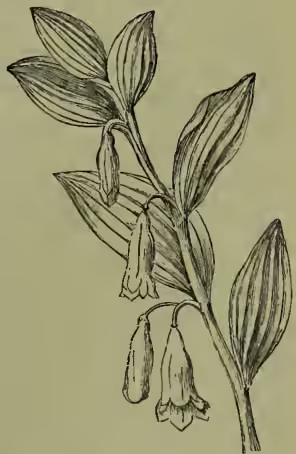
Solomon's Seal (Polygonatum), a genus of plants of the natural order Liliaceæ, differing from Lily of the Valley (q.v.) chiefly in the cylindrical tubular perianth, and in having the flowers jointed to their flower-stalks. There are three British species. The Common Solomon's Seal (P. multiflorum) is found in woods and copses in many parts of England and in a few places in Scotland. It has a stem about two feet high, the upper part of which bears a number of large, ovate-elliptical, alternate leaves in two rows. The flower-stalks are generally unbranched; the flowers not large, white, and drooping. The roots are knotty, and a transverse section of them reveals characters which the fanciful have imagined represent the impress of the famous seal of Solomon, to which very ancient legends attributed magical properties; the appearances on the cut root being variously described as looking like the 'marke of a seal,' like the magical Pentacle (q.v.), or like Hebrew letters. The Narrow-leaved Solomon's Seal (P. verticillatum) is a rare British plant, only found in a few places in Scotland. The leaves are whorled. The Angular or Sweet-smelling Solomon's Seal (P. officinale) is also rare in Britain, and is found only in England. It more nearly resembles the Common Solomon's Seal, but is smaller, and has greenish, fragrant flowers. All these species are common in many parts of Europe. They are very similar in their properties. In America there is a P. giganteum, 2 to 7 feet high, and a smaller P. biflorum. The young shoots of P. officinale are eaten by the Turks like asparagus. The root is white, fleshy, inodorous, with a sweetish, mucilaginous, acrid taste. It contains Asparagin. It is a popular application to bruises, to prevent or remove discoloration, and its use is well known to those who are too apt to get a black eye now and then. A kind of bread has been made of it in times of scarcity. The berries are emetic and purgative.