Sound, in ordinary language, is that which appeals to us through our organs of hearing. Experience teaches us that almost every sound can be traced to a source outside of us, and that as a rule the sound is characteristic of the source from which it comes. Different voices are easily recognisable, and there is no difficulty in distinguishing a trumpet-call from a violin-note. Here we have brought out the quality or timbre or colour of a sound. Another very obvious characteristic is the pitch of a sound. On it the whole theory and practice of music is based. Even the most unmusical ear can distinguish between a deep-toned note and a shrill one, between, for example, the extreme notes on a piano or organ. Then there is the question of the intensity or loudness of a sound. In terms of these three fundamental characteristics all differences of sound can be expressed. It is the object of the science or theory of sound to investigate the physical or mechanical nature of whatever under suitable conditions can be heard by the ear, and to express in terms of motion of matter these three ever-present characteristics—quality, pitch, and intensity.
Generally speaking, the air is the medium through which sound travels towards us. Whatever be the sound-producing body, it must first transfer something to the air, which in its turn conveys a corresponding something to our ear. Within us the sensation produced is a purely subjective one, and must not be confused with the objective cause existing outside of us. There is, however, a distinct relation between the two; for when the external conditions are physically identical, so are the resulting sensations. The very fact that air can transmit to us such a variety of sounds shows that it is capable of responding more or less completely to the varied characteristics of the sound-producing body. The necessary condition for the production of sound is that the body must, by its own vibrations or in some other way, set the air into vibration. Bells, tuning-forks, violin-strings, and drums are familiar instances of vibrating bodies; but if these are made to vibrate in vacuo no sound will be heard. Vibrating in air they give forth their appropriate sounds. In the Siren (q.v.) we have an instrument which produces sound by breaking up a continuous blast of air into a succession of pulses. The instrument is valuable as proving that the pitch of a note depends on the number of pulses per second. The faster the siren spins, the more quickly the pulses follow each other, the greater is the frequency or number of pulses per second, and the higher is the pitch, as the ear at once tells us. The same fact can be proved by holding the edge of a card against the teeth of a revolving toothed wheel. If the wheel is going fast enough, the successive noises of the card as it frees itself from each tooth and impinges itself on the next succeeding are no longer distinguishable, but coalesce to produce a note of definite pitch which rises as the wheel rotates faster. Now it may be shown that, when the ear is satisfied that the notes produced by a siren and a tuning-fork have the same pitch, the number of pulses given by the siren in one second is exactly equal to the number of vibrations of the tuning-fork in the same time. Thus the vibrating tuning-fork transfers to the air a series of pulses timing accurately with the vibrations. It is not difficult to see how this takes place. As the forks vibrate to and fro they push the air first on one side and then on the other; and just as a hand moved slightly to and fro in water starts a series of waves travelling outwards along the surface, so the tuning-fork starts in the air a series of waves of condensation and rarefaction which travel outwards through the air. In the case of the water-waves gravitation supplies the force which, by its tendency to keep the surface level, gives the power of recovery that is indispensable to all wave-motion. In the case of the sound-waves the air's own Elasticity (q.v.), or power of resisting change of bulk and of recovering completely its original density, is the essential factor in producing and sustaining the wave-motion (see WAVE).

The essential features of the wave-motion in the air may be indicated by the behaviour of a row of points, each of which oscillates to and fro about its mean position. The time or period of oscillation is the same for all; and we shall suppose the oscillations to be of the simplest type known as Simple Harmonic Motion (see WAVE). When at rest the points are all at equal intervals apart, as in fig. 1, a. When in motion so that each point moves through its mean position a little later than does the immediately preceding point, then the points will be crowded together in some regions and widely distributed at others (fig. 1, b). As the points continue their oscillations the configuration will not remain steady, but will move along among the points (fig. 1, c and d). Any given region will become alternately more crowded and less crowded, a region now of condensation, now of rarefaction. This ever-changing condition, which we have supposed to be the characteristic of a row of points, may easily be imagined to be possessed by a swarm of space-filling particles; and, from the analogy of the circular ripples which expand outwards over the surface of a lake which has been disturbed by a stone being dropped into it, we can readily picture a succession of spherical waves of condensation and rarefaction radiating out through air from the source of disturbance, in the present instance the source of sound. The mode by which the condensation or rarefaction is passed on from one region of air to another may be explained as follows: Because of its elasticity air resists compression and will tend to recover its original density as soon as the compressing force is removed. But because of its inertia it will, if left perfectly free, overdo the recovery—just as a pendulum when drawn aside and let go swings to the other side of its natural position of rest. Now if any small region of air undergoes rarefaction it can only do so by itself expanding and thereby compressing the surrounding layer of air. But as it, so to speak, swings back through its condition of normal density to a state of condensation, the surrounding layer will swing from its state of condensation to a state of rarefaction, that is, expansion, compressing thereby in its turn the next encompassing layer of air. This second layer, having thus acquired an oscillatory character, will in the same way impress the next layer with a like character, and so on indefinitely.
Returning to the case of the tuning-fork, we see how the energy of its vibrations is gradually transferred to the air and transmitted through it to the farthest limits at which the sound is heard, if not farther. Thus the motion of the tuning-fork gradually decays, and the intensity of the sound heard at any given distance simultaneously diminishes. Ultimately the sound dies away, and the tuning-fork comes to rest. What is called the intensity of a sound depends in some way upon the degree of agitation communicated to the air—in accurate language, upon the vibratory energy existing in the air at the place where the sound is heard. Now it is a familiar experience that with great variations of intensity the pitch of a sound remains unchanged. The pitch depends upon the number of vibrations per second, and the intensity upon the energy of vibration. We find then that within wide limits the extent or amplitude of the vibration, or (as in air) the range through which the density may vary, does not affect the periodic time of the vibration. The quantitative relation between the energy and the amplitude, and therefore between the intensity and the amplitude, is that the former varies as the square of the latter. With double the amplitude we have four times the intensity, with half the amplitude one-fourth the intensity. That the intensity falls off at a much quicker rate than the amplitude is at once evident to any one closely inspecting the diminishing range of motion of a tuning-fork and at the same time paying attention to the decreasing loudness of the tone. The ear is by no means so sensitive in comparing intensities as it is in comparing pitches. When two notes are of very different pitch it is often difficult to say which is the louder.
We now pass to the consideration of the quality of a musical sound. A tuning-fork gives a colourless inexpressive sound, whose one useful property is the constancy of the pitch. When sounding the same note the pianoforte, the violin, the trumpet, the clarionet, and the human voice all impart their own peculiar flavour, which is readily recognised by the ear. Not only so, but we can distinguish different pianofortes, different violins, different voices, and so on. These differences of quality cannot depend on the frequency or number of vibrations per second, for that determines the pitch; nor upon the energy of vibration, for that determines the intensity. Quality, in fact, can depend only on the internal nature of the vibration. This may be shown synthetically, as König has done, by making siren discs, each perforated with its own peculiar shape of hole, but all identical as regards number of holes and rate of rotation. It is evident that if the blast of air is broken up into successive portions which have issued through, say, triangular instead of the usual circular holes, the form of the pulses which build up the note will be changed. And such a change is recognised at once by the ear.
Most instructive in this connection are the laws of vibration of stretched strings. If we fix one end of a pretty long rope to a wall, and, with the other end in the hand, keep it in a stretched condition free of the floor, we may observe any slight disturbance given to it running as a solitary wave along the rope and back again after reflection at the wall. The tighter the rope is stretched the quicker will this disturbance travel to and fro along it. It is not difficult to show that the speed at which such a disturbance or wave will travel along a stretched cord depends on the tension () and on the mass () per unit-length of the cord, being given by the simple formula . Suppose we have such a stretched cord of indefinite length, and that a series of exactly equal waves are running along it from left to right, as shown in fig. 2, a, in which the straight line indicates the undisturbed position of the string. Now let there be propagated along the string from right to left an exactly equal series of waves, which, if existing alone, would throw the string into some such form as shown in b (fig. 2).
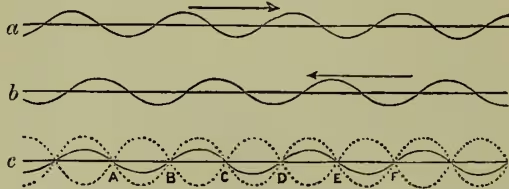
The superposition of these two exactly similar series of waves propagated in opposite directions gives rise to a resultant motion indicated in c (fig. 2). Here the points ABCDEF, being once at rest, are always at rest; since, whatever be the displacement due to the a waves, an exactly equal and opposite displacement is produced by the b waves, now and forever. Intermediate points, however, will move up and down between the limits indicated by the dotted loops in c (fig. 2). The string, in fact, will vibrate in segments whose ends are fixed at the points ABCDEF. The segments will be, at any instant, alternately above and below the undisturbed position of the string. The motionless points are called nodes; and it is evident that we may fix any two of them, and cut away all the string lying beyond these chosen nodes without in any way affecting the motion of the part lying between them. If we fix two contiguous nodes, for example A, B, we have a definite length of string vibrating as a whole. If A and C are fixed we get twice that first length of string vibrating in two segments; if A and D, we have three times the length vibrating in three segments; if A and E, four times the length vibrating in four segments; if A and F, five times the length vibrating in five segments; and so on. Now all these are simply different ways of producing exactly the same vibration, so that a note which is given by one length of stretched string vibrating as a whole may be given by lengths of a similar string similarly stretched, vibrating in segments. But we may have this string of length itself vibrating as a whole. We have merely to suppose the oppositely directed series of waves to be times longer than those shown in fig. 2 (a, b). If is the frequency of any vibration, and the wave-length or distance from crest to crest, it is easy to see that a given wave will travel over a distance in one second. That is, we have , a quantity depending only on the tension and mass of the string. Consequently, if we double the wave-length we halve the frequency; if we halve the wave-length we double the frequency; and so on. Generally then the frequency of vibration of a string of given tension and density varies inversely as its length. This is the principle on which all instruments of the violin and guitar types are played. The player, by pressing the string down with the finger at different points, can shorten the string in the required ratio, thereby producing a correspondingly higher note.
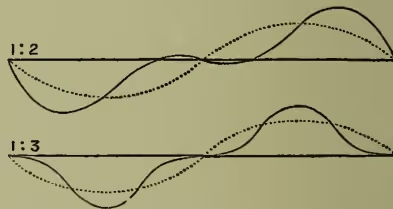
From what precedes we see that a stretched string, which vibrates as a whole, say, 100 times per second, can also vibrate 200 times per second in two segments, 300 times per second in three segments, and, in general, hundred times in segments, if the segments are not too short. By lightly touching, without pressing, a violin-string at the proper point, so that that point is made a node, any of these higher notes (overtones) may be obtained. This is a very common practice in playing the violoncello. Not only, however, may a string be so made to utter any of the overtones, but it is practically impossible to prevent some of them sounding along with the fundamental note. It is, in fact, upon the presence of these overtones that the quality or character of the sound depends. They give the form to the vibration. In fig. 3 we see how the form of the wave is changed by superposing upon a given vibration the first and second overtones, having frequencies twice and three times the frequency of the fundamental tone. The musical relations of these overtones of stretched strings are discussed under HARMONICS (q.v.). The harmonics of a note are the simple harmonic vibrations into which, according to Fourier's analysis, any steadily recurring periodic motion can be decomposed. The prime or fundamental tone is the first harmonic; and higher harmonics are all overtones. But, as we shall see hereafter, all overtones are not necessarily harmonics.
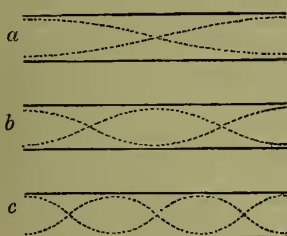
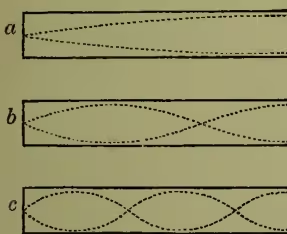
Air-columns, such as we have in organ-pipes (see ORGAN), vibrate according to laws very similar to those which rule the vibrations of strings. The frequency of the note is inversely as the distance between two successive nodes. One essential difference is that the ends of a stretched string must be nodes, whereas in pipes one or both ends may be loops, where the velocities experience their maximum change and the pressure is invariable. In the open organ-pipe both ends are loops, between which one node at least must exist if a sound is produced. This gives the fundamental vibration, and may be diagrammatically indicated, as in fig. 4, a. The wave-length is (approximately) double the length of the tube. The second harmonic is produced when two nodes intervene, as in b (fig. 4); the third when three nodes intervene, as in c (fig. 4); and so on. The wave-lengths of these are respectively the length of the tube and two-thirds the length of the tube. Hence, if the fundamental tone has frequency 100, the second has frequency 200, the third 300, and so on. In the closed or stopped organ-pipe, again, one end is a node and the other a loop. In fig. 5, a, we have a diagrammatic representation of the prime tone, whose wave-length is (approximately) four times the length of the tube. Thus by simply stopping the one end of an open organ-pipe we lower the prime tone a whole octave. The next possible mode of vibration is indicated in b (fig. 5), in which are two nodes. Here the wave-length is times the length of the tube. In the next mode, with three nodes (fig. 5, c), the wave-length is of the length of the tube; and so on to higher harmonics. If the fundamental tone of a closed pipe has frequency 100, the next possible harmonic will have frequency 300, the next 500, and so on. Thus in any note uttered by an open pipe all the harmonics may enter; but in a closed organ-pipe only those pure tone of the simplest harmonic type. When strings or columns of air are vibrating, the harmonic overtones may be picked out by the ear with tolerable ease after a little practice. Their presence may, however, be made evident to the most unmusical ear by the use of resonators.
The function of a resonator is to reinforce the intensity of a note produced by some vibrating body in its neighbourhood. The principle is made use of in all musical instruments. For instance, in the violin the greater part of the energy of vibration of the string does not pass directly to the air, but indirectly through the body of the violin, which vibrates with the string. The sounding-board of a piano plays the same rôle, being set into vibration by the impacts of the waves upon the terminal fixed points of the strings. In these and similar cases a greater mass of air is influenced by the vibrations of the system, the energy originally given to the string is more quickly transferred to the air, and the result is increased intensity. The word resonator is, strictly speaking, applied to a body which resounds to one note only or to one of a definite harmonic series. If a tuning-fork be held in front of the lip of an organ-pipe, one of whose own harmonics has the same pitch as the note of the tuning-fork, the sound uttered by the tuning-fork will be distinctly reinforced. This reinforcement will not occur in the case of a tuning-fork having no harmonic relation to the pipe. The pipe in the above case acts as a resonator. Again, hold down any note on the piano so as to leave the corresponding strings free, and then strike the note an octave lower, or an octave and a fifth, or two octaves lower. Release this latter note, so that its strings become damped, and the former note will be heard distinctly as if it had itself been struck. Its intensity may be reinforced again and again by repeated striking of a lower note of which it is an harmonic. Here the strings of the note that is being held down act as resonators to the corresponding harmonic of the note that is struck. The same effect may be produced by singing a suitable note, or playing it on some other instrument. The boxes to which large tuning-forks are attached are so shaped that the mass of air within them vibrates naturally to the note of the tuning-fork. And just as a pendulum or ordinary swing may be made to describe larger and larger arcs by properly timed impulses, so a resonator responds to the timed pulses of the note to which it is tuned. Helmholtz's spherical resonators, tuned to the successive harmonics of a particular note, are an indispensable part of the equipment of a physical laboratory. Each is a hollow sphere provided with two apertures diametrically opposite each other. The smaller aperture is made in the form of a small projecting tube which can be fitted close into the ear. Through the other and larger aperture the outside disturbance sets the mass of air inside the sphere into vibration. As an example of their use, take the case when the note to which one of the resonators is tuned is sounded by (1) an open organ-pipe, (2) a closed organ-pipe. By placing in turn each resonator to the ear we readily convince ourselves that the successive harmonics are all present in the sound of the open organ-pipe, but that with the closed pipe the even harmonics are absent. When the proper resonator is placed behind a tuning-fork the sound becomes powerfully reinforced. By taking advantage of this principle Helmholtz proved synthetically that vowel-sounds of the same pitch have different harmonics present. By means of the Phonograph (q.v.) Jenkin and Ewing analysed the vibrations produced by vowel-sounds at various pitches; and their results show that the relative intensities of the principal
of odd number can be present. This lack of the even harmonics gives a curious nasal quality to the tone of the closed organ-pipe. By overblowing we may so accentuate the second harmonic in the open pipe as to make it sound a note appreciably an octave higher than the fundamental note. By overblowing the closed pipe the pitch of the note jumps up an octave and a fifth. With flutes and whistles similar effects may be produced.
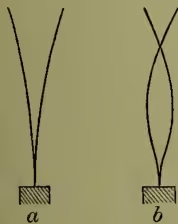
A tuning-fork is a vibrating bar whose one end is a node. In producing its fundamental tone each prong vibrates so that there is no other node, as in fig. 6, a. The next possible mode of vibration is when a second node exists, as shown in fig. 6, b. This first overtone is not related to the fundamental tone according to the harmonic series already given for strings and air columns. For example, if the fundamental tone of the tuning-fork is C of the bass clef, the first overtone is two octaves and 7.7736 mean semitones higher—i.e. a little flatter than G above the treble C. In the case of stretched membranes, vibrating plates, and bells similar complexities hold; and it is impossible to get from them overtones harmonically related to the fundamental tone and to one another. There is no doubt, however, that the characteristic clang of a bell is due to the presence of these anharmonic overtones; and the art in bell-making is to prevent them having a pronounced discordant effect on the ear. By careful manipulation the first anharmonic overtone of a large-sized tuning-fork may be made to sound instead of the fundamental tone, and not infrequently it may be heard along with it. In this latter case it rapidly dies away, and the tuning-fork continues to utter a harmonics present in any given vowel-sound vary with the pitch.
As with all forms of wave-motion, sound may be reflected (see ECHO) and refracted. When a string or air-column is thrown into a steady state of vibration with nodes occurring at regular intervals there is in reality a reflected wave, which, travelling backwards along the vibrating substance, interferes with the forward-travelling wave in the manner already described. Interference (q.v.) is also shown by the phenomenon of beats.
The existence of beats is determined by the coexistence of two notes differing very slightly in pitch; and the number of beats per second is simply the difference of the frequencies. Because of the absence of upper harmonics in the note given by a tuning-fork, the phenomenon is produced in its purest form by means of two tuning-forks originally in unison but thrown slightly out of tune by weighting the one tuning-fork with a small piece of wax attached to it. If the tuning-forks, for example, have frequencies 300 and 302, there will be heard two beats per second—i.e. the intensity of the resultant sound will vary from zero to a maximum and back to zero again twice every second. The reason of this will be easily seen if we consider the resultant effect of the two sets of waves at different times. For, since the two sounds have the same velocity, it is clear that across any surface set in the path of the rays of sound the higher note will transmit two more waves per second than the lower note, or one more wave in half a second, or half a wave extra in a quarter of a second. Suppose that at the beginning of the second chosen the nearly equal waves combine crest to crest and trough to trough, so as to produce an increased intensity; then a quarter of a second later the slightly quicker vibration will have gained half a wave-length on the other, crest will fall with trough and trough with crest, and little or no vibratory motion will be the result. At the half second, crest and crest will again coincide, and the resultant sound once more reach a maximum; and so on indefinitely. The transition from maximum to minimum loudness is of course gradual. If notes in which higher harmonics exist are used the beating is not so simple. For example, with open organ-pipes tuned to frequencies 300 and 302, not only will the primes beat twice a second, but the second harmonics 600 and 604 will beat four times a second, the third harmonics six times a second, and so on. There is generally no difficulty getting beats from a piano-forte note, since the two or three strings that belong to the note are rarely in accurate tune.
In general if and are the vibration numbers of two notes sounding together which give beats, will be the number of beats per second. If this beating does not occur oftener than two or three times a second the ear is not distressed. Rapid beating, however, produces very unpleasant sensations even after it has reached a rapidity too high to be counted. When the difference of frequencies is greater than 25 or 30, the note of frequency is heard in addition to the two original notes. There is no difficulty in hearing this differential tone, as it is called, when the two notes are sufficiently loud. On instruments giving sustained sounds, such as the organ, harmonium, and concertina, very marked differential tones are produced; and to an ear trained to their perception they are recognisable on the piano. When the difference of the frequencies lies between 30 and 100 the rattling of the beats may often be distinguished from the low hum of the differential tone; so that we are not warranted in regarding these two phenomena as of the same nature. By bringing the two notes by different courses to the two ears we can hear the beats, but cannot hear the differential tone. Moreover, in addition to the differential tone , there are other differential tones of frequencies , , &c., and also at times a weak summational tone of frequency . This last-named tone was discovered by Von Helmholtz, to whom we owe the complete discussion of the origin and significance of these Combinational Tones, as they are collectively termed. Two kinds are distinguished by him. If the vibrations transferred from the vibrating body to the air are very large the simple law of superposition may not hold. A simple pendular vibration, such as a tuning-fork may give, will when transferred to the air lose to some extent its simple harmonic character, and higher harmonics will enter in. If two simple pendular vibrations act powerfully on the air combinational tones will be produced in addition to the higher harmonics of the two original notes. These combinational tones existing in the powerfully disturbed air can be reinforced by use of resonators. Combinational tones of the second kind cannot be so reinforced, since they are produced in the ear itself. They are due to the asymmetric character of the drum of the ear, which cannot respond to two coexisting vibrations without producing combinational tones. The frequencies of these combinational tones, whether of the first or second kind, are all included under the general formula , where and are the frequencies of the original notes, and and are integers from zero upwards. As experiment shows, only the first few integers are of any importance, and no summational tone of higher order than ( and both unity) has ever been heard. As an example, take two notes having frequencies 200 and 315. Their principal combinational tones will have frequencies 115 () and 85 (). This latter may be regarded as the differential tone between the lower prime and the first combinational tone. These two tones can both be heard if the intensities of the sounds are sufficiently strong. Both theory and experiment show that the comparative intensity of combinational tones grows rapidly as the intensities of the real notes are increased, and also that combinational tones of low pitch are most prominent.
As first brought out clearly by Helmholtz, combinational tones are of peculiar interest when the two notes form a consonant interval. Thus, take any two notes a musical fourth apart. Their vibration numbers may be represented by and . Their principal differential tone will have the frequency (), and will therefore form the fundamental tone of which the given two are harmonic overtones. Again, take any perfect triad (do, mi, sol) having frequencies , , . Each successive pair gives the same differential tone ; the first and last together give the differential tone . Thus we hear the low tone which is harmonically fundamental to all, and its octave. In some cases the differential tone becomes so loud that the real notes which are being sounded become merged in it as upper harmonics. If the notes of the triad are not in perfect tune the differential tones will not be harmonically related. On an organ tuned in equal Temperament (q.v.) the chord built upon the treble C consists of notes having frequencies 522, 657.7, 782.1 (see PITCH). The two lowest differential tones have frequencies 135.7 and 124.4—notes which, sounding together, produce 11.3 beats per second. The ear that has accustomed itself to the pure harmony of the perfect triad will easily recognise a certain dissonance in the triads given by pianos and organs.
Beats always mean the coexistence of two notes of nearly the same frequency. If on any organ or harmonium any note and its fifth are struck together beats are heard. It is indeed by getting rid of these beats that we finally effect a perfect tuning of say two contiguous violin-strings. These beats on the tempered instruments are due to the fact that the interval is not a true fifth, so that the higher harmonics which are present cause beating combinations. This is shown by comparing the first three harmonics of notes which form (1) a perfect fifth and (2) a tempered fifth.
| PERFECT FIFTH. | TEMPERED FIFTH. | ||||
|---|---|---|---|---|---|
| C. | G. | Beats. | C. | G. | Beats. |
| 522 | 783 | .. | 522 | 782·1 | .. |
| 1044 | .. | .. | 1044 | .. | .. |
| 1566 | 1566 | 0 | 1566 | 1564·2 | 1·8 |
| &c. | &c. | .. | &c. | &c. | .. |
Similar results may easily be obtained for all tempered intervals, if the higher harmonics exist in sufficient strength. We may, however, make use of the combinational tones in producing beats. For instance, by the rule given above, we get for the first combinational tones 260·1 and 261·9, which beat also 1·8 times a second. The second combinational tone is intensified by the actual presence of the second harmonic of C; and we can make the beating still stronger by sounding the octave along with C and G.
All vibrations in air of sufficient intensity and suitable frequency produce sound-sensations. The highest frequency which gives an audible sound is about 70,000. This is much higher in pitch than the highest notes used in music. For example, the frequency of the highest note on the pianoforte falls short of 4000. Very high pitched sounds near the limit of audibility are very disagreeable to the ear; and sounds which are heard by one person may be, because of their high pitch, quite inaudible to another. There are many noises of whose pitch it is impossible to say anything definite. They are no doubt confused mixtures of tones of fluctuating pitch. König has pointed out that the peculiar quality or timbre of trumpet notes and other notes of piercing quality is in great measure due to a fluctuating character in the vibration. The various overtones, both harmonic and anharmonic, do not combine with the prime in a steady periodic manner. Anharmonic overtones must of necessity produce fluctuations in the periodic character of the note; and the theory of quality cannot be complete without taking their existence into account. In this direction Helmholtz's theory requires extension.
Of great value and interest are Helmholtz's investigations on the forms of vibration of strings, especially of violin strings. If we can experimentally determine the form of the wave into which the string is thrown when bowed, we can by Fourier's mathematical process calculate the harmonics that enter in. Helmholtz solved the problem by viewing through a microscope the motion of a small white speck at different points of the string, the microscope itself being attached to the vibrating end of a tuning-fork, and being so made to execute a simple harmonic motion at right angles to the direction of vibration of the white speck. The principle of the method is identical with that introduced by Lissajoux in obtaining what are known as Lissajoux's Figures. Two tuning-forks, with bright reflecting surfaces fixed to their vibrating ends, are arranged so that while one vibrates to and fro vertically, the other vibrates to and fro horizontally. A beam of light is reflected from the one upon the other, and after a second reflection is focussed sharply upon a screen or viewed in a telescope. When either fork is vibrating alone the image on the screen will vibrate also along a straight line. But when both are vibrating together the light spot on the screen will execute the motion which is the resultant of the two mutually perpendicular vibrations. Definite figures are obtained only when the two forks are tuned accurately in unison, or by some simple interval apart. For example, if the two forks give the same note the figure on the screen will be an ellipse or one of its extreme forms, the circle or straight line. If the forks are very slightly out of tune—imperceptibly so to the ear—the ellipse will gradually change shape, passing from the circle to the straight line. The figures obtained when the ratio of the frequencies is as 1 : 2 (the octave), 2 : 3 (the fifth), 3 : 4 (the fourth), and so on, are very beautiful; and if the interval is just short of perfect tuning the gradual passing of the figure through a series of related but slightly differing forms is very instructive. The experiment is valuable as giving an optical demonstration of the laws of combination of vibratory motions in lines inclined to one another. Compare the explanation of elliptic and circular Polarisation (q.v.) of light.
Although sounds come to our ear through the air or other fluid as waves of compression and rarefaction, they may have their origin in vibrations of quite a different type. In solid substances there are distortional waves as well as compressional waves. In a pure distortional wave the substance changes form and does not change bulk. Its existence depends upon the Rigidity (q.v.) of the substance. In gases and liquids only compressional waves can exist, and these depend upon the compressibility (see COMPRESSION). When a bar, stretched string, or plate is set into vibrations a certain kind of elasticity is brought into play, and a certain strain produced, which in general involves both change of form and change of bulk. Corresponding to this there is an appropriate stress whose ratio to the strain is the coefficient or modulus of elasticity upon which the velocity of the wave depends. Calling this modulus , we find for the velocity of a vibratory wave the expression , where is the density of the substance set into vibration.
This formula was first applied by Newton to the case of air. Assuming Boyle's Law (see GAS), he obtained the expression for the velocity of sound, where is the pressure. But when the proper numbers are put in the velocity is found to fall short of its true value by about 180 feet per second, or by one-sixth of the whole. Newton's assumption is in fact false. Boyle's Law holds only when, throughout the changes of pressure and density, the temperature remains constant. But in the rapid condensations and rarefactions which accompany audible sounds the temperature varies, increasing during condensation and decreasing during rarefaction. Now rise of temperature means increase of pressure and fall of temperature decrease; so that the result of these temperature changes is to increase the forces at work—i.e. to increase the elasticity. Laplace first made this necessary correction to Newton's calculation. We must in fact multiply the pressure by 1·41, which is the square of 1·2 nearly. The complete theory gives for the velocity of sound in dry air at a temperature of F. the value
which is as near as may be to the mean of experimentally determined values.
The quantity is the same for all the true gases. Hence the velocity of sound in gases varies inversely as the square root of the density. In other words, a given wave-length will vibrate proportionately faster. Thus, if an organ-pipe be blown with hydrogen gas in it instead of air, the note will leap up nearly two octaves in pitch, since the density of air is 14·4 times that of hydrogen.
In the case of any liquid the quantity is the reciprocal of the compressibility, which is not appreciably affected by slight changes of temperature. For water the density is unity, and is . Hence centimetres (4730 feet) per second. Colladon's value, determined by experiments on the Lake of Geneva, was 143,500. Thus sound travels four times faster in water than in air. In the case of solids, in the form of thin rods or wires, waves of compression will travel at still higher speeds. The quantity is practically Young's modulus of elasticity. In steel , and ; hence centimetres (17,130 feet) per second, or nearly sixteen times the velocity of sound in air.
The standard book on Sound is Lord Rayleigh's Theory of Sound (1878; 2d ed. 1894). Tyndall's Sound is a popular exposition of the subject, illustrated by well-chosen experiments. Helmholtz' Tonempfindungen, or Sensations of Tone (Eng. trans. 1875), discusses in a highly original manner the borderland between sound as a branch of physics and music as a branch of aesthetics. Sedley Taylor's Sound and Music (2d ed. 1883) is a simple exposition of the chief of Helmholtz' discoveries. König's Expériences d'Acoustique (1889) contains some valuable novelties. See Nature, vol. xliii. 1890; also the articles ACOUSTICS, HARMONICS, MICROPHONE, TELEPHONE, VOICE.