Sowing-machines. Formerly sowing was always performed by scattering the seeds from the hand over the prepared surface of the soil. This mode, distinguished as hand-sowing, is still employed in many places, especially on smaller holdings and in garden husbandry. In the United States there are broadcast-sowers carried in the hand, in which a mechanism turned by a crank expels the seed from the receptacle very evenly. In the more extensive operations of the farm it has been very much superseded by the use of sowing-machines of various kinds drawn by horses—the broadcast sowing-machine, the drilling-machine, and the dibbling-machine. The first is employed exclusively for cereals and grasses, the other two for any kind of crop.
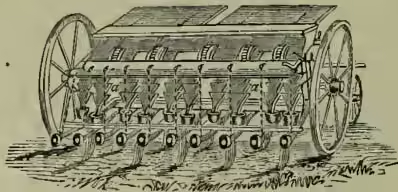
Cereals.—As above mentioned, cereals may be sown either broadcast, drilled, or dibbled. If the first method is to be adopted, the land receives what is called the seed-furrow, or, if rough, it gets a single stripe with the harrows, and the seed is then sown either by hand or by the broadcast machine. This machine consists of a triangular frame with the apex to the front, supported on three wheels, and carrying a long wooden box of the form of a triangular prism, set with a flat side—the lid—uppermost. This box, which is placed at right angles to the line of draught, is furnished with a row of small holes at the bottom, about 7 inches apart; and a little above this row is placed a longitudinal spindle, carrying a set of hard circular brushes, one opposite each hole, and deriving a rotatory motion from the axle of the hind-wheels. The size of the apertures can be adjusted to the desired quantity of seed per acre by means of a movable plate outside provided with holes corresponding to those of the box. When the box is supplied with seed, and the machine set in motion, the grain drops through the holes, which are kept from clogging by the rapid rotation of the brushes. The box is made of such a length (16 to 20 feet) that 30 to 35 acres may be sown in a day. The seed is then covered by harrowing. This machine is much used in Scotland, being rather better suited to hilly and uneven surfaces, and, from its more rapid execution, to a climate which frequently interferes with agricultural operations. In England, where the climate is more favourable and the surface more level, the drilling-machine is the favourite. So it is now in certain parts of Scotland, where the amount of seed deposited by drilling has increased immensely. The land is prepared for sowing by as complete pulverisation as possible, and its surface is made quite even by the harrow and roller. The drill (fig.), which in the arrangement of some of its essential parts corresponds to the broadcast-machine, differs from it in being furnished with a set of coulter, which are hollowed behind to enclose the lower ends of a corresponding set of tin tubes, whose upper ends are fixed opposite to the holes in the seed-box. By this machine a series of furrows of uniform depth are made by the coulter; into these furrows the seed is directed by means of the tin tubes. The modern drill-machine covers the seed most uniformly. The harrowing is generally completed before drilling begins. The spindle inside the seed-box is provided with grooved cylinders or pinions in place of brushes, and the seed-rows are generally made from 4 to 10 inches apart. The advantages of this machine over the former consist in the greater regularity of deposition of the seed, which admits of hoeing and other cleaning operations during the early period of growth; in the uniform depth at which the seed is planted, so that none of it is lost by being buried, while it is all covered; in the protection of the operation from the disturbing influence of winds; in the saving of seed and greater yield of grain, it being often found that if drilled seed be to broadcast, in quantity, as two to three, their respective yields are nearly as five to four; in the free access of sun and air during growth; and in the less liability of the crop to 'lodge' flat at the root. But it has one disadvantage: an ordinary drill cannot sow more than 10 to 12 acres per day, and employs more men and horses than the broadcast-machine. From 2 to 3 bushels of seed per acre suffices with the drill, whereas from 3 to 4 is necessary with the broadcast-machine, and from 5 to 6 bushels with the hand. The great saving of seed and other advantages thus fully atone for the extra work involved by the drill. Many kinds of grain-drills are in use in the United States; the drill for maize being a special modification of these.
The third method of machine-sowing, by dibbling, is employed chiefly on the light soils in the south of England, and now even there not generally, at least in the case of cereals, so that a minute description of the machines by which the operation is effected is unnecessary. Suffice it to mention that dibbling only requires about one-third of the seed which is necessary in drilling, and presents still greater opportunities for weeding and stirring the soil in the early stages of growth, but is attended with various important defects, and is more expensive.
When a cereal crop is to be followed by grass the grass seeds are sown a few days, perhaps even a week or two, after the other crop by a broadcast-machine or by the hand.
Beans.—The sowing of this crop (see BEAN) is performed by means of the bean-barrow, a machine the same in structure as the drilling-machine for corn, but wanting the coulter, and having only three tubes, through which the seeds fall. Peas are frequently sown along with beans, the latter acting as a support to the former, and the two together better preventing the growth of weeds. The hand is also sometimes adopted.
Turnips.—For this crop the ground must be more thoroughly cleaned and broken down than for any other; after which—if the drill-system is pursued—it is formed into drills from 26 to 29 inches apart, which are then supplied with manure, and covered with the drill-plough, splitting the original drills. The new ridges thus formed being directly above the manure, the seeds are sown on the top of each ridge by means of the turnip-drill. This machine has, instead of a seed-box of the ordinary form, two tin or tinned-iron barrels, placed on a spindle. Each cylinder has a row of holes round its middle circumference, the row being covered by a circular sliding collar of thin metal, perforated with corresponding holes. Each seed-box has its corresponding seed-tube and hollow coulter, as in the corn-drill; but the turnip-machine has in addition a roller in front of the coulter for compressing the crests of the ridges, and some machines have two light rollers attached behind which slightly compress the earth raised by the coulter and cover the seeds. In the southern counties of England a different form of machine is used, one which sows the seed in rows on the flat surface, and perhaps at the same time drops artificial manure, or waters the seed-bed, or both.