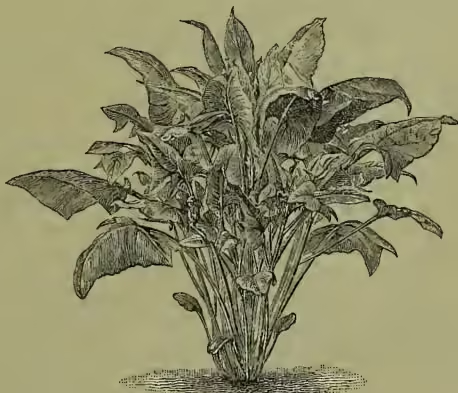
Spinach, or SPINAGE (Spinacia), a genus of herbaceous plants of the natural order Chenopodiaceæ; dicocious, the male flowers consisting of a four-parted perianth, and four stamens; the female, of a two to three cleft perianth, and an ovary with four styles; the perianth hardening around the fruit as it ripens; the fruit an achenium. Common Spinach, or Garden Spinach (S. oleracea), is in general cultivation for the sake of its young leaves, which are a favourite and wholesome vegetable, prepared either by boiling or by frying with a little butter. Two very distinct varieties are cultivated—Prickly Spinach, which has the leaves somewhat triangular and arrow-headed, and the fruit rough with prickle-like projections; and Smooth Spinach, or Round Spinach (S. glabra of some botanists), with the leaves more round and blunt, and the fruit smooth. Spinach is an annual. Its stem rises to the height of from 2 to 4 feet; the male flowers are in long spikes, the female in clusters close to the stem. After the stem begins to be developed the leaves become bitter and unfit for use. This bitterness appears also at an earlier period in dry weather or in poor soil; and the more luxuriantly spinach grows the better it is. It is sown in spring, and is ready for use in a very short time; or it is sown in autumn, thinned out, and used early in spring. The smooth spinach is very generally preferred for the former purpose, and the prickly kind for the latter; but a somewhat intermediate variety called Flanders Spinach, in the seed trade named Viroffley Spinach, is now often used for both, being particularly esteemed for the large size of its leaves. The native country of spinach is not well known, but is believed to be some part of Asia, as the plant was introduced by the Arabs into Spain, and thence diffused over Europe. Another species (S. tetrandra) is cultivated and much esteemed in India. The name spinach is also given to a number of other plants of very different botanical characters, but which have the same bland and nutritious qualities, and are used in the same way. New Zealand Spinach is Tetragonia expansa, a plant of the natural order Mesembryaceæ, sub-order Tetragonieæ (natural order Tetragonieæ of Lindley), a trailing, succulent annual, spreading widely over the surface of the ground, and producing a great abundance of stalked ovate-rhomboid leaves. The young stems and leaves of this plant are much used in New Zealand, and have now come into very general use also in other parts of the world as a kind of spinach. It is cultivated in the middle and south of Europe and in Britain, succeeding well even in Scotland with the slightest aid of a hotbed in spring, and is found particularly useful in light dry soils, in which in summer it is difficult to maintain supplies of the common spinach. Patience Dock, or Garden Patience (Rumex Patentia; see DOCK), is called in Germany English Spinach, and was formerly much cultivated in England, but is now neglected.