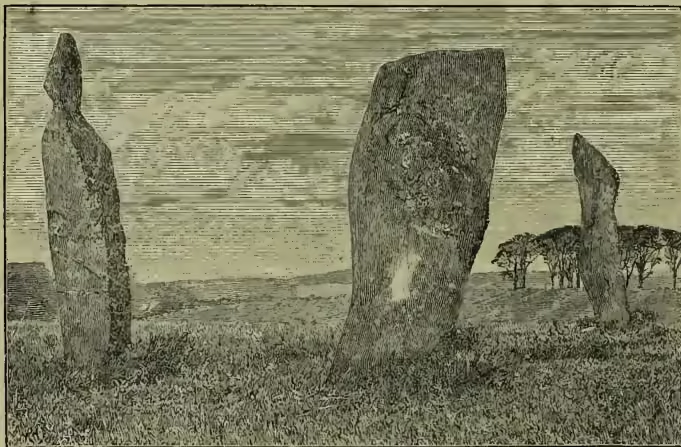
Standing Stones, or monoliths of unhewn stone, erected singly or in groups, are met with almost everywhere. They are not in all cases necessarily of ancient origin, but the motive of their erection may be presumed to have been in general honorary or commemorative either of events or individuals. In certain cases, however, they marked the boundaries of sanctuary or proprietary rights. Single stones, sometimes of great size, are often found standing in sites where no memory or tradition of their purpose exists. Occasionally accident or investigation discloses the fact that they mark the sites of prehistoric burials. They are sometimes arranged in groups of two or four, placed at short distances apart, as at Lundin Links, near Largo, in Fife, three of which are still standing (about 18 feet in height), as shown in the engraving. Such groups if composed of a large number of stones may be arranged in the form of circles, or avenues, or alignments, or groups of irregular lines converging slightly at one end. When arranged in the form of circles they are usually considered as belonging to a special class of prehistoric monuments or burial-places known as Stone Circles (q.v.). Other groups of standing stones arranged in lines like those of Carnac (q.v.) in Brittany, however, are as yet undetermined as to their purpose, though they are unhesitatingly assigned to the prehistoric period. Smaller groups than the famous ones of Brittany are found in the north of Scotland, and are sometimes associated with burial-cairns, presumably of the age of bronze.
Several of these have been described in Caithness, the largest consisting of about 450 stones disposed in twenty-two rows of about 150 feet in length. In Norway groups of standing stones arranged in triangular and rectangular forms occur, and are known by investigation to be burial-places of the iron age. Commemorative monuments of the early Christian time frequently consist of unhewn blocks of stone having short inscriptions cut on their smoother faces, or incised with crosses or symbols. See Ferguson's Rude Stone Monuments (1872), and other works cited at ARCHEOLOGY and SCULPTURED STONES.