Steam-hammer, a contrivance which has done more perhaps than any other mechanical invention of modern times to develop the wonderful resources of the iron trade. The first idea of a steam-hammer appears to have been due to James Watt, the great father of engineers, and was patented by him in 1784. In 1806 William Deverell, 'an engineer of Surrey,' also took out a patent for one; but in neither case does it appear that steam-hammers were actually constructed, though in both specifications a direct-acting steam-hammer is, so to speak, sketched in words. From this time till 1839 the idea seems to have been entirely lost sight of. It was then again taken up by Mr James Nasmyth, of the Bridgewater Foundry near Manchester. Mr Humphries, engineer to the Great Western Steamship Co., who had been unable to induce any forge-master to undertake the heavy forgings required for the intermediate paddle-shafts of the Great Britain steamship, then in course of construction, applied to his friend Nasmyth for suggestions as to how this difficulty might be overcome. Nasmyth made a sketch of a hammer operated by steam-power, and sent his sketch to Humphries, who, along with Brunel and others, heartily approved of the scheme; but in consequence of a change of design, and the substitution of a screw for paddles, the proposed heavy shafts were not required, and the hammer was not then constructed. The scheme was then offered to many forge-masters and engineers; but they failed to duly appreciate its value and importance, and the hammer remained a mere sketch in Nasmyth's 'scheme-book' till 1842. In the spring of that year Nasmyth, much to his surprise, saw at Creusot in France a steam-hammer at work, which had been built in accordance with a copy of his own rough 'scheme-book' sketch, made by two French engineers during a business visit to the Bridgewater works. Nasmyth had been previously urged by his friends to protect his invention by a patent, and immediately on his return to England secured one in June 1842. It is interesting to note that this patent mentions the use of steam above the piston to increase the intensity of the blow, and also a self-acting arrangement. The first English steam-hammer under this patent was made at the Bridgewater Foundry early in 1843; but, although considered an improvement upon the old 'helves' hitherto used for forging purposes (see HAMMER), it was far from being a perfect tool. The principle on which the hammer worked was as follows: two vertical columns or frames supported an inverted vertical steam-cylinder; the hammerhead or tup was attached to the rod of the piston working in this, while vertically beneath, supported on the floor, was the anvil; steam admitted beneath the piston raised it, and with it the hammerhead, at some chosen point the supply was cut off and the steam beneath the piston allowed to escape into the atmosphere, the piston and tup at once fell and gave a blow to anything placed on the anvil; the force of this blow simply depended on the weight of the tup and the height to which it was raised before being allowed to fall. The admission and exhaust of the steam was controlled by means of an ordinary slide-valve worked by a long lever, requiring great labour and constant attention in order to give the blow required; some automatic contrivance was considered necessary to secure complete command over the power of the blow, and to insure that the instant the blow was struck the block should immediately rise again, thus preventing the heat in the mass of iron on the anvil being reduced by the cold face of the block. The peculiar difficulty of securing a true automatic arrangement will be seen, when it is considered that the time of descent of the hammer must vary with almost every blow that is struck; for the piece on the anvil becomes thinner and thinner by each succeeding blow, and with flat bars a blow is first given on the flat side and then on the edge, the difference in the fall of the hammer in the two cases being often many inches; furthermore the hammer must be under perfect control at all times.
It is stated that Nasmyth failed to devise a satisfactory automatic arrangement, but Mr Robert Wilson, then engineering manager of the works, afterwards managing director and successor to Nasmyth on his retirement, who was assisting to work out the details, after a week's scheming solved the difficult problem. His automatic device was first tried on a small 5-cwt. hammer, the second one made, and as it at once proved successful was immediately fitted to several 5-ton hammers then under order; the first one actually made for sale was delivered to the Low Moor Ironworks on August 18, 1843, and answered every expectation. This improvement was covered by a patent taken out by Nasmyth in July 1843. The time of releasing steam from under the piston, and therefore the height of fall, was regulated by a tappet-lever carried by two vertical screws. The tup in its upward movement struck this lever, thereby moving the valve, cutting off the steam, and also releasing it so as to allow the hammerhead to fall. The attendant turning these screws by a small hand-wheel was able to rapidly alter the vertical height of the tappet-lever, and therefore the length of fall. The second point—i.e. the instant rise of the tup after the blow—was obtained in a very ingenious fashion by taking advantage of the inertia of a rocking lever carried on the tup. When the hammerhead struck the metal on the anvil, this lever, by virtue of its momentum, continued to move down against the resistance of a light spring, and in doing so set in motion a system of levers which at once opened the valve, admitted steam under the piston, and again raised the tup. The system of levers could also be operated by hand; thus steam could be admitted under the piston, and the hammer checked and stopped at any point of its descent. This gearing reduced enormously the labour of operating the hammer, increased greatly the number of blows which could be given in any time, and brought it so completely under control that while at one instant the tup could be brought down so gently that it failed to crack an egg on the anvil, the next blow could be made to shake the very ground on which the hammer stood with the violence of the shock. Such satisfaction was given by this remarkable tool that orders began at once to flow in from all parts of the country. The hammer remained in this condition, with slight improvements in details, till 1853, when Wilson devised and applied to steam-hammers what is known as the 'circular balanced valve,' in substitution for the flat slide-valve hitherto used. The steam-pressure on the back of the old flat valve was so great that the friction during any movement of the valve was excessive. This made the expenditure of power in opening and closing the valve very heavy and wasteful, and was one of the chief reasons for introducing the automatic device. By the use of the balanced circular valve the movements of opening and closing became so easy that they could be readily and rapidly made by hand-power, and as a result the somewhat complex automatic gear was abandoned, the mechanism being entirely operated by hand-gearing only. A patent was taken out for this in 1856.
The next improvement, made with the object of greatly increasing the power of the hammer without increasing the weight of the tup, was introduced in 1861 by Wilson. It is known as the double-acting hand-gear motion. In this arrangement steam is admitted under the piston as before to raise it; then just at the instant when the fall is about to take place, by slightly increasing the travel of the hand-lever, steam is admitted into the cylinder above the piston. The effect of this steam-pressure on the top of the piston is to enormously increase the intensity of the blow, and hence the capacity of the hammer, since the hammerhead will descend with much greater velocity, and therefore possess much more energy when it strikes. For example, a double-acting 5-ton hammer may become equal in power to a single-acting 10- or 15-ton one. It should be stated that steam-hammers are commercially rated by the weight of the falling tup, piston, and rod, even when they are fitted to be used as double-acting; so that the power of the blow is not known unless the range of fall is also stated, and whether it is single or double acting.
The figure shows the form of the modern simplified steam-hammer. They are often of great size; 80-ton ones have been made, double-acting, possessing therefore enormous power, as at Essen in Germany and Creusot in France, as well as in the United Kingdom; one in Pennsylvania, the largest made up till 1891, of 125 tons. Of recent years powerful hydraulic presses have been substituted for these big hammers for heavy forging work, but many engineers still prefer the hammering action.
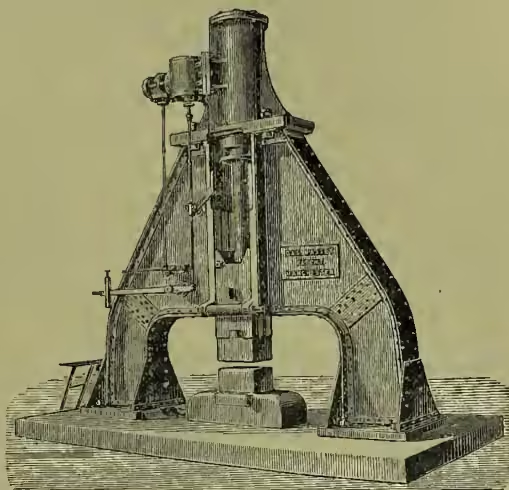
In Condie's hammers, a patent for which was taken out in 1846, the piston is stationary, while the cylinder with the tup attached to it is the moving piece. Since the expiration of Nasmyth's patent great numbers of different types of hammers have been put on the market, but they differ from one another principally only in details, the general arrangement being the same. The modern double-acting hammer can usually be worked in four ways: (a) as a single-acting one, no steam being admitted above the piston, the falling weight therefore alone acting, and again the blow may be made a dead one or a cushioned and elastic one, the latter effect being obtained by admitting steam under the piston before the blow is finished to cushion the piston and cause the tup to rebound the instant it has struck; (b) as a double-acting hammer, by using steam-pressure above the piston during the fall, giving also either dead or elastic blows.