Stone Age, or AGE OF STONE, is a term used in archaeology to denote the condition of a people using stone as the material for the cutting tools and weapons which, in a higher condition of culture, were made of metals. The expression 'age,' when used in this connection, is not therefore significant of a fixed period in chronology, but implies merely the time, longer or shorter, earlier or later, during which the condition subsisted. The duration of such a condition must necessarily have varied from various causes in different areas, and chiefly in consequence of contact with higher degrees of culture. Populations placed in remote situations, and on that account remaining uninfluenced by such contact—like the islanders of the South Pacific and the Eskimos of the extreme north for instance—have remained in their stone age to the 19th century. On the other hand, the populations of the European area, in portions of which there were successive centres of high culture and civilisation from a very early period, had all emerged from their stone age, through the use of bronze, many centuries before the Christian era. The progress of early culture in Europe seems to have been from the south and east, northward and westward, so that the emergence of the different populations from their age of stone was accomplished much earlier in southern and eastern Europe than in its northern and western parts. But while the stone age of different areas is thus not necessarily synchronous, it seems to be true of all European areas that this is the earliest condition in which man has appeared upon them. Our knowledge of the details of the archaeology of Asia, Africa, and America is still too limited for general conclusions to be drawn with certainty, but the existence of similar prehistoric conditions, as re- gards the use of stone prior to the introduction of metals in Asia Minor, India, China, Japan, the northern parts of Africa, and many parts of North and South America, has been fully established. There are no data by which the period of the early stone-using populations of Europe can be defined, even approximately. But in England, Belgium, and France, and across the Continent to the shores of the Mediterranean, they were contemporary with animals which are now either wholly or locally extinct, such as the mammoth, woolly rhinoceros, cave-lion, cave-bear, and hyæna, the reindeer, musk-ox, and urus. It is an open question to what extent this change of fauna implies a change of climate, but from the geological conditions in which the flint implements of the earliest types are found it is evident that, though extensive changes must have taken place since they were deposited in the river-basins, they belong exclusively to the later deposits of the Quaternary period.
The stone-age implements of Europe have been divided into two classes—the palæolithic or older stone implements and the neolithic or newer stone implements. This is equivalent to dividing the stone age of Europe into two periods, earlier and later, as the palæolithic implements are found associated with the extinct and locally extinct fauna, while the neolithic implements are found associated with the existing fauna. The palæolithic stone implements are distinguished as a class from the neolithic by their greater rudeness of form, and by the facts that they are exclusively of flint and have been manufactured by clipping only. The neolithic stone implements on the other hand are of finer forms, often highly polished, and made of many varieties of stone besides flint (see fig. 4). But the mere fact of an implement having been fashioned by clipping alone is not decisive of its palæolithic character, because certain varieties of implements of neolithic time still continued to be made by clipping only. The distinguishing differences are the typical forms and the circumstances of association in which the implements are found.
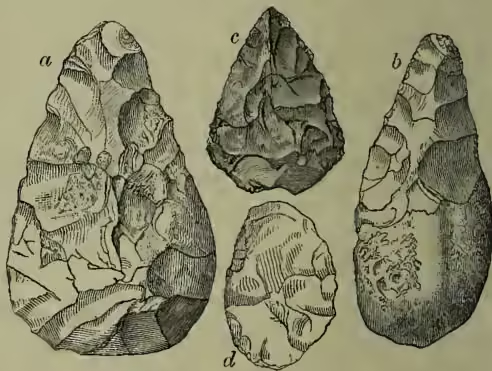
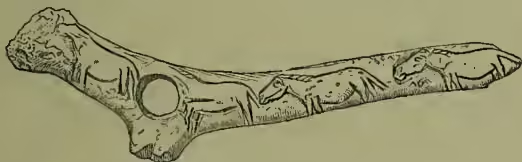
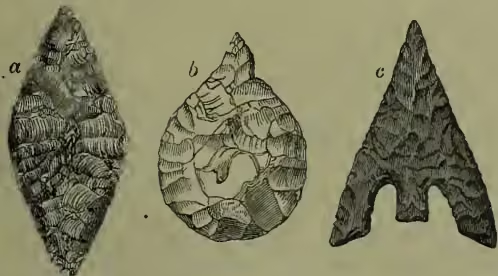
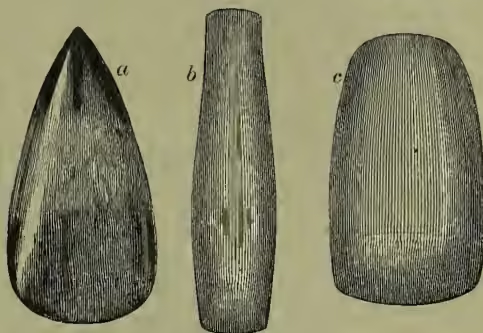
Palæolithic stone implements are found in situ in river-gravels, in caves, and in association with bones of the extinct animals before mentioned. Neolithic stone implements are found in the surface-soil, in refuse-heaps of ancient habitations, and in chambered tombs. Implements of bone or deer-horn of both periods are similarly distinguished by their typical forms and their circumstances of association. The palæolithic implements of flint are mostly so rude in form and finish that it is impossible to apply to them names indicative of specific use (see fig. 1). They are roughly chipped and destitute of that secondary working of finer character along the sides and edges which gives finish to the forms of the neolithic types. They present, however, a considerable number of well-marked typical forms. Those from the river-gravels are chiefly flakes, trimmed and untrimmed, for cutting and scraping; pointed implements, some almond-shaped or tongue-shaped; and more obtusely pointed implements, with rounded and often undressed butts. There is also a series of scraper-like implements, and another of oval sharp-rimmed implements, which are more carefully finished than most of the other varieties. The flint implements from the caves present a greater variety of form. They are generally characterised by secondary working, and are therefore much more carefully finished, often in many respects approaching closely to neolithic types. From the caves also come a series of implements of bone and of carvings on bone which have excited much astonishment on account of the extraordinary contrast between their artistic character and the extreme rudeness of many of the implements of stone with which they are associated (see fig. 2). These bone implements consist of well-made needles, borers, javelin or harpoon points barbed on one or both sides, and implements of reindeer-horn of unknown use (called by the French archaeologists batons de commandement), which are usually carved in relief or ornamented with incised representations of animals, and occasionally of human figures. The animals, as for instance a group of reindeer from the cave of La Madelaine, Dordogne, are drawn with wonderful faithfulness, freedom, and spirit. In another instance, engraved on a flat piece of mammoth-tusk is an outline representation of that animal showing its characteristic elephantine form and the covering of hair peculiar to the species. The neolithic stone implements consist of axes and axe-hammers, knives, daggers, spear and arrow heads (fig. 3), saws, chisels, borers, and scrapers. The axes and axe-hammers are made of many varieties of stone besides flint. Some of the finer polished axes are of jade and fibrolite. The jade axes were once thought to have been importations from eastern Asia (see JADE), but the chippings of their manufac- ture have been found in the lake-dwelling sites of the Lake of Constance, and jade itself was discovered about 1887 in situ at Jordansmuhl near Breslau in Silesia. The axes are mostly imperforate. They are simple wedges, the butt end of which was inserted in the shaft, or in a socket of stag's-horn with a tenon on the upper end mortised into the shaft, though the shaft was sometimes put through a hole in the stag's-horn socket. The perforate stone axes, or axe-hammers, which belong to the close of the stone age, had the hole for the shaft bored through them by a cylinder of wood or bone, working with sharp sand and water. Most of the other implements were made only of flint, and generally finished by clipping, without being ground or polished. Some of the long Danish knives and daggers (fig. 5) are marvels of dexterous workmanship, on account of the thinness of the blade, and the straightness and keenness of the edge, produced by the mere process of clipping or removing successive flakes from the surface.
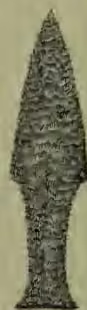
Danish
Flint-dagger.
The burial customs of the stone age included both inhumation and cremation, the former being, however, the earlier method. No burials of the river-drift period have yet been discovered. The cave-dwellers of the stone age buried their dead in cavities of the rocks like that of Cro-Magnon in Dordogne, in which four or five skeletons were found huddled together, without being enclosed in cists or skeletons accompanied by sepulchral pottery. Flint-dagger. From a comparison of the remains from such cave-cemeteries in different localities it has been concluded that even at this early period Europe was already occupied by more than one race of men. The populations of the neolithic time deposited their dead, with or without previous cremation, in or on the floors of the chambers of dolmens, or great chambered cairns. The sepulchral pottery accompanying these burials, in Britain at least, is generally of a hard-baked dark-coloured paste, the form of the vessels mostly basin-shaped and round-bottomed, and the ornamentation entirely composed of straight lines placed at various angles to each other. The implements found with these interments are mostly of the commoner kind, such as flint knives, scrapers, or strike-lights (used with a nodule of pyrites of iron), arrow-heads, and more rarely axes and axe-hammers of flint or polished stone. The neolithic inhabitants of northern and central Europe were not merely nomadic tribes subsisting on the products of the chase; they practised agriculture, and possessed the common domestic animals we now possess. The presence in the refuse-heaps of their seacoast settlements of the remains of deep-sea fishes shows that they must have possessed boats and fishing-lines, as was also the case with the stone-age inhabitants of the Lake-dwellings (q.v.). The estimates that have been made of the antiquity of the stone age in Europe are necessarily very various and all equally conjectural, but it has been considered that the close of the neolithic period or the time when stone began to be superseded by bronze in northern Europe cannot have been much later than from 1000 to 1500 B.C. See Sir J. Evans, Ancient Stone Implements (2d ed. 1897).