Sulphuric Acid, , is the chemical name of the liquid commercially known as Oil of Vitriol—so called from its having been first produced by the distillation of green vitriol (sulphate of iron). It is an odourless, dense, oily-looking liquid, sp. gr. 1.842. When pure it is colourless, but usually it is of a straw to brown colour, derived from impurities which have fallen into it and been charred. It has all the properties of a typical acid, being intensely corrosive and changing vegetable colours. Exposed to the air it absorbs water, and when mixed directly with water great heat is evolved, the liquids contracting in bulk. It does not evaporate at ordinary temperatures, and dilute solutions spilt on cloth gradually become stronger till the acid begins to destroy the fibres of the cloth. Oil of vitriol, or the protohydrate, is not the only hydrate of sulphuric acid. Three others are known to exist. When the fuming oil of vitriol of Nordhausen is exposed to a low temperature a white crystalline substance separates, which is a hydrate, containing half as much water as the common liquid acid; its formula is , and its fusing-point is ( C.). Again, a mixture of 49 parts of the strong liquid acid and 9 parts of water freezes at ( C.), and crystallises into splendid rhombic prisms, from which property it is often termed glacial sulphuric acid, with sp. gr. 1.780. Lastly, when a very dilute acid is concentrated by evaporation in vacuo, at ( C.), till it ceases to lose weight, there will be a resulting compound, consisting of 40 parts of the real acid and 27 of water, and represented by the formula . The compound formerly known as anhydrous sulphuric acid possesses none of the characteristic properties of an acid; see SULPHURIC ANHYDRIDE.
Sulphuric acid in its free state is a very rare natural product; although in combination with bases it is common in the animal and vegetable, and abundant in the inorganic kingdom. In plants it exists in the juices, and in animals in the blood and its derivatives chiefly in the form of sulphates of the alkalies; while in the mineral kingdom it occurs as gypsum (sulphate of lime), heavy spar (sulphate of baryta), celestine (sulphate of strontia), &c. It may be prepared on a small scale by boiling sulphur in aqua regia or in nitric acid, the sulphur becoming gradually oxidised into sulphuric acid. As a general rule, however, the commercial acid is employed even for laboratory experiments. In order to obtain the acid in a pure form, suitable for medical use or medico-legal analysis, it must be redistilled with sulphate of ammonia in a retort containing a few slips of platinum foil, the first and last portions being rejected. The distillation is attended with violent concussions, partly owing to the high specific gravity of the acid, and partly owing to its high boiling-point, and this convulsive action is moderated mechanically by the platinum slips. Sulphuric acid thus prepared according to the directions of the British Pharmacopoeia may be regarded as perfectly pure, presuming arsenic is not present. Strong sulphuric acid has comparatively little action on the metals except at a high temperature, when it dissolves them, and at the same time undergoes partial decomposition; the metal being oxidised by a portion of the acid which becomes decomposed into oxygen and sulphurous acid, and then uniting with a portion of undecomposed acid to form a sulphate. Silver, copper, mercury, arsenic, antimony, bismuth, tin, lead, and tellurium are thus acted on. Gold, platinum, rhodium, and iridium are not affected by the acid even at a boiling temperature. The more oxidisable metals, such as zinc, iron, nickel, and manganese, are readily soluble in the dilute acid, water being decomposed and hydrogen liberated, while the oxygen of the water unites with the metal; and the metallic oxide, at the moment of its formation, combines with the sulphuric acid to form a sulphate.
The sulphates—or salts formed by the combination of sulphuric acid with a base—are generally composed, as in the case of green vitriol, , of 1 equivalent of acid and 1 of metallic oxide, with or without water of crystallisation. With the alkalies this acid also forms acid salts, as bisulphate of potash, and in a few cases—copper, for example—it forms basic salts. The insoluble sulphates, such as that of baryta, may be obtained by precipitating a soluble salt of the base by a soluble sulphate; thus, nitrate of baryta and sulphate of soda yield an insoluble sulphate of baryta and nitrate of soda, which remains in solution. The soluble sulphates may be prepared by dissolving the oxide or carbonate in dilute sulphuric acid, in those cases in which the metal itself is not readily attacked by the acid. Sulphuric acid and the soluble sulphates are easily detected by their yielding, with a solution of a baryta salt, a white precipitate of sulphate of baryta insoluble in acids.
Sulphuric acid is prepared on a large scale by two distinct processes—viz. by the distillation of green sulphate of iron—the original process of Basil Valentine (15th century); and by the oxidation of sulphurous acid through the agency of nitrous acid and hyponitric acid. The first process is chiefly employed at Nordhausen in Germany. The sulphate of iron is distilled in earthen retorts, and the acid passes over into a receiver containing a little ordinary sulphuric acid, forming a brown fuming oily liquid, of about sp. gr. 1.900. This acid is known in commerce as Nordhausen acid, and is chiefly used for dissolving indigo.
The second method is that universally followed in Great Britain, the germs of which were likewise discovered by Valentine. He observed that when the fumes of burning sulphur were collected under a bell jar, slightly moistened with water, a small quantity of liquid was deposited. This liquid, which was simply sulphuric acid, on being concentrated from its solution by boiling was long sold as oil of sulphur at prices as high as 2s. 6d. per ounce. About the year 1740 the French chemists Lefevre and Lemery suggested that, by the use of nitre along with the sulphur, the operation might be conducted in close vessels, and a much greater quantity of acid might be produced. This idea was acted on in England by Dr Ward, who established works at Twickenham and Richmond, conducting his manufacture by burning the mixed sulphur and nitre in large stoppered glass receivers, into each of which a small quantity of water was first introduced. The substitution, in 1746, by Dr Roebuck of Birmingham, of lead chambers in place of the glass vessels may be regarded as essentially the establishment of the process of manufacture followed at the present day.
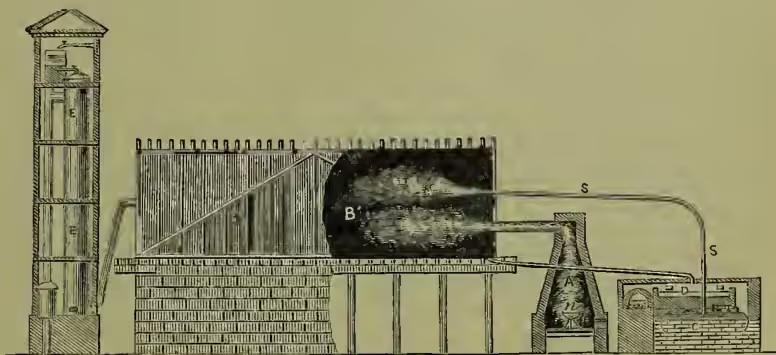
The first stage in the manufacture of sulphuric acid is the preparation of sulphurous acid by the burning of sulphur or of iron pyrites. Previous to the year 1838 Sicilian sulphur was almost exclusively used in the manufacture, but in that year the establishment of a monopoly of the sulphur trade by the Sicilian government, and its consequent increase in price, diverted the minds of manufacturers to the employment of iron pyrites (sulphide of iron). Iron pyrites is now much more used than sulphur, and the only hindrance to its universal adoption is the presence of foreign matter in the pyrites, the most deleterious being arsenical compounds; and it has hitherto been found impracticable to free the sulphuric acid wholly from the arsenious acid which renders it inapplicable for many purposes.
When sulphur is the material used for producing the sulphurous acid it is burned in an oven or 'burner' (A) of brickwork, having a sole or bottom of iron, termed the 'burner-plate.' Under this a small fire is at first lighted, which is allowed to go out after the sulphur has ignited. A little above the sulphur a small pot, called the nitre pot, n, is either placed on a stand or hung from the roof, filled with a quantity of either nitrate of soda or nitrate of potash, with sulphuric acid sufficient for its decomposition—8 or 10 lb. of the nitre with 5 or 6 lb. of sulphuric acid being allowed for every cwt. of sulphur. The decomposition of the nitre by the action of heated sulphuric acid furnishes nitric acid fumes, which go over into the chamber along with the sulphurous acid. The sulphurous acid readily abstracts from the nitric acid the additional oxygen required for its conversion into sulphuric acid, reducing the nitric acid to nitric oxide, NO. Nitric oxide in its turn quickly converts itself into nitric peroxide, by the abstraction of additional oxygen from the air that is constantly entering the chamber through the burners. Again, in the presence of moisture which is supplied by a jet of steam from the boiler, C, sulphurous acid readily deprives the nitric peroxide of oxygen, and thus forms more sulphuric acid, and again liberates nitric oxide; which is ready once more to seize upon the oxygen of the air, and would continue so acting and reacting ad infinitum, were it not carried forward and out by the chimney.
The chamber is an immense box or room of lead, bound together with a strong framework of timber, and generally raised on arches several feet above the ground. Chambers vary in size from 60 to 140 feet in length, and from 20 to 40 feet in width and height. Curtains of lead proceeding alternately from the bottom to near the top, and vice versa, are very frequently used; they serve to retard the progress of the gases, and thus ensure the transformations desired. The floor of the chamber is covered with water, into which the sulphuric acid falls as it is formed; and when this solution attains a certain strength it is tapped off for concentration. When the gases reach the chimney, on account of the reactions of the nitrous compounds already explained, a large amount of nitrous acid would not only be wasted, but would also be deleterious to the neighbourhood, were steps for its recovery not adopted. This recovery is usually effected by means of a tower filled with coke, E, down which a constant stream of strong sulphuric acid trickles, the acid absorbing the nitrous fumes in their way upwards. Instead of a single chamber, curtained off or not as the case may be, sometimes three or five distinct chambers, connected by pipes, are employed, those communicating directly with the burners being termed working chambers, and the others receiving chambers, the last either acting as or communicating with a condenser or chimney.
When iron pyrites is used as the source of sulphurous acid suitable burners are used. In England these are arched chambers about four feet each way, on plan with furnace-bars placed a little above the ground. There are also the necessary doors and air-holes. The pyrites is broken into pieces and spread in layers on the bars, which are previously heated to redness, and the heat evolved by the burning sulphur is thereafter sufficient for the fresh charges. The exhausted ore is frequently sufficiently rich in copper for its extraction; indeed, when there is as little as 2½ per cent. present in pyrites it is now recovered. In consequence of strong sulphuric acid absorbing both sulphurous acid and nitrous acid, the acid requires to be drained off from the chamber while the solution is comparatively weak, at which strength—viz. of a specific gravity of about 1·4—it is used for some purposes in the arts under the name of ‘Chamber Acid.’ This is concentrated by evaporating in lead pans, D, till it reaches the specific gravity of 1·6, then boiling in a platinum retort, on which strong acid does not act, even at high heat, or in large flint-glass retorts. In the process introduced in 1859 by Mr Glover the gaseous sulphuric acid from the sulphur or pyrites burners is not conducted direct to the lead chamber, but is first passed through a Glover’s or denitrating tower, and there purified of nitrogen compounds, which are saved for use in the lead chamber.
The manufacture of sulphuric acid is a very extensive industry; immense quantities of it being consumed in the manufacture of Soda (q.v.), in that of bleaching-powder, in calico-printing and dyeing, and in fact in most chemical operations both in the manufactury and the laboratory. In medicine a dilute sulphuric acid, formed by gradually mixing the strong purified acid with water, or aromatic sulphuric acid (known also as elixir of vitriol), prepared by mixing sulphuric acid, rectified spirit, tincture of ginger, and spirit of cinnamon, are almost always employed. In doses of from ten to thirty minims, properly diluted, these preparations exert a strong astringent power, and are serviceable in all forms of passive hemorrhages, and in checking inordinate discharges when they arise from debility. Poisoning with this and other irritant acids is noticed at POISON, Vol. VIII. p. 265.
There are works on the manufacture by Smith (1873), Lock (1879), and Lunge (new ed. 1891).