Sunfish (Orthagoriscus), a genus of pelagic fishes of the family Diodontidae (see GLOBE-FISH), having the body compressed, and not capable of inflation, as in the other Diodontidae; abruptly terminating in a very short tail; the dorsal and anal fins long and pointed, united to the short tail-fin; the jaws undivided in the middle, and comparatively feeble, and furnished with a cutting edge of bone instead of teeth. The total number of vertebrae is seventeen, and the spinal cord is merely a short appendage of the brain. The species are found in every part of the oceans within the tropical and temperate zones. The young undergo remarkable changes. The food consists of small pelagic crustacea. The Short or Rough Sunfish (O. mola), found frequently on the south coasts of England and Ireland, when young is almost perfectly round, but becomes rather more elongated when full grown. The name Sunfish is variously regarded as derived from the form of the fish and from its habit of floating at the surface of the water, in fine weather, as if to enjoy the sunshine. It attains a large size, being sometimes 7 or 8 feet long, and is captured by sailors. Its skin is rough and minutely granular. Its flesh is white and well flavoured, somewhat resembling that of the skate.
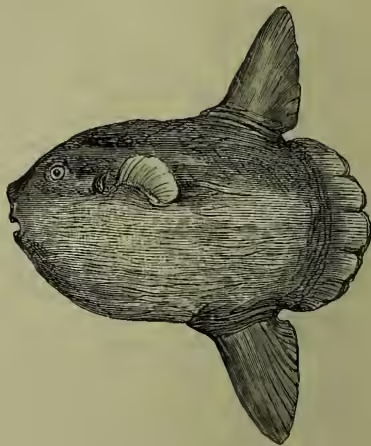
The liver yields a large quantity of oil, which is in repute among sailors as an external application for the cure of sprains, rheumatism, &c. The Oblong Sunfish (O. truncatus), of which specimens have also been taken on the British coasts, but more rarely, is of a longer form. It also attains a large size. It has a smooth tessellated skin, and is one of the rarest fishes in collections.