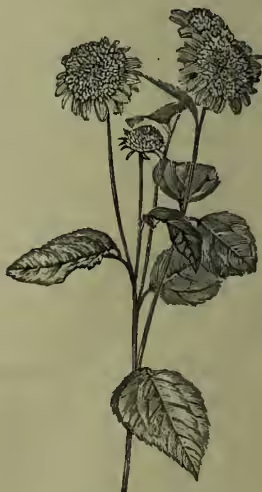
(Helianthus multiflorus).
Sunflower (Helianthus), a genus of plants of the natural order Compositæ, sub-order of Corymbiferae, having large flowers; the florets of the ray strap-shaped, without stamens or pistils, yellow or orange; the florets of the disc tubular, perfect, yellow or purplish brown; the flowers solitary or in corymbs, with an involucre of numerous leaves; the fruit compressed, with a pappus of two or more deciduous scales. The species are numerous, all natives of America; large herbaceous plants, with opposite or sometimes alternate undivided leaves. The Annual Sunflower (H. annuus), common in flower-gardens, is a native of tropical America, where it sometimes attains a height of 20 feet. The stem is thick and rough; the flowers solitary, and from 1 foot to 2 feet in diameter, nodding; the leaves heart-shaped-ovate. This plant is now cultivated in almost all parts of the world, and in the south of Europe is sometimes a field-crop, the seeds being valued as food for cattle and poultry, and on account of the oil which they yield, which is little inferior to olive-oil. An acre of good land produces about fifty bushels of seed, each bushel yielding a gallon of oil. The seeds are also used like almonds for making demulcent and soothing emulsions; and in some parts of Europe a bouilli is made of them which is used as food for infants. Russians eat them like nuts, and American Indians make bread of them. The flowers abound in honey, and are much frequented by bees. The leaves are good fodder for cattle. The stems are used for fuel, and yield much potash. A profusely flowering garden variety, H. multiflorus, is referred to the same species. The fallacy that the flowers of the sun-flower turn with the sun is mentioned by Gerarde (1597), who adds, however, 'the which I could never observe, although I have endeavored to finde out the truthe of it.'—The Jerusalem Artichoke (q.v.) belongs to this genus.