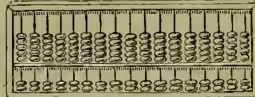
Ab'acus, an instrument sometimes employed in infant-schools to make the elementary operations of arithmetic pal- pable. It consists of a frame with a number of parallel wires, on which beads or counters are strung, being variously arranged to represent units, tens, &c. By the ancient Romans it was used in practical reckoning, and it is still in use in some parts of Russia, in the Caucasus, Persia, and China. According to Professor Knott's monograph on The Abacus (Yokohama, 1886), the abacus was probably a Semitic invention, introduced by the Semites to the Aryans, and so passed on to the Chinese. An improved abacus is called 'adder' in the United States. In architecture, the abacus is a square or oblong level tablet placed above the capital of a Column (q.v.), and supporting the superimposed Entablature (q.v.).