Aerostatics is that branch of Hydrostatics (q.v.) which treats of the equilibrium and pressure, &c. of air and gases.
Æschines, an Athenian orator, second only to Demosthenes, born 389 B.C. In the question of the attitude of Athens towards King Philip of Macedon, who was then pursuing his designs for the subjugation of the several Greek states, Demosthenes advocated the policy of opposing him before it was too late, while Æschines was the head of the peace-party. He was a member of more than one embassy sent by the Athenians to Philip; and Demosthenes accused him of receiving bribes from the Macedonian monarch, and of betraying the cause of Athens and of her allies. There is no proof that this was the case; and perhaps Æschines was deceived by the wily Philip into believing that no harm was meant to the liberties of Athens, and that peace was the best policy for his countrymen. The result justified the sagacious fears of Demosthenes, and condemned the selfish, isolating policy of Æschines. When it was proposed to reward Demosthenes with a golden crown for his patriotic exertions in defence of his country, Æschines indicted the proposer, Ctesiphon, for bringing forward an illegal proposition. Demosthenes replied in perhaps the greatest of his speeches, and Æschines being vanquished, and having thus incurred the penalty attached to an unfounded accusation, was obliged to retire from Athens. He finally established a school of eloquence in Rhodes, which enjoyed a high reputation. The story is told that once he read his great oration against Ctesiphon at Rhodes, and when some of his hearers expressed their wonder at its want of success, he replied, 'You would cease to be astonished if you had heard Demosthenes.' He died at Samos, 314 B.C. The oration against
Ctesiphon and two others are the only authentic productions of Æschines that have come down to us. They are found in editions of the Attic orators, as those of Bekker. Good editions of the three speeches alone are those by Franke (Leip. 1860) and Weidner (Berl. 1872). See Jebb's Attic Orators (2 vols. 1876-80).
Æschylus, the son of Euphorion, to us the father of Greek tragedy, was born at Elensis, the town of the Mysteries, near Athens, in 525 B.C., and no doubt had his religious feeling stimulated by the solemn services which represented the deepest and purest elements of Greek religion. We know that he was initiated, by the fact that he was accused of divulging the divine secrets in one of his plays. The first attempts at tragedy had been made by Thespis, who is to us only a name; and there were older contemporaries of Æschylus, with whom he contended successfully, but who no doubt helped to perfect his education in poetry. He fought for Athens in the great Persian wars, and is reported to have been wounded at Marathon, where his brother fell. Pausanias tells us that in his epitaph he recalled these facts of his life, rather than his victories as a poet. The first of these latter was gained in 485 B.C., and from this time till the middle of the century he worked with all the energy and patience of a great genius at his art. He won thirteen first prizes in tragic competitions, and was exceedingly hurt at being defeated by Sophocles in 468 B.C. This may have induced him to leave Athens and go to Sicily, which he had already visited to bring out a play for the artistic tyrant Hiero. He produced there a new edition of his extant Persæ. His trial before the Areopagus on the charge of divulging the Mysteries is, however, also stated as a cause of his departure. His last great victory was won in 458 B.C., with the trilogy which we still possess, and three years later he died at Gela in Sicily, where his tomb was shown long after. The Athenians specially rewarded any impresario in after-days who brought out his plays afresh. There are a few fables current in addition to the above meagre facts, but they are not worth repeating here. Out of some sixty plays ascribed to him, we have only seven extant, on each of which we shall say a word.
The Suppliants is the earliest, at least in form (its date uncertain), for the chorus is still the principal feature, as we know it had been in the first attempts of Thespis. The plot, which is exceedingly simple, is based on the escape of the fifty daughters of Danaus from their suitors, the sons of Ægyptus, and their supplications to the king of Argos to protect them. There is very little character-drawing, save that of nationalities, the petulant and insolent Egyptians being contrasted with the honourable and somewhat democratic people of Argos, whither the suppliants have fled. Yet this simple subject gives the poet occasion for the loftiest utterances on Fate and Divine Providence, expressed in that tremendous diction which no other Greek poet ever equalled.
The Persæ is profoundly interesting, as giving us, in a tragedy, a piece of contemporary history, for the poet fought in the battle of Salamis, which he describes. But far from degrading his play into a mere panegyric of Athenian valour, the poet lays his scene far away at the Persian court, where the queen-mother Atossa is awaiting news of Xerxes' army. The ghost of Darius which appears is perhaps the most distinctive character.
The Seven against Thebes brings us to a more advanced stage of the poet's development. It is no longer the chorus but Eteocles, the patriotic king of the Cadmeans, who takes the leading part. The drawing of his character is clear and sharp, and Mr Verrall, in his edition of this play (1887), has also shown with what delicate artifice the poet has brought his hero, by the insensible steps of a hideous fate, to meet his brother Polynices in fratricidal conflict. Both the narrative of the messenger who gives the details of the fight, and the choruses uttered by terrified maidens of the city, are full of life and beauty. The bringing in of the bodies, and the lament over them, form a sort of musical conclusion to the play.
The Prometheus Bound is the perfection of Æschylus' art, and shows us what his genius could do in simple tragedy, in the old plotless, motionless, surpriseless drama, made up of speeches and songs and nothing more. We now have three actors together on the stage, and the duties of the chorus, once so prominent, are becoming restricted to subordinate work. Prometheus, the heroic sufferer, sustains the whole interest of the play. He is driven with insult to the Caucasus. He soliloquises. He discourses with friendly nymphs and their cautious father, Oceanus. He condoles with the frantic Io, who passes by in her wanderings: he prophesies her future. Lastly, he bids defiance to Zeus, through his messenger Hermes, sent to coerce him into further prophecy, and disappears amid thunder and whirlwind. Almost every commentator has imagined that Æschylus had some deep theory in his mind, which he desired to illustrate by the play. But whether that theory was philosophical, or moral, or scientific, or political—whether he meant to symbolise the struggles of man against nature, or against passion, or against tyranny, or against theology—will never be determined.
We now come to the Oresteia, or three plays on the fortunes of Orestes, which is the latest and greatest work we have from Æschylus. These pieces, the Agamemnon, Choephori, and Eumenides, are the only extant specimens of what the Greeks called a trilogy, and show us how the older tragic poets combined three plays on a single subject.
The first of the series, the Agamemnon, is the longest play left us by the poet, as perhaps the greatest Greek play of all that have survived. With a perfectly simple plot, there is splendid and consistent drawing of character, deep philosophy in the choral songs, and a certain gloomy grandeur which makes it unique. The central point of interest to the reader is the scene between Cassandra and the chorus, when she tries to make plain to them the horrid murder of the king, which she foresees as imminent. Agamemnon is drawn as in the Iliad, a great king but a weak man, while Clytæmnestra is the leading spirit of the piece. Even in the collateral quality of picturesqueness, this masterpiece is above almost all its rivals.
The Choephori, a shorter and less striking play, but not without the same grandeur and the same gloom, gives us the return of Orestes from exile, and his murder of Clytæmnestra, in accordance with both the command of the oracle and the sentiments of the Greek mind.
In the Eumenides, we find the necessary results of the previous tragedy. Though Orestes has obeyed one great moral law, avenging the blood of his father, he has violated another no less sacred in taking the life of his mother, whose Furies (Eumenides) persecute him with ceaseless pursuit.
There are a large number of short fragments preserved in quotations, but none of sufficient importance to detain us here. The genius of Æschylus is quite peculiar in Greek literature, and he has no equal. There is something oriental in his boldness, his uncouth yet expressive compounds, his daring, piled-up metaphors. But what distinguishes him still more from great contemporaries like Pindar, or great successors like Sophocles, is the grandeur of his conceptions in theology, in the providential ruling of the world, the inheritance of sin, the conflict of rude with purer religion.
The newest critical text of all the plays is Wecklein's (Berlin, 1885). The handiest commentary is Dr Paley's (4th ed. 1879); we have translations by Potter, Blackie, Plumptre, and Lewis Campbell (1891). For special plays, Sidgwick's Agamemnon, and R. Browning's and Fitzgerald's translations of the same, Verrall's Septem, Prickard's Persæe, and Mrs Browning's version of the Prometheus, are the best helps available to English students.
Æsculapius (Gr. Asklēpios) appears in Homer as the 'blameless physician,' of human origin; in the later legends, he has become the god of the healing art. The most common account makes him the son of Apollo and Coronis. He was brought up by Chiron, and instructed in the healing art, in which he soon surpassed his teacher, and succeeded so far as to restore the dead to life. Pluto, afraid that his realm would get no new inhabitants, therefore complained to Zeus, who slew the physician by a thunderbolt. After this he was raised to the rank of the gods by the gratitude of mankind, and was especially worshipped at Epidaurus, on the coast of Laconia. Here oriental elements, especially serpent-worship, seem to have been mingled with his rites and ceremonies. From Epidaurus the worship of the healing god extended itself over the whole of Greece, and even to Rome. According to Homer, Æsculapius left two sons, Machaon and Podalirius, who, as physicians, attended the Greek army. From them the race of the Asclepiades descended. Hygieia, Panacea, and Ægle are represented as his daughters. The temples of Æsculapius usually stood outside of the cities in healthy situations, on hillsides, and near fountains. Patients that were cured of their ailments offered a cock or a goat to the god, and hung up a tablet in his temple, recording the name, the disease, and the manner of cure. Many of those votive tablets are still extant. The statue of the god at Epidaurus, formed of gold and ivory by Thrasymedes, represented Æsculapius as seated on a throne, and holding in one hand a staff with a snake coiled round it, the other hand resting on the head of a snake; a dog, as emblem of watchfulness, at the foot of the deity. Praxiteles and other sculptors represented the god as an ideal of manly beauty, closely resembling Zeus; with hair thrown up from the brow, and falling in curls on each side. The upper part of the body was naked, and the lower was covered by a mantle falling in folds from the shoulders. He had sometimes a laurel wreath on his head, and a cock or owl at his feet; or was attended by a dwarf-figure named Thelesphorus.—ASCLEPIADES, the followers of Æsculapius, who inherited and kept the secrets of the healing art; or, assuming that Æsculapius was merely a divine symbol, the Asclepiades must be regarded as a medical, priestly caste who preserved as mysteries the doctrines of medicine. The members of the caste, or medical order, were bound by an oath—the Hippocratis jusjurandum—not to divulge the secrets of their profession. Hippocrates is said to have descended from the Asclepiades of Cos, who traced their descent, on the mother's side, from Hercules.
Æsir, a race of gods in the Scandinavian Mythology (q.v.).
Æsop, the famous Greek fabulist, who lived in the later half of the 6th century B.C. He is supposed to have been originally a native of Phrygia and a slave, but to have been afterwards made free. He then visited the court of Creesus, and gained his confidence to such an extent that he was sent on several missions, in one of which, to Delphi, he was thrown over a precipice by the priests, infuriated at his witty blasphemies. The traditions of his ugliness and his buffoonery may be dismissed. We know from Aristophanes that fables bearing the name of Æsop were popular at his time, and indeed we find that his name became in Greek literature a peg on which to hang anything in this form. The fables connected with his name were long transmitted through oral tradition. Socrates' turned such of them as he could remember into verse during his imprisonment, and the same was done by Demetrius Phalereus. The only Greek version, however, of which any entire fables remain, and which, as shown by Bentley, has furnished materials to subsequent collections, is that of Babrius (q.v.). Later investigations have given to these ancient fables a still more venerable antiquity, in tracing the origin of many of them to the Jatakas or Birth-stories of Buddha. See Halm's work (2d ed. Leip. 1860), and the article BEAST-FABLES.—A Roman actor of this name, CLAUDIUS ÆSOPUS, a contemporary and friend of Cicero, was as eminent in tragedy as Roscius was in comedy.
Æstheticism is an art movement which has sprung up during the present generation, manifesting itself in various forms. As its name implies, it is concerned with the beautiful; but the fantastic developments which have accompanied it, have recently tended to bring the new gospel into ridicule. Its more amusing and extravagant aspects have been happily travestied in the pages of Punch, and in Gilbert and Sullivan's Patience (1881). The fundamental principle of æstheticism is to carry a love of the beautiful into every home, and into all the relations of life. Bric-à-brac, china, ornamental dados, and curtains of old gold, with Queen Anne furniture, or with reproductions of Greek and Roman art, have demonstrated the aspirations of the æsthete in his home. While the movement generally has led to much superficial dogmatism upon art, culture, and classicism, it has undoubtedly given an impetus to the study and appreciation of the beautiful amongst the masses. Mr Ruskin has done much to advance an understanding of the higher æstheticism by his writings, and Sir Frederick Leighton and Alma-Tadema are conspicuous amongst those who have realised its ideal in their dwellings. In art, Holman Hunt, Rossetti, Burne Jones, and others associated with the pre-Raphaelite movement, have given expression to the nobler æsthetic ideas and principles in their works. When the extravagances attending the movement have been purged away, there may still be left an educating influence, which will impress the lofty and undying principles of art upon the minds of the people.
Æsthetics is the term now commonly used to denote the science or philosophy of the Beautiful; the principles of taste and of art. Æsthetica was first used in this sense by the Wolfian philosopher, Baumgarten; and though Kant, keeping nearer the meaning of the original Greek word, dealt in his Transcendental Æsthetic with the conditions of sensuous perception, Baumgarten's usage, as being convenient, became popular, and was established in Britain about 1830.
The name of Plato is bound up with the history of speculation on the Beautiful, which he never wholly separated from the Good. His position is far from precise, but it may be said that for him the beauty of finite things arises out of their participation in the eternal and ideal archetypes which constitute the keynote of all his speculations. Aristotle is more precise than his master, and left a body of valuable and still valid canons of criticism, especially for poetry. An Aristotelian dictum is, that the beautiful is that which is neither too large nor too small, a mean between extremes.
Bamgarten above mentioned (circa 1750) is the father of æsthetics as a well-defined system. According to him and his followers, sense is the lower intellectual power, understanding and reason the higher. As the true and the good are apprehended by the latter, the beautiful is grasped by the former; and æsthetics is a humbler stage of the intellectual energies.
Winckelmann did much to further æsthetic criticism by his examination of the principles of Greek sculpture; Lessing still more, by his attempt to distinguish, in his Laocoon, the province of poetry from that of painting and sculpture, and by excluding from the legitimate sphere of plastic art the representation of the repulsive and disgusting. Schiller was not merely a great poet, but a suggestive critic; and one of his trenchant maxims was that 'the annihilation or superseding of the matter by the form is the true art-secret of the master-artist.' The influence of Goethe by means of his Wilhelm Meister and other works, has probably influenced the thought of Europe still more.
Kant's Critique of Judgment deals with the a priori principles of emotion, of pleasure and pain, as intermediate between knowledge and volition, the judgment being æsthetic or teleological respectively; while the beautiful is analysed with reference to the four well-known categories of his system. Fichte and Schelling both included æsthetics in their schemes of philosophy; but the work of Hegel in this department attracted much more interest, and was for a time of paramount influence in Germany. With him, the beautiful is the absolute ideal realising itself; nothing is truly beautiful except this; nothing, therefore, which exists in concrete form can be so termed. Out of the sphere of the pure reason we have only an eternal aspiration. In the finite mind, the absolute ideal is always striving to realise itself, but never completely succeeds; there is only a ceaseless approximation. Beauty, whether of nature or history, is rare, accidental, fugitive, and tarnished by intermixture with the not-beautiful. The beautiful first passes into self-recognition in the dawn of human intelligence, and its conscious realisation of itself increases in proportion to the culture of the race or the individual. The highest finite realisation of it is Art; for though the form of art be material, it is matter shaped according to an idea. The artist looks on the form simply as the objective embodiment of the idea. Form, though springing out of matter, is thus a deliverance from matter, and the particular arts may consequently be regarded as the gradual working of the mind out of materialism. The formative arts—Architecture, Sculpture, Painting—are silent, heavy, still partly material. Music is an advance on these, and breathes in a higher region; the materialism of Sound becomes all but ideal. Poetry is a further advance. It is the pathway of the intellect to pure thought.
Herbart and the Realists, including Zimmermann, directly opposed the Hegelian theory. For them, æsthetics is that branch of philosophy which deals with the forms by which any subject of thought provokes pleasure or the reverse, whether it be a representation of a reality or a pure invention of the imagination; a picture does not gain in beauty by reality, though it may gain in truth. Vischer and Carrière, Schopenhauer and Kirchmann, Fechner and Lotze, amongst German systematists, have all copiously dealt with æsthetics.
In France, Diderot and Père Buffier propounded theories of beauty. The founder of the Eclectic School of Philosophy, Victor Cousin, eloquently expounded the Platonic view.
In Britain, the first publication on this subject of any consequence—if we except Lord Shaftesbury's Characteristics, in which there is set forth a 'rapturous Platonic doctrine'—was Hutcheson's Inquiry (1725). In this work, the existence of an 'internal sense,' through which we either obtain a perception of the beautiful, or are made in some way conscious of its presence, was maintained.
Burke, in his famous Treatise on the Sublime and the Beautiful (1756), relies mainly on physiological considerations. Amongst the elements of beauty are smallness, smoothness, variety of outline, delicacy, brightness and softness of colour. 'All objects appear beautiful which have the power of producing a peculiar relaxation of our nerves and fibres.'
Sir Joshua Reynolds, borrowing from Père Buffier, treated beauty as the mean between two extremes. Hogarth's more ingenious and acute Analysis of Beauty emphasises fitness, variety, symmetry, intricacy with simplicity and distinctness, and size.
Alison's Essays on the Nature and Principles of Taste (1790) propounded the theory of Association. Jeffrey, in his famous essay, substantially adopts and expounds Alison's views. According to Jeffrey, 'these emotions (that is, those excited by the contemplation of certain objects) are not original emotions, nor produced directly by any qualities in the objects which excite them; but are reflections or images of the more radical and familiar emotions to which we have already alluded, and are occasioned not by any inherent virtue in the objects before us, but by the accidents, if we may so express ourselves, by which these may have been enabled to suggest or recall to us our own past sensations or sympathies.' He explicitly denies that there is any independent or intrinsic beauty in form.
Sir William Hamilton distinguishes beauty into Absolute and Relative. 'In the former case,' he says, 'it is not necessary to have a notion of what the object ought to be before we pronounce it beautiful or not; in the latter case, such a previous notion is required.' In the case of free or absolute beauty, 'both the imagination and the understanding find occupation; and the pleasure we experience from such an object is in proportion as it affords to these faculties the opportunity of exerting fully and freely their respective energies. The beautiful is that whose form occupies the imagination and the understanding in a free, full, and consequently an agreeable activity.'
Ruskin has done much to awaken and extend the appreciation and enjoyment of art in this country, and in several of his works discusses æsthetic theories; especially in Modern Painters he has attempted a systematic exposition of our ideas of beauty. Beauty is typical or vital, the former falling under the heads of infinity, unity, repose, symmetry, purity, moderation—all typical of divine attributes; while vital beauty is relative or generic. Ruskin's position is that of an extreme spiritualist, and takes no account of the value of association at all.
Bain, a prominent representative of the empirical school, has largely treated of æsthetics in his work on The Emotions and the Will, and has made an elaborate analysis of the elements in our perception and enjoyment of beauty. Herbert Spencer has endeavoured to establish an original theory of the origin of our pleasure in beauty and art, based on the doctrine of evolution as developed by him.
Others who have contributed to the discussion of the problem are Jean Paul Richter in Germany; in France, Jouffroy and Taine; and in Britain, Reid, Addison, Dugald Stewart, and Lord Kames. Schasler, Zimmermann, Lotze, and Carrière have written in Germany works on the history of æsthetics; in France, Lévéque; and in his Mental and Moral Science, Professor Bain discusses the principal theories. American writers are Jarves, Bascom, Kedney, and Torrey. See the articles on ART, ASSOCIATION OF IDEAS, EMOTION; Hegel's Phil. of Fine Art (transl. by Bosanquet, 1887); Lotze's Outlines of Æsthetics (trans. by Ladd, 1887), and Bosanquet's History of Æsthetics (1892).
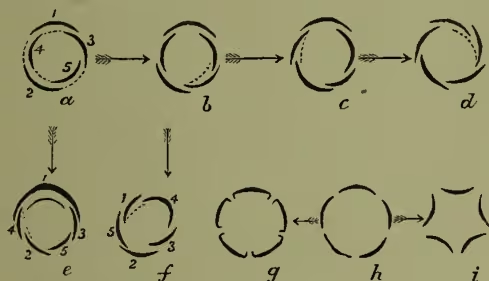
Æstivation (Lat. æstivus, 'belonging to summer'), or PRÆFLORATION, a term employed to denote the manner in which the sepals and petals are disposed in the flower-bud. The different modes of æstivation are different solutions of the problem of packing the floral envelopes into smallest bulk, and some of the arrangements are apparently the results of twisting. The æstivation of the sepals is often different from that of the petals. The precise arrangement in a flower can be readily seen by making a cross section of the bud, but some of the commonest forms may be noted. When the parts meet but do not overlap, the arrangement is called valvate; but if the adjacent margins are turned inwards or outwards, the terms induplicate and reduplicate are used. In many cases, each part overlaps its neighbour at one margin, and is still overlapped at the other, and to this the term contorted is applied. In imbricate æstivation, the parts successively overlap from the first, which is wholly external, to the last, which is wholly internal. The term quincuncial is applied to an exceedingly common arrangement in which two parts are external, two internal, while the fifth overlaps one of the internal parts and is overlapped by one of the external. In the papilionaceous corolla (see LEGUMINOSÆ), the standard overlaps the wings, and they in turn overlap the keel. In the poppy, the petals are much crumpled in the bud.
Ætheling. See ÆTHELING.
Æthrioscop is an instrument for measuring the minute variations of temperature due to the condition of the sky, and consists of a differential Thermometer (q.v.) whose bulbs are both within a cup-shaped mirror, one being in the focus of the mirror.
Ætiology, or ETIOLOGY (Gr. aitia, 'cause,' and logia, 'discourse'), the science or philosophy of causes and causation, especially (1) the department of biology, which seeks to give a rational account of the forms, functions, and history of organisms (see DARWINIAN THEORY, and EVOLUTION); (2) the branch of medicine which investigates the causes and origin of diseases.
Æctius, a great Roman general, born in Mœsia towards the end of the 4th century A.D. He was for a time a hostage amongst the Huns. He led an army of Huns to the support of the usurping
Emperor John; and by help of the Huns compelled the empress-mother Placidia to advance himself at the expense of his rival Bonifacius. In 433 he became patrician, consul, and general-in-chief; and as such maintained the empire against the barbarians for twenty years, defeating West Goths, Burgundians, rebellious Gauls, and Franks. But his 'crowning victory' was that at Chalons over Attila (q.v.) in 451. In 454 the Emperor Valentinian III. (q.v.), jealous of his greatness, stabbed him to death with his own hand.
Ætna. See ETNA.
Ætolia, a district of ancient Greece, lying on the N. coast of the Gulf of Corinth. It was divided from Acarnania by the river Achelous, and on the N. touched Thessaly. In later times, these boundaries were considerably extended to the N. and E. The country had few cities; was, except on the coast, generally wild and barren. Here, according to the legend, Meleager slew the Calydonian boar. The Ætolians make a great figure in the heroic age of Greece; but at the time of the Peloponnesian war, they were rude and barbarous. The Ætolian Confederacy, first called into existence about 323 B.C., became an important rival to the Achæan League (see ACHAIA). Their assembly was styled the Panætolicon. They sided with the Romans against the Achæan League, but afterwards aided Antiochus III. against the Romans, and were subjugated by the Romans in 189 B.C., though not formally included in a Roman province till 146. Along with Acarnania, Ætolia now forms a department of the modern kingdom of Greece, with a united area of over 3000 sq. m. The mountains in the NE. are offsets of the Pindus chain, and slope steeply on the SW. down to the central plains. The chief towns are Missolonghi and Lepanto.