Ant. Ants (Formicidæ, Myrmicidæ) are a group of Hymenopterous insects, in the same order as wasps and bees, which they resemble, not only in general structure, but in the high evolution of their instinctive habits and social life. The word 'ant' is contracted from the old-fashioned Saxon word emmet; and 'pismire' is another almost obsolete, originally Danish term. The white ants or Termites (q.v.) are members of an entirely different order—Neoptera. The ant family is represented by between two and three thousand different forms, widely distributed in temperate and tropical countries. Three sub-families are usually distinguished—the Formicidæ proper, the Poneridæ, and the Myrmicidæ. Numerous fossil forms are known, often beautifully preserved within pieces of amber. In the tertiary formations, eighty-three distinct species have been chronicled.
The study of ants has engaged the attention of naturalists from before the days of Aristotle and Pliny, but it is only since the beginning of this century that the careful researches of Latreille, Hüber, Forel, Smith, Mayr, Lubbock, and many others, have established an exact knowledge alike of their forms and habits.
Different Forms.—Like most bees, ants occur in three different forms—(a) the perfect females or queens, the mothers of new generations; (b) the short-lived males, which die soon after the 'nuptial flight;' and (c) the great majority of workers, which are predominantly females, though rarely sexual, and often exhibit different forms according to the work which they have to do. In some cases, further, there are distinct classes of workers.
Structure.—As in other insects, the body consists of three parts—head, thorax, and abdomen. The head, which of course contains the 'brain,' is, though minute, yet large in proportion.
Life-history.—As in many other insects, there are four chapters in the life-history of an ant—viz. egg, larva, chrysalis, and perfect insect. The after a period varying from a few weeks to as many months, become pupæ or chrysalids. These may remain naked, or may spin silken robes or cocoons. The nursing care of the workers does not cease; the brood is kept clean, shifted into the sunshine, or carried off in case of danger. Ant pupæ are collected and sold both in this country and on the Continent as food for young birds. After a short while, during which no food is taken, the perfect insects appear, weak and helpless, still dependent upon the kindly aid of the workers, even to free them from their silken birth-robes. For some weeks, in fact, the workers continue to care for them. As in all insects with a similar history, or complete metamorphosis, the insect has attained its full size when it leaves the pupa stage. Left to themselves, the males generally die after fertilising the queens in the nuptial flight, but the queens and workers may live for several years. Great numbers fall victims to other animals—insects, spiders, birds, ant-eating mammals, &c.; and, small as they are, ants are not unfrequently attacked by still smaller parasites.
Food.—The whole food-supply for the inmates of the nest is collected by the industrious workers, or in a few cases by captured slaves of another species. The food chiefly consists either of insects and available animal matter, or of sweet vegetable substances, such as honey, fruit, and sugar. In the Honey Ant, described by M'Cook (see fig. 4), the abdomen is enormously distended with honey, which is forcibly injected by the normal workers, and is afterwards utilised for the young brood. When the honey exudes by accident, it is greedily lapped up by the workers, but if the honey-pot die, both corpse and honey are buried. The squeezed-out honey is said to be sold in Mexican markets as the basis of a drink resembling mead. The harvesting or grain-storing habit, often alluded to in ancient literature, and remaining unquestioned in popular belief, was for a long time regarded with considerable scepticism by scientific investigators. It was questioned in 1747 by the Rev. W. Gould, one of the early students of ants in Britain, and such authorities as Latreille and Hüber believed his hesitation to be thoroughly justified. The barleycorn-like pupæ cocoons suggested the possibility of mistaken observation, while the torpor of ants during the winter of northern countries did not consist with any storing habit. Yet the opinion of the ancients was expressed in unmistakably circumstantial language, as in this regulation as to ant-granaries found in the Mishna: 'The little caves of ants, when in the midst of a standing crop, are adjudged to the owner of the field; of those behind the reapers, the upper part is the property of the poor, the lower of the proprietor.' The opinion of the ancients has been amply confirmed. Thus in 1829 Lieutenant-colonel Sykes noted at Poonah the large heaps of millet-seed stored up by a species of ant which he named Atta providens. The same was demonstrated by Mr Moggridge in regard to some ants in the south of Europe, while Dr M'Cook has given a most graphic account of the harvesting habits exhibited by the agricultural ants of Texas. Moggridge also noted that the seeds are somehow prevented from germinating, but if the process should in exceptional cases begin, the ants are clever enough to eat off the radicle.
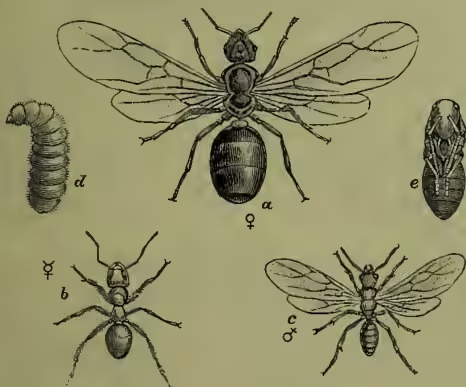
a, queen; b, worker; c, male; d, larva; e, pupa.
(After Lubbock.)
Ants are especially fond of the sweet secretion which flows out from the plant-lice or Aphides (q.v.); and some species not only tap and tickle the latter to induce them to part with their honey-dew, but keep them, as Linnæus said, as 'cows,' protecting them in sheds, and yet more marvellously caring for their eggs. Several breeds minute white or yellowish eggs laid by the queen in the ant nest, are hatched in from two to six weeks, and develop into white legless larvae or grubs. Both eggs and grubs are carefully watched, and the grubs fed, by the ever-vigilant workers. Thanks to the abundant food-supply, which is given them in a prepared form, the larvæ increase greatly both in size and in complexity, and of aphid 'cows' are thus appropriated and utilised, and apparently regarded by these pastoral ants as distinctly their 'property,' for the possession of which, if need be, they will even fight. Other insects are sometimes similarly utilised. Several naturalists, such as Bates and Belt, have given vivid accounts of the ravages of the Drivers and Hunting Ants. 'The dread of them is upon every living thing. Their entrance into a house is soon known by the simultaneous and universal movement of rats, mice, lizards, cockroaches, and vermin of all sorts. When they are fairly in, we give up the house, and try to await with patience their pleasure, thankful indeed if permitted to remain within the narrow limits of our beds and chairs.' 'Wherever the marauding Ecitonids move,' Bates says, 'the whole animal world is set in commotion, and every creature tries to get out of the way. The main column of the army, from four to six deep, moves forward in a given direction, clearing the ground of all animal matter dead or alive, and throwing off, here and there, a thinner column to forage on the flanks.' The blind driver ants of Africa (Anomma) are perfect nomads, overcoming every obstacle in their blind march, and even forming 'animated suspension-bridges' over broad streams. Though useful as scavengers, their unchecked multiplication may result in ravages very much the reverse of beneficial. More than a hundred years ago, vast hordes of Formica saccharivora appeared in the island of Grenada, and did the greatest damage to the sugar plantations. 'They descended from the hills like torrents, and the plantations, as well as every path and road for miles, were filled with them. Rats, mice, and reptiles of every kind became an easy prey to them; and even birds, which they attacked whenever they lighted on the ground in search of food, were so harassed, as to be at length unable to resist them. Streams of water opposed only a temporary obstacle to their progress; the foremost rushing blindly on certain death, and fresh armies instantly following, till a bank was formed of the carcasses of those which were drowned, sufficient to dam up the waters, and allow the main body to pass over in safety. Even fire was tried without effect. When it was lighted to arrest their route, they rushed into the blaze in such myriads as to extinguish it.' A reward of £20,000 was offered in vain for an effectual means of destroying them; but in 1780 a hurricane which tore up the canes, and exposed their habitations to a deluge of rain, freed the island from this plague. In reference to their food-acquiring habits, ants may be classified as hunting, pastoral, and agricultural—'three types,' as Lubbock remarks, 'offering a curious analogy to the three great phases in the history of human development.'
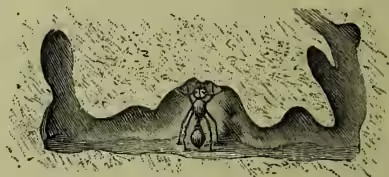
Pogonomyrmex molifaciens, the Agricultural Ant of Texas.
(From M'Cook.)
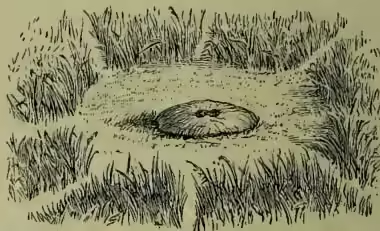
Pogonomyrmex molifaciens, the Agricultural Ant of Texas.
(From M'Cook.)
Nests.—Most ants live in chambered nests. These are of very varied construction, from simple heaps of loose material to houses of more or less elaborate architecture. Some simply utilise the shelter of a large stone, under which they burrow, while others weave a hanging silken nest; some bore into old stumps, which they riddle with their tunnels, and others form a home from leaves glued or woven together. The common yellow ant, F. flava, makes an underground nest, which looks like a little grassy mound, perforated by innumerable passages, and sometimes a foot in height. The nest of F. rufa is often twice as large, and exhibits a thatched dome, with lattice-work shutters and doors which are closed at night. In South America, the ant-hills are sometimes several feet in height, and exhibit internally a marvellously complex and orderly arrangement of chambers and galleries. The so-called 'mason-ants' use soft clay in forming the roofs and partition of their neat chambers, while the 'carpenters' hollow out their houses in trees and shrubs. F. flava forms its partition-walls of a sort of papier-mâché of sawdust, earth, and spider's web. F. smaragdina, an East Indian species, forms its nest of a thin silk-like tissue. F. bispinosa, in Cayenne, makes a felt of the down which envelops the seeds of the Bombax criba; while an East Indian species, Myrmica kirbi, forms a globular nest of a congeries of tile-like plates of cow-dung. M. nidificans, in Malabar and Malacca, forms a nest of some papery material which it fixes on a leaf; and the 'umbrella' ant of Brazil was said by Bates to thatch its large mansion (sometimes 40 yards in circumference and two feet in height) with circles of leaf 'cut with accurate precision from coffee and orange trees, which they oftentimes strip bare to carry out their bold architectural designs.' Belt has, however, noted that, in Nicaragua at least, the leaves are stored until they decay and become covered with a fungus which forms the food of the ant. Roads, tunnels, and covered ways are also frequently formed round about the nests for safe and convenient transit. Many communities, sometimes including alien lodgers, may live within the bounds of a large nest, and a single community may contain more than half a million members.
Sexes.—As has been already noted, an ant's nest contains three kinds of individuals—the crowd of workers, the short-lived males, and one or more queen-mothers. The workers are really imperfect females, and besides the queens, some species include a third form of female. Though the queens are the real mothers, Lubbock has proved that in most nests there are a few fertile workers, but their eggs, if they develop at all, seem always to produce males. It is generally supposed that the ants are able, like bees, to determine, by differences of food, &c., whether a given egg will develop into a worker or a queen. In the course of summer, when external conditions are favourable, the winged males and young queens leave the nest in a marriage-flight, during which fertilisation is effected. The columns of myriad insects, rising like smoke, and glittering in the sun, attracted attention long before they were understood.
'Each column looks like a kind of slender network, and has a tremulous undulating motion. The noise emitted by myriads and myriads of these creatures does not exceed the hum of a single wasp. The slightest zephyr disperses them.' During this flight many fall victims to the elements and living enemies. It is still doubtful how the new nests are generally founded, but Lubbock has shown that an isolated queen-ant is capable of giving origin to a new community, while it appears that in other cases an old-established nest may adopt a fresh queen, secured by the workers when she falls near the nest from her marriage-flight. Several queens may reign together in one nest, and they are always treated with a loyal devotion, associated, however, with a judicious measure of control. The Rev. W. Farren White quotes the following interesting passage from Gould, who has been already referred to as one of the early students of British ants. 'In whatever apartment a queen condescends to be present, she commands obedience and respect, and a universal gladness spreads itself through the whole cell, which is expressed by particular acts of joy and exultation. They have a peculiar way of skipping, leaping, and standing up on their hind-legs and prancing with the others. These frolics they make use of both to congratulate each other when they meet, and to show their regard for the queen.' As among bees, there are a few genera of solitary ants. In these Mutillidae, the males are winged, the females wingless, and there are no workers. Four forms have been found in Britain, one of which, Mutilla europæa, inhabits the nests of humble-bees, on which it appears to be parasitic.
Division of Labour, and Polymorphism.—There is a general division of labour involved in the existence of a caste of workers separate from the males and normal females. But apart from this the workers come to discharge among themselves very different functions. The young and the old, the small and the large, are set apart for different duties. Such division of labour tends, however, to produce difference of form (or polymorphism), just as variety of occupation tends to do among men. Thus it is not surprising to find in some species several types or castes of workers. In the Saiba or umbrella ant of South America, besides males and queens, there are (a) small ordinary workers, (b) large workers with very large hairy heads, and (c) large workers with large polished heads. Bates suggests that the last two kinds are of use in war as passive butts, 'as pièces de résistance, serving as foils against onslaughts made on the main body of workers.' In other cases, certain members of the community serve as 'animated honey-pots,' with the somewhat tantalising function gravely recorded. The observations of the ancients have been verified by Hüber with his characteristic carefulness, and Thoreau gives a graphic account of some of the encounters he witnessed during his life at Walden. In some ant communities, members of other species are captured when young, and used as slaves. As these not only work and forage for their masters, but even feed them, the latter degenerate, and Polyergus rufescens is wholly dependent even for its life on its slaves. Lubbock notes how every transition is exhibited between bold marauders and enervated masters—hopeless parasites upon their slaves. Besides the association with aphides already noted, ants tolerate various insect inmates within their nests.
Relation to Plants.—While flying insects, like bees, which carry the fertilising pollen from one plant to another, have played an important part in the evolution of flowers, ants have had an influence of another kind. Visits of ants would in most cases simply mean a loss of honey without any advantage to the plant; it is therefore natural that many plants should exhibit contrivances for warding off the attacks of ants. Moats formed by leaf-cups, curved slippery surfaces, narrow or closed passages, viscid secretions, bristling hairs, &c. are all effective protections against ants. In the tropics, some species of ants do much damage by stripping off the leaves of plants, but in other cases ants may be of actual service in driving off more destructive species or other insects. The large 'bull's-horn thorns' of certain Central American species of acacia are tenanted by a species of ants (Pseudomyrma bicolor), forming 'a most efficient standing army for the plant, which not only prevents the mammalia from browsing on the leaves, but delivers it from the attacks of a more dangerous enemy—the leaf-cutting ants.' Moseley notes that in the case of two plants growing as Epiphytes (q.v.) on trees, a gall-like tumour is always formed at their base by ants, without which the plants cannot thrive.
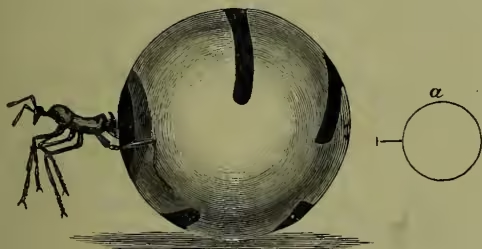
a, natural size.
(From Rev. W. Farren White.)
Intelligence.—The senses of ants are well developed. They are keenly sensitive to slight changes of temperature and light, and can both perceive rays and hear sounds for which our sense-organs are not adapted. Some forms are able to make a rasping noise by means of a structure on the abdomen, and the solitary ant, Mutilla, utters when seized a characteristic note between a buzz and a squeak. The highly developed sense of smell appears to aid them greatly in finding their way, in which, however, they are not, at the best, adepts. They are able to recognise the members of their own community even when these are intoxicated, or removed from the nest as larvæ and brought up separately. Several naturalists have shown that ants are able definitely to communicate with one another 'by something approaching to language.' The habits of ants have long formed a favourite study of naturalists, and the intimacy with which they have been studied is, doubtless to some extent, the reason of their being so often referred to. Their ceaseless industry when there is work to do has become proverbial, while many authorities have also noted an indulgence in 'sportive exercises' or 'play.' A recent observer, the Rev. W. Farren White, describes the exuberance of delight exhibited by the inmates of a formicarium when placed near the fire. 'They embraced each other, and skipped and danced like playful lambs or kittens.' Careful removal of the dead has also been observed. Their ingenuity in economising labour, e.g. in dropping desired objects from a height to others waiting below—in overcoming obstacles, e.g. by themselves forming living bridges or building more substantial inanimate ones—in the architectural devices exhibited by their manifold of 'receiving, retaining, and redistributing the honey.' Sanguinary wars between different species of ants have been observed from very early times, and the dates of certain remarkable campaigns nests, and in many other ways—has become a common subject of deserved admiration, though their marvellous powers are associated with no less striking limitations. In their recognition after separation for months, in their care for the young or disabled, as well as in their persistent enmity to competing species and communities, ants exhibit a considerable range of emotional development.
‘When we see an ant-hill, tenanted by thousands of industrious inhabitants, excavating chambers, forming tunnels, making roads, guarding their home, gathering food, feeding the young, tending their domestic animals, each one fulfilling its duties industriously and without confusion, it is difficult altogether to deny them the gift of reason,’ or escape the conviction ‘that their mental powers differ from those of men, not so much in kind as in degree’ (Lubbock).
See INSTINCT, INSECT, APHIDES; Lubbock’s Ants, Bees, and Wasps (Internat. Sc. Series, 1882), to which valuable work, as well as to personal revision by its author, this article is very largely indebted; Rev. W. Farren White’s Ants and Their Ways, with a useful list of British ants; McCook’s Agricultural Ant of Texas (1880); Bates’s Naturalist on the Amazon; Belt’s Naturalist in Nicaragua; and the abundant literature referred to in the works of the first two.