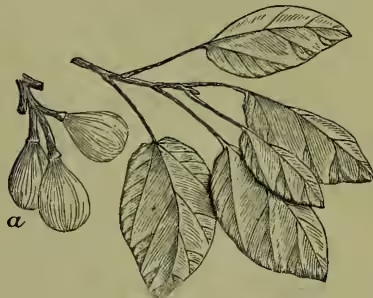
a, fruit.
Sycamore (Sycomorhus), a genus of trees of the natural order Moraceæ, regarded by many botanists as a mere sub-genus of Ficus (see FIG), and differing from the true figs only in the elongated, straight, thickened, and club-shaped stigma. The species are chiefly African, but the geographical range extends also into the west of Asia. Some of them attain a large size and a great age. The Egyptian Sycamore (Ficus Sycomorhus), supposed to be the sycamore of the Bible, is a large tree, abundant in Egypt and in Syria and other parts of the west of Asia, often planted near villages for the sake of its shade, its wide-spreading head sometimes covering a space 40 yards in diameter. The figs are top-shaped, and grow in clustered racemes on the trunk and oldest branches. They are sweet, well flavoured, and somewhat aromatic. The wood is light, porous, and of little value. Other species are found in Abyssinia, South Africa, &c.
The sycamore-tree of England is a species of Maple (q.v.), and in Scotland is usually called plane-tree (though neither plane nor sycamore). In some parts of North America the name of sycamore is given to the Plane (q.v.) of that country, Platanus occidentalis.