Telescope (Gr. tēle-skopos, 'far-seeing') usually consists essentially of a lens or mirror, to form within our reach a real image of a distant object suspended in space; and a Microscope (q.v.), to examine this image in detail. Anticipations of the telescope have been claimed for Roger Bacon (died 1294?); and Sir Richard Burton alleges that long ere this it was known to the Arabian scientists (see the supplement to his Arabian Nights). Leonard Digges, an English mathematician, very suggestively describes in his Geometrical Practise (1571) 'the marvellous conclusions that may be performed by glasses concave and convex, of circular and parabolic forms,' speaks of a separate volume (never published) describing 'the miraculous effects of perspective glasses,' and must be held to have at least anticipated the invention. Della Porta (died 1615) may have made a rude telescope. But the telescope from which all later ones proceed by lineal descent seems to be that presented to the General States of Holland on 2d October 1608 by the optician Hans Lippersheim or Lippershey of Middelburg—though possibly another optician, Zacharias Jansen, and the mathematician Adriaan Metius had also something to do with the development of this same telescope. The value of the invention was immediately realised; telescopes were being sold in Paris next year; and Galileo, hearing of the Dutchman's invention, made a telescope for himself, with which, the first night he used it (7th January 1610), he discovered three of Jupiter's moons. Kepler (1611) is the inventor of the astronomical telescope.
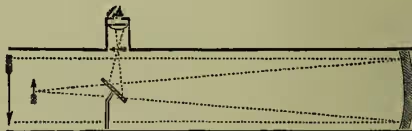
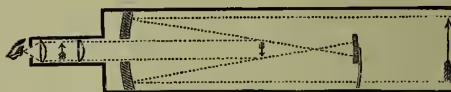
The way in which an inverted real image is formed by a lens is described under LENSES; see also MIRROR. The reason why it is necessary in a telescope to produce a real image which may itself be subjected to examination by means of a lens is the following: If a single magnifying lens, or an equivalent combination of lenses, be placed between a distant object and the eye, the image formed will not be thrown upon the retina itself, and nothing will be distinctly seen, unless indeed the eye is taken far enough back to see the minute real image itself. If, on the other hand, a real image be projected in space within our reach, a magnifying lens or combination of lenses can be made to examine that image as if it were an object, after the fashion of the Microscope (q.v.). If the eyepiece be equivalent to a single magnifying lens or simple microscope, the inverted real image will not appear to be re-inverted, and then what the eye sees on looking through the combination is an inverted magnified representation of the distant object, as in the astronomical refracting telescope; but if it be equivalent to a compound microscope, it will appear to re-invert the inverted real image under examination, and will thus furnish an uninverted representation of the object, as in the terrestrial telescope. The astronomical form is thus simpler than the terrestrial, and absorbs less light; and it is accordingly used for sailors' night-glasses. If the real image be formed by a concave mirror, a plane reflecting surface or secondary mirror may be interposed so as to turn back or turn aside the reflected rays before they have actually formed the real image, and thus to cause the real image to be produced in some place where it can conveniently be examined by a magnifying eyepiece. If the reflected rays be turned aside through 90° by a plane reflecting surface, the magnifying eyepiece will be at the side of the instrument; and then we have the Newtonian form of the astronomical reflecting telescope (fig. 1), exemplified by Lord Rosse's telescope. If the reflected rays be simply sent back along the axis of the instrument, they—or the central portion of them—may be allowed to pass through a small hole in the centre of the concave mirror, and dealt with by an eyepiece on the other side of that mirror; in which case we have the Gregorian form of the reflecting telescope (fig. 2), where the eyepiece is at the end, as in the ordinary terrestrial telescope. If the concave mirror be tilted slightly to one side it will, without loss of light due to the intervention of a second mirror, itself bring the real image towards one side of the apparatus. There it may be examined by means of an eyepiece suitably placed, directed obliquely towards the mirror; and this is the Herschelian form of the instrument (fig. 3).
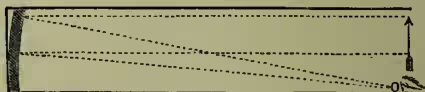
These are the three main forms of the reflecting telescope; they are subject to minor modifications, for which see works on practical astronomy.
A telescope cannot be made of invariable length, for two reasons. In the first place, for a given eye there is a fixed, most suitable distance between the eyepiece and the proper position of the real image to be examined by it. Wherever the real image happens to be formed, the eyepiece, simple or compound, must be moved into the proper relative position with regard to that real image; but the image of a nearer object is formed farther from a lens or from a concave mirror than is the image of a more distant object, for which reason the eyepiece of a telescope must be moved farther away from the objective or reflector in order to examine the image of a nearer object; and the telescope as a whole must be lengthened for nearer, or shortened for more distant objects. In the second place, the eyes of different observers may not be similar; each observer may have his own proper fixed distance between the eyepiece and the real image, according to his long-sightedness, short-sightedness, or normal vision. Consequently the distance traversed by the rays between the objective or mirror and the eyepiece is always made adjustable by sliding tubes or otherwise.
When a telescope is in 'focus' a pair of cross-fibres, placed in the focus of the eyepiece, will appear to retain a fixed position with regard to any point of the object as seen through the telescope, even though the eye of the observer be moved up and down or from side to side. This is called the parallactic method of focussing. By substituting for a given eyepiece others of different magnifying powers, the magnifying power of a telescope as a whole may be varied. The magnifying power of a telescope is the ratio between the focal length of the objective and that of the eyepiece. For suppose an object, say a chimney-stalk, 100 feet high at 10,000 feet distance, and the telescope directed towards the bottom of it, the angle subtended by the object, from the point of view of the objective-lens, at the crossing-point of the rays from the top and the bottom of the chimney-stalk, will be a little over , an angle whose tangent is . If the objective could be supposed to look backwards and to see the real image produced by it in the body of the telescope, that image would again subtend an angle of , and there would not be any magnification, for the visual angle subtended would be the same. If the image were produced at 1 foot from the crossing-point of the rays, it would have an actual length of foot or inch. But after passing through the eyepiece the rays from the virtual image of the whole object would tend to enter the eye of the observer at the same visual angle as the rays from the top and the bottom of the real image of the chimney would cross one another in their transit through the eyepiece if it were a real object there situated; and so we may look at the matter as if that crossing-point in the eyepiece were itself the organ of vision. From that point the real image of the size mentioned at say inch distance would subtend an angle of , or an angle whose tangent is , or twenty-four times the preceding. But the apparent size is proportional to the tangent of the visual angle measured with reference to the axis of the system; hence the magnification here is as 24 to 1, or as 1 foot (the focal distance between the real image and the objective) is to inch (that between the real image and the eyepiece). If in this last case the aperture of the object-glass had been the same as that of the pupil of the eye, the magnification would not have been affected; but there would have been a lack of illumination, because an equal amount of light from the same source would have been made to produce on the retina an image about twenty-four times as large linearly, or 576 times superficially.
If, however, in the case supposed, the objective be twenty-four times as great in diameter as the pupil of the eye, this is—apart from loss of light by absorption in the lenses—compensated for, and the illumination is restored. With lenses of larger diameter than is necessary to compensate the loss of illumination by magnification, the field appears brightly lit. Where there is no loss of illumination through magnification, as in the case of stars, which are too far to be magnified into appreciable discs, the increase of brightness in the objects viewed enables objects to be seen which make no impression upon the naked eye. Suppose a star to be so far as to be visible and no more; then another equal star, ten times as far, would appear to shine, under the law of inverse squares (see LIGHT), with one-hundredth the intensity of the former, and would be invisible to the eye; but if its light were collected over an area a hundred times as great as that of the pupil, and sent into the eye, the eye would again be just enabled to perceive it; and in order to secure this hundred-fold area the diameter of the objective must be ten times that of the pupil of the eye. The space-penetrating power of a telescope is therefore—assuming that there is no loss of light in the telescope itself, which is not the case—directly proportional to the diameter of the objective.
The Opera-glass (q.v.) is often described as a form of telescope under the name of Galileo's telescope; and, while it does not magnify greatly, it is very serviceable in collecting much light and brightening the field. Mr Francis Galton says (Vacation Tours in South Africa, chap. ix.) that a large opera-glass is 'one of the most perfect of night-glasses, besides being the most useful of telescopes.'
As to the unavoidable imperfections of the telescope, we find in the first place that even with a mirror, as in a reflecting telescope, where we are not annoyed by the breaking up of white light into its component colours, since the Law of Reflection (q.v.) is the same for all rays, it is impossible to form a perfectly sharp image of more than one definite point at a time. In order to do even this the mirror must be formed as part of the prolate spheroid produced by the rotation, about its longer axis, of an Ellipse (q.v.), one of whose foci is the object-point, the other the image. If the object-point be, like a star, practically at an infinite distance, the requisite form of the mirror is that formed by the rotation of a Parabola (q.v.) about its axis. The axis of the mirror must then be directed to the object-point, and all rays from it will, after reflection, pass accurately through the focus. But this is not strictly true for any other object-point in the field of view, although it is so nearly true that no inconvenience is practically found to result. But if the mirror used be part of a sphere, no point can be found such that rays diverging from it shall all be brought after reflection accurately to one point of the image; and this defect, called Spherical Aberration, increases with the surface of the mirror of any given radius; so that by increasing that surface, for the attainment of brightness, we increase proportionally the indistinctness of the image. To give an idea of the delicate manipulation required in the construction of a reflecting telescope we take the case of a speculum of 4 feet aperture and 40 feet focus, as calculated by Sir J. Herschel. If this be first ground to a truly spherical form it must have a radius of 80 feet. Now, such a mirror will give a very indistinct image, even under the most favourable circumstances; yet to grind it to the parabolic form, which is practically perfect, leaving the middle untouched, and grinding more and more away from its surface as we proceed outwards to the edges, even at the edges we have to remove a film of metal of only the part of an inch, somewhere about the th part of the thickness of the paper on which this is printed! The spherical aberration is partly compensated in Cassegrain's modification of Gregory's telescope, in which the small secondary mirror is convex.
Lenses, whether the object-lens or the eye-lens, have this defect also; but, as a rule, the most conspicuous fault of single lenses is their Chromatic Aberration, which arises from the different refrangibilities (see REFRACTION) of the various coloured rays, and leads to the formation, by a lens, of separate overlapping images of a bright object for each coloured ray. The remedy consists in achromatising (see ACHROMATISM, REFRACTION) the lens—i.e. forming it of two or more lenses of different kinds of glass, so that the colours, separated by one, shall be reunited by the others.
The curvatures of the lenses which make up the achromatic combination, and the distances between them, may be so chosen as to minimise the effects of spherical as well as of chromatic aberration. Galileo's telescope has less chromatic and spherical aberration than the common astronomical telescope, and is shorter, since the distance between the lenses is approximately the difference, not the sum, of their focal lengths.
Before the discovery of the possibility of forming an achromatic lens Huygens, Cassini, and others had endeavoured, by enormously increasing the focal length of the object-glass of the common astronomical telescope in proportion to its diameter, to get rid as far as possible of chromatic aberration.
They thus formed the aërial telescope, in which the object and eye lenses were mounted separately on stands; the tube (which would have been 100, 200, or even 600 feet long) being dispensed with. Valuable work was done with some of these telescopes, of 125 feet focus, but the longer ones proved unmanageable. The principle involved in these constructions is, practically, the throwing the magnifying power more on the object-lens than on the eye-lens; for the image formed by the former was still so imperfect as not to bear much additional magnification. The great step required for shortening the unwieldy instrument was therefore the perfecting of the object-lens, by achromatisation. Various very ingenious improvements on achromatic combinations, which might even yet be thought worthy the consideration of opticians, were devised by Dr Blair. He found solutions of mercury or antimony in hydrochloric acid to be much more refractive and more dispersive than crown-glass, while no irrationality of dispersion as compared with crown-glass could be detected in them. By means of lenses filled with these liquids he was enabled to give the telescope an aperture of one-third of its focal length without a trace of residual colour.
The process of Liebig for depositing on glass an exceedingly thin film of silver, which, by careful polishing, can be rendered more highly reflective than any other material, has been taken advantage of by Steinheil in the construction of large specula for reflecting telescopes. This is an immense step, since any disc of glass will do, its optical properties not being employed; while, if it be once brought to a true parabolic figure, the silvering may be renewed as often as may be required. One of the great difficulties in the construction and working of large reflectors has hitherto been the casting and annealing of metallic masses of some tons weight. This, in the silvered specula, is entirely avoided. We cannot here enter into a description of the processes, often extremely ingenious, which have been devised for the grinding, figuring, and polishing of lenses and specula.
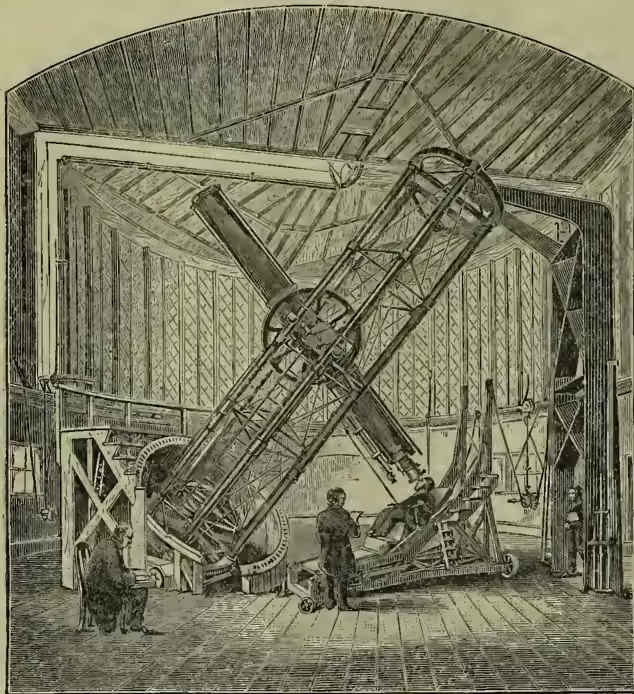
Amongst the largest reflecting telescopes are those of Lord Rosse at Birr (72 inches aperture, 1844), Mr Commons, at London (1889, 60 inches), Bessemer (50½ inches), Sir William Herschel (48 inches, 1789, long since dismantled), Melbourne (48 inches), Paris Observatory (47 inches). To the largest refracting telescopes belong those of Yerkes Observatory, Chicago (41½ inches, 1897), Lick Observatory, California (36 inches, 1880), Pulkova (30), Nice (30), Greenwich (28; see a figure here given). Among the most distinguished makers of great telescope lenses may be named Sir Howard Grubb in England and Alvan Clark in America. The making of optical glass, for which the Messrs Chance of Birmingham are famous, is described at GLASS, Vol. V. p. 244. See also EQUATORIAL, OBSERVATORY.
See an address by Sir Howard Grubb, Royal Institution, 2d April 1886; Nature, xxxiv. 85. For the subject in general, see Sir John Herschel's Telescope; and for the history, the histories of astronomy and the monograph by Servus, Geschichte des Fernrohrs (1885).