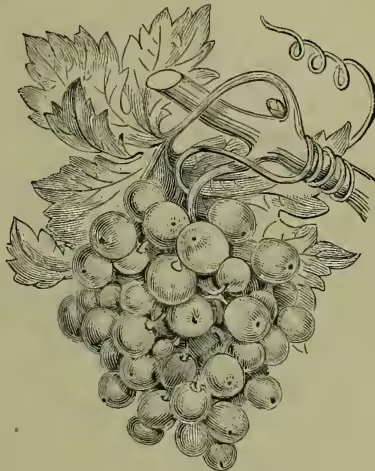
Vine, the Vitis of the botanist, is a genus of which there are a number of species; they are found over a wide range of the northern hemisphere, the majority in temperate Asia, as well as in North America, but none are found in Europe. The genus belongs to the Vitæa section of the order Vitaceæ (q.v.). It has pentamerous flowers (five-toothed, five petals, and five stamens); the petals are attached to the discs at the base of the ovary, but, contrary to general rule, they adhere at the top and form a cap, which is thrown off by the stamens as they elongate and expand; the latter adhere for a time to the base of the fruit. All the species are furnished with clasps by which to lay hold for their support on any object within their reach. Some have leaves greatly lobed, others have them nearly plain.
The Vitis vinifera, the European wine-yielding grape-vine, is that which has greatest economic and commercial importance. It is found on the shores of the Caspian Sea, and it grows wild throughout the lower Caucasus and in Armenia. The cultivation of this plant has occupied much of man's time and attention in all nations that have attained to any degree of civilisation, from the very dawn of history, and it is spreading more rapidly at the present time than ever it did at any previous one. The endless variety of grape-vines in cultivation seems to indicate that the Vitis vinifera is not a true species, and this view is confirmed by the circumstance that seed taken from any variety of grape does not reproduce the parent, as it should do if it were an unbroken species, but one widely different, and as a rule very inferior to the parent, except in exceedingly rare instances, when a step in advance may take place. The writer has raised hundreds of vines from seeds taken from the finest grapes in cultivation, the rare exception being a variety equal or superior to the parent, and the rule being a reversion to a very inferior type; it is questionable if any of our high-class grapes are to be found in an uncultivated state in any part of the world. The plant has evidently been developed by the ingenuity of man at some very remote date, of which there is no record, just as our apples, plums, pears, peaches, and many other fruits and vegetables have been; and if man's constant care were withdrawn from their cultivation they would soon disappear from the earth, leaving it in possession of their wild progenitors.
By many Persia is thought to be the home of the grape-vine, and excellent wine is still made there and exported. In European graves of the Bronze Age (q.v.) grape stones have been found, and in Greece and Italy the culture is primeval. The culture of wine on a commercial scale is dealt with in the article WINE and in the articles on the wine-growing countries—Italy, France, Hungary, Germany, the Madeira and Canary Islands, and in later times Cape Colony, Victoria, South Australia, and the United States, especially California. In Europe now the line of open-air culture of the vine on a large scale passes from the country just north of the Loire in France through Belgium, central Germany, and Silesia; but in the middle ages wine was largely produced north of this—in North France, Holland, and in England—either because the climate was warmer, or because consumers were content with poorer wine.
The cultivation of the grape-vine was introduced into England by the Romans. At the date of the Norman Conquest there is evidence that the vine was pretty extensively cultivated in the south and south-west of England for the production of wine until about the middle of the 18th century, when for this purpose its cultivation was given up, and it was grown for dessert purposes against walls and dwelling-houses with considerable success, and continues to be so grown up to this date. For this mode of cultivation the Royal Muscadine, Sweetwater, and Black Hamburgh are amongst the most suitable. All the finer sorts of grapes, such as Frontignans, Muscats, Gros Colman, and many others of the higher classes of grapes, can only be cultivated in Britain in hothouses, and at the present date enormous quantities are so cultivated in Britain and the Channel Islands, some growers sending from 50 to 100 tons to market annually. This great supply has depressed the price of grapes by more than one-half since 1882, very much to the public benefit, for it is now recognised that for man, whether in health or sickness, there is no more wholesome or grateful food than good grapes, acting as they do favourably on every organ of the body. An attempt has been made by the Marquis of Bute to establish what may be called an open field vineyard on his Cardiff Castle estate in Wales, for the production of wine. The vineyard was planted in 1875, and 40 gallons of wine were made in 1877 and more in 1878. But in the cold wet summer of 1879 the crop was a failure, as also in 1880 on account of the wood not being ripened the year before. In 1881 the wine was of the best quality, like a first-class still champagne, and was all sold at 60 shillings a dozen: 1882 and 1883 were complete failures; but since 1884 more or less wine has been made every year, though quantity and quality vary much with the season. In 1893, 14 acres produced 40 hogsheads (in respect of quantity 70 per cent. of a full crop in Germany), which was sold for £3000; and some of this again was resold at 115 shillings a dozen.
The soil most suitable for the vine in Britain is a good calcareous, wheat soil. Turf taken from such land, stacked in narrow ridges for a winter, may be chopped down in the spring, and if clay is in excess, it should have burned clay or old lime rubbish mixed with it in the proportion of 1 to 10. The best manure for a vine border is one into which finely-ground bones, horn shavings, and other phosphatic manures enter, not forgetting potash. It is well to avoid stable manure, as that very frequently breeds fungi. On the other hand, cow manure sours the soil, and should also be avoided.
The writer, while investigating the system of vine-culture on the banks of the Rhine, found that growers there confined the cultivation to soil nearly all made up of the scoriae and debris of the rocks, and avoided soil which in England was found most suitable; but the explanation was that, while the soils in question would grow grapes well, they did not yield wine of the desired bouquet.
The vine is easily propagated in a variety of ways—by layers, by cuttings, by eyes; also by budding, inarching and grafting, as well as by raising from seed. The common method of establishing vineyards for open-air cultivation in grape-growing lands—as in California—is to trench the soil where the land is hard, and to plant young canes at distances of from 3 to 4 feet apart, and 4 to 5 feet between rows, placing a stake to each young vine for its support. In the second year fruit can be produced, though it is better for the ultimate success of the vineyard not to crop till the third. Another method—more laborious and costly, and showing in greater ultimate advantage—is to put the vine cuttings in 'nursery rows,' to let them form roots there (as with gooseberry cuttings), and then transplant. Much of the labour required for growing grapes either in the open or under glass is devoted to pruning and training the plants. Various systems of pruning are in use, for securing greater vigour in the plant, to obtain more and better fruit, to keep up a constant supply of fruit-bearing wood, and to maintain the fruit-bearing portion, not on the extreme branches only, but near the ground. Nothing can well be less like the great vines grown under glass than the ordinary vine of a French or German vineyard, the vines being kept to some 3 or 4 feet in height, so that the uninitiated thinks rather of a raspberry garden than of a vineyard. In Italy greater luxuriance is allowed, and vines are even trained on trees pruned for the purpose.
The vine is very fruitful, and would soon exhaust itself by over-production; hence the clusters have to be carefully thinned. The extent to which thinning is necessary depends on the strength and size of the plant. The berries on the clusters also usually require thinning, according to circumstances; thus a cluster of Black Hamburgh with 120 berries may with advantage be reduced to half the number. The vines most suitable for cultivation under glass for early forcing, so as to give ripe grapes in June, are the Black Hamburgh, Buckland's Sweetwater, Foster's White Seedling, and Royal Muscadine. Those who desire to have grapes of the very highest flavour should plant the Frontignans—black, white, or grizzly, the Muscat of Alexandria, Black Muscat, and Duke of Buccleuch. For a late house to yield grapes all winter and into the spring, the following sorts may be planted: Black Alicante, Gros Colman, Lady Downes, and Mrs Pince.
Of vine diseases, some are caused by insects, beetles, weevils, caterpillars and larvæ of various kinds; of these the most destructive is the Phylloxera (q.v.); of various fungoid diseases, Oidium has been most harmful.
The great Hampton Court vine, planted in 1769, fills a house 66 feet long by 30 wide, and bears annually as many as 1700 small bunches (Black Hamburgh). Nearly twice the size is the vine at Cumberland Lodge, Windsor Park, which produces a crop of 2000 bunches, averaging three-quarters of a lb. each. The Breadalbane vine in Perthshire covers a house 172 feet long by 25 broad.
At the international exhibition of the Royal Caledonian Horticultural Society in 1875 a single bunch of the Raisin de Calabria was shown, weighing 26 lb. 4 oz.; and at the same exhibition was shown a cluster of White Nice only a few ounces lighter. These are coarse varieties of grapes, it is true; but at the Belfast Exhibition in 1874 a bunch of the Black Hamburg was shown which weighed 21 lb. 12 oz., and this is a grape of high quality.
In the United States, especially California, the development of viticulture has been great and rapid. Early attempts were made to grow foreign grapes in the open air, but none of these met with success east of the Rocky Mountains. Till the Californian grape industry developed, the growing of foreign grapes in the United States was under glass, and for dessert purposes. Four native American vines (of some ten found wild) are used for wine-making, the most important being V. Lambrusca. In 1890 there were 400,000 acres under vines, three-fourths of which were producing wine, and the total produce was about 40,000,000 gallons. In California alone the acreage of vines was 150,000 acres, seven-eighths of which were devoted to wine. American vine-stocks, as being less liable to suffer from the phylloxera, have with advantage been introduced into France for grafting on. On the Murray River, in Australia, a vast extent of land is being irrigated and planted with vines, the fruit of which is being converted into raisins and wine. See VICTORIA, SOUTH AUSTRALIA.
See D. Thomson, Fruit Culture under Glass (2d ed. 1881); Barron, Vines and Vine Culture (new ed. 1887); and the present writer's Practical Treatise on the Grape Vine (1862; 10th ed. 1890). There are American works by Haraszthy (1863), Hyatt (1867), and Husmann (1880), and innumerable works in French, German, and Italian. See also WINE, and books there cited.