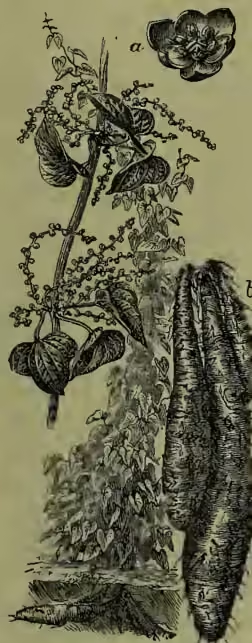
a, a flower; b, root.
Yam (Dioscorea), a genus of plants, mostly tropical, natives of the West Indies, Polynesia, China, &c. The great fleshy roots of some of them are very much used as food; they contain much starch, and generally become somewhat mealy and pleasant to the taste when boiled. This, however, is not the case with all: the roots of D. triphylla, D. dæmonum, D. virosa, and several other species with ternate leaves are very nauseous, even when boiled, and are poisonous. The tubers of all the yams contain an acrid substance, which, however, is dissipated by boiling, except in the species with compound leaves. The roots of the Winged Yam (D. alata) of Polynesia are to 3 feet long, and often 30 lb. in weight, with a brownish or black skin, juicy and reddish within; they vary exceedingly in form. The stem, which is winged, twines up tall poles. Two or three small tubers are generally found in the axils of the leaves. It is supposed that this species may be the original of most, or perhaps all, of the yams cultivated in the tropical parts of Asia, Africa, and America—as the common yam of the West Indies (D. sativa). which has a round stem and heart-shaped leaves; D. bulbifera, in which the tubers in the axils of the leaves attain the size of apples; the Prickly Yam (D. aculeata); D. globosa, the most esteemed yam of India, which has very fragrant flowers, and roots white internally; D. rubella, another Indian kind. Yams are propagated by means of their tubers; the small axillary tubers, or the small tubers produced at the base of the stem around the neck of the large tuber, being used for this purpose. A species of yam (D. batatas) brought from the temperate parts of China is found to succeed well in France. It is hardly enough to endure the climate even of Scotland without injury; but the heat of the summer is not sufficiently great, so that, in general, the plant merely lives, without producing a large tuber. The stem requires the support of a pole, round which it twines; the leaves are more elongated and acuminate than those of the West Indian yams; the root strikes perpendicularly down into the ground, and forms its tuber often at a very considerable depth; this may be prevented by putting a slate under it. The true yam is little cultivated in the United States, where the name is often given to the Sweet Potato (q.v.). See also COCCO.