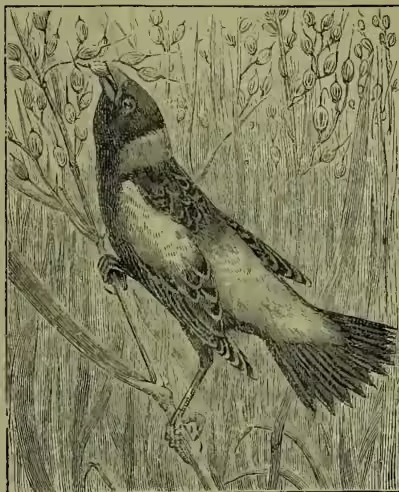
Bob-o-link, or BOBLINK, REED BIRD, or RICE BIRD (Dolichonyx oryzivorus or Icterus acripennis), a common American bird found from Paraguay to Canada, the only one of its kind, and that difficult to classify. Some place it near the Baltimore bird (Icterus), others near starlings, but both the characteristics and the character of the bob-o-link exhibit much that is unique. The beak is short and straight; the nostrils surrounded by a fold of skin; the wings are long, especially in their first feather; the tail-feathers are stiff-pointed. The plumage is unusually conspicuous for a ground bird. In the male the head, lower surface, and tail are black, while the upper surface is lighter, yellowish white in front, black with yellow streaks behind. The colour and the note change with the seasons and with the functions of the bird. The female is much plainer—yellowish brown with darker streaks above, and pale grayish yellow below.
The name—originally Bob Lincoln—is an imitation of the bird's note. In song, the full-throated male bob-o-link is unique, rivalling the lark, inimitable by the mocking-bird, 'in qualities of hilarity and musical tintinnabulation,' according to Burroughs (Birds and Poets), quite unequalled. His volubility borders on the burlesque. In disposition also the male is interesting; he affords the 'most marked example of exuberant pride, and a glad, rollicking, holiday spirit, that can be seen among American birds.' His love-making emotions appear to be unusually strong, as strong indeed as his Quaker mate is shy, retiring, and indifferent. The change of the male in colour and form at the breeding time is very striking. He becomes black and white more emphatically, so as sometimes to be called the 'skunk bird,' and acquires a broad form and a curious 'mincing gait.' Robert o' Lincoln becomes 'an ornithological coxcomb' of the highest order. He sings on brier and weed, or jerking up and down in the air, while his mate may be brooding in a simple nest among the grass. The bob-o-link is said to exhibit the common trick of seeking by exaggerated fuss in some other quarter to lead intruders away from the nest.
The bob-o-link is a bird of passage, spending the winter in the West Indies. In summer it is found as far north as the banks of the Saskatchewan, in 54° lat., but is most plentiful in the Atlantic states and other eastern parts of America, where it is to be seen in every meadow and cornfield. It renders good service by the destruction of insects and their larvæ; but in the South, both in April and August, at seed-time and harvest, its ravages seriously cripple the rice-growing industry, and destroy about a fourth of the crop. Thousands of men and boys are then employed to shoot the trespassers, who are killed in great numbers for the table; their flesh is delicate, and resembles that of the ortolan. On account also of their beauty and powers of song, many are caught, caged, and sold in the New York and other markets.