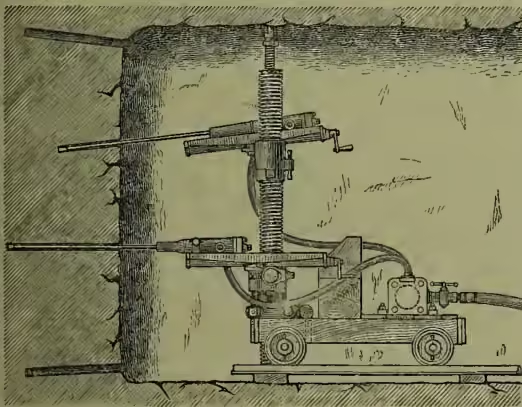
Boring-animals. While individual boring-animals are noticed under many separate articles (e.g. BARK-BEETLE, BEE, BIVALVES, BORERS, CATERPILLAR, SHIP-WORM, &c.), it may be convenient to indicate the widespread nature of the habit. Every one is familiar with the appearance of an oyster-shell on the shore riddled with small holes. This is the work of a small sponge, Clione or Vioa, one of which inhabits each hole. Other Clionids exhibit a similar power, but how the are the Barrow, Burleigh, Darlington, Ferroux, Ingersoll, and M'Kean rock-borers. Diamond-drills working in the manner described below are also used. Brandt's rotary borer is an apparatus similar in action to the diamond-drill, but with a crown of hardened steel in place of cutting diamonds. The tool is pressed against, and rotated by water-power. An apparatus similar in principle to the brace and bits of the carpenter is used with advantage in uniform rock such as slate.
The bores for deep wells of all kinds, and for discovering the mineral contents of a region, come under one category. As a preliminary operation in mining, boring is of the utmost importance for discovering the position, thickness, and dip of mineral strata or lodes, and for ascertaining the nature of the overlying deposits. Bores are made by three boring is effected is not known. The action is probably both chemical by means of secretion, and mechanical by means of spicules. Many worms not only bore in the sand and soil, but into soft organisms like sponges, or among corals and the like. Some sea-urchins, being well equipped with a protruding masticatory apparatus, seem to bore or at least to improve holes for themselves. The Crustaceans can hardly be said to bore, though they burrow very considerably, as in the case of the common crayfish. One of the Isopods, however, Limnoria terrebrans, devours the wood of harbour piles and the like, and does no little damage to such structures on northern coasts. Many insects are consummate borers both in their adult and in their larval stages. The work of the Bark and Boring Beetles (q.v.), and of the Carpenter Bee (q.v.), are good illustrations of this activity. The name bore-fly is sometimes applied to the large genus of Dipterous insects (Trypetæ) whose larvae do great damage to many plants. The most important borers, however, are the molluscs, especially such bivalves as Pholas (q.v.), Xylophaga, and Teredo. These belong to the large family Pholadidæ, which includes some four-score species, all more or less efficient borers in wood or soft stone. Of these the Ship-worm, Teredo (q.v.) is probably the most formidable. A closely allied family of Gastrochaenidæ is characterised by the same habit; Gastrochaena, Clavigella, and Aspergillum (q.v.) are the most important genera. A common bivalve on most coasts, Saxicava, is usually credited with considerable boring powers, but it seems probable that its activity has been overrated, and that it utilises old holes to a large extent. Lithodomus, belonging to the edible mussel family, is a powerful borer, and has left its marks on the well-known pillars of the Serapis temple near Naples. Many Gastropods, too, bore with their odontophores into the shells of other molluscs, into coral stocks, and the like; and any one who likes to confine snails in a paste-board box will soon have evidence of the rapidity of their boring powers. There is considerable divergence of opinion as to the exact way in which bivalve molluscs bore, but there can be little doubt that the foot rather than the shell is the chief agent.