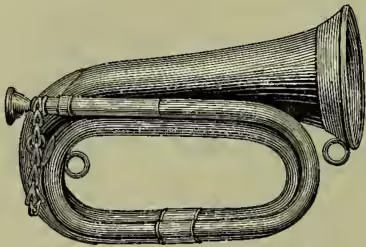
Bugle (Fr. bugle; Ger. flügelhorn; Ital. tromba), a treble musical instrument with a cup mouthpiece, usually made of copper, with strengthening pieces of brass soldered on where most exposed to wear. The bell is less expanded than the Trumpet (q.v.), and the tube is shorter and more conical. (Compare the figure with those in the articles CORNET and TRUMPET.) This form gives it that peculiar, penetrating, and far-reaching sound which renders it so admirably suited for its sole purpose—viz. a military signalling instrument. The bugle was formerly used only in the infantry branch of the service; but it has now superseded the trumpet for field duty in the cavalry and artillery branches.
It is made in the key of B♭, and its notes are the open notes of the tube—C (below the stave), G, C, E, G. It has also C, octave lower, and B♭ and C above; but the first five are the only effective notes. It is provided with two rings, to which a cord is attached for suspension to the shoulder of the bugler. See BAND (MILITARY).
The Kent bugle, a bugle with keys to provide the additional notes (see MUSIC—Musical Instruments), was at one time very popular as a leading instrument in brass bands. It was, however, difficult to play, and another modification, the valved bugle, was introduced. Both are now entirely superseded by the Cornet (q.v.) as a leading instrument, except in the purely bugle-bands of some of the rifle regiments. A valved attachment to fit on to the ordinary bugle, to enable it to be used as a band instrument, has also been invented, but little use has been made of it.
Bugle sounds or calls, as the military signals are called, are all written within the compass of the five principal notes of the bugle. They vary in character from a single note G, meaning 'right' (two Gs being 'centre,' and three 'left'), to the infantry 'reveille,' or morning call, which may be said to have some pretensions to being a musical composition, as it has five movements, a largo, allegretto, vivace, adagio, and presto. The soldiers display much ingenuity and considerable humour in adapting words to many of the calls. We append a few of the 'sounds' as specimens:
INFANTRY SOUNDS.