Cedar, or CEDAR OF LEBANON, a tree much celebrated from the most ancient times for its beauty, its magnificence, and its longevity, as well as for the excellence and durability of its timber. It is often mentioned in Scripture; it supplied the woodwork of Solomon's temple; and in the poetry of the Old Testament it is a frequent emblem of prosperity, strength, and stability. It belongs to the natural order Conifere, and is the Pinus Cedrus of the older botanists; but is now ranked in the genus Cedrus under the name of C. Libani, in reference to its best-known habitat, Mount Lebanon. It is found, however, on other mountains of Syria and Asia Minor, and also in Cyprus.
Of the celebrated Cedars of Lebanon comparatively few now remain. The principal grove, situated at the head of the Kedisha Valley at 6314 feet elevation, consists of about 375 trees, five only being of liform appearance in graduated stages from base to summit of the tree. The leaves are about an inch long, arranged in clusters, persistent for about two years, at first bright green, but changing with age to a deeper tint, with a glaucous hue, which in some individual trees increases to an almost silvery
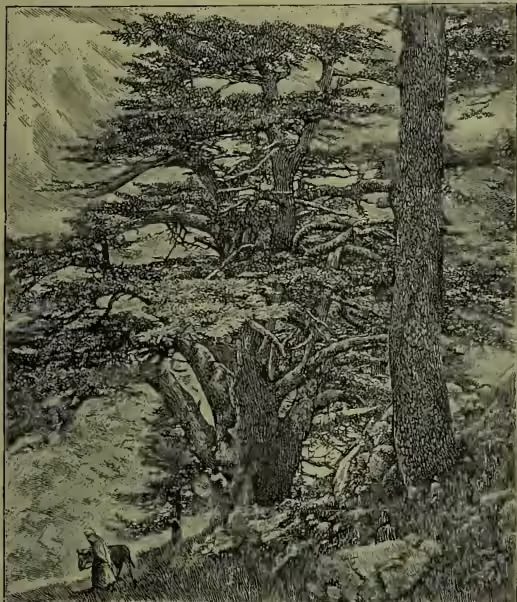
gigantic size, measuring 30 feet round. In age they may vary from 50 or 80 to 800 or 1000 years; but as they have long ceased to add regularly yearly concentric rings of wood to their trunks, there are no reliable data by which to estimate the age of the few patriarchal cedars that yet remain on the Lebanon. Arabs of all creeds have a traditional veneration for these trees; and Maronites, Greeks, and Armenians annually celebrate mass on a homely altar of stone at their feet.
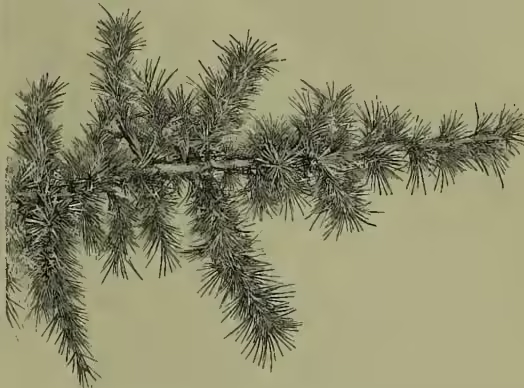
The general aspect of the cedar is distinct and majestic in fully developed trees. The trunk is massive, but attains only a moderate height—50 to 80 feet—much branched; the branches assume the proportions of timber, are horizontal, and spreading usually so as to exceed the total height. They are arranged in apparent whorls, or stages, and the branchlets springing from them in a flat fan-like fashion in great profusion and density impart a tabu- liform appearance in graduated stages from base to summit of the tree. The leaves are about an inch long, arranged in clusters, persistent for about two years, at first bright green, but changing with age to a deeper tint, with a glaucous hue, which in some individual trees increases to an almost silvery whiteness that gives to them a strikingly venerable aspect. The cones are erect on the upper sides of the branches, from 3 to 5 inches long and 2 to 2½ inches broad, blunt at both ends. They require two years to reach maturity, and do not, as in the case of other allied conifers, drop from the branches, but when ripe the scales only along with the seeds drop to the ground, and leave the axis of the cone attached to the branch.
The timber of the Lebanon cedar enjoyed a high reputation for durability in ancient times, which, however, is hardly supported by modern experience. The wood of trees that have been grown in Britain and other parts of Europe has proved light, soft, brittle, liable to warp, and far from durable, probably owing to the immaturity of these comparatively young, though well-developed, samples, and also perhaps to climatic influence. The superior quality of the timber of the Lebanon trees is attested by Sir Joseph Hooker, who visited the famous cedar grove in 1860.
The secretions of the cedar of Lebanon have long been celebrated for remarkable properties. The whitish resin (Cedria) which it exudes, it is said the Egyptians used in embalming their dead. Ancient writings were kept in cabinets or boxes of cedar-wood, but it would appear to be rather dangerous to commit modern printed documents to such repositories. Mr Smee, in My Garden, says: 'The wood of the cedar contains a volatile essential oil, which has the curious property of unsettling printers' ink and making it run. Some years ago a Bank of England note was offered to the cashier with its printing disturbed. Inquiry was set on foot, and it was traced to several individuals, who satisfactorily explained its custody and possession. It was then brought to me, when I suggested that the detectives should inquire whether it had been kept in a cedar box; it was then discovered that the last possessor had kept it in a new cedar box which she had recently bought, and thus the mystery was solved.' In very ancient times, cedar-oil, a kind of turpentine, was prepared from the wood, and was spread on books in order to their better preservation. The branches of the cedar, like those of the larch in warm countries, exude a sweet substance, which is known by the name of Cedar Manna.
The botanist Belon brought a Lebanon cedar with him to France in 1549: when it was intro- duced into Britain is not exactly known. The distinction of introducing it is ascribed with most evidence of accuracy to Evelyn, who in his Sylva (published 1664) mentions having 'received cones and seeds from the mountains of Libanus,' while describing the beauties of the tree and speaking of its probable adaptability to the English climate. Aiton in Hortus Kewensis makes 1683 the date of planting the celebrated Chelsea cedars, which are assumed by some to have been the first trees planted in England. There are many fine specimens of the Lebanon cedar in different parts of Britain, notably at Sion House, Goodwood, and Enfield in England, and at Hopetoun, Dalkeith, and Beaufort in Scotland.
The Deodar, or Himalayan Cedar (Cedrus Deodara), a tree held in great veneration by the Hindus, and of which the name is properly Devadara ('divine tree'), is common in the Himalaya mountains at elevations of 7000 to 12,000 feet, forming magnificent forests, and attaining a great size, a height sometimes of 150 feet, with a trunk 30 feet or more in circumference, an ample head, and spreading branches. It and the cedar of Algiers (C. Atlantica or Africana), found in the mountainous regions of the north of Africa, are but sub-species or varieties of the Cedrus Libani. The wood of the deodar is resinous, fragrant, compact, and very durable. It is susceptible of a high polish, and in its polished state has been compared to brown agate. Owing to the abundance of resin, laths of it burn like candles. Its turpentine is very fluid, and although coarse, is much used in India for medical purposes; and tar and pitch are obtained from the trunk. The deodar has now become very common as an ornamental tree in Britain, although few specimens have yet attained a very considerable size.—The name cedar is often given to other coniferous trees besides the true cedars. Thus, the Siberian Stone Pine, or Cembra Pine, is called the Siberian Cedar (see PINE), and a species of fir (Abies religiosa) is the Red Cedar of California (see FIR). A species of Cypress (q.v.) is known as White Cedar, and another as the Cedar of Goa. Several of the trees which bear the name cedar are species of Juniper (q.v.), among which are the Virginian Cedar, or Red Cedar of North America, and the Bermuda Cedar—which yield the cedar-wood used for pencils—the Spanish Cedar of the south of Europe, &c. The name cedar is even given to trees which have no resemblance to the true cedars except in the resinous quality of the wood; thus the Cedar-wood of Guiana is produced by Icica altissima, a tree of the natural order Amyridaceæ (q.v.); the cedar of the West Indies (see next article) belongs to the natural order Cedrelaceæ; and the name Bastard Cedar is given in India to a tree of the natural order Byttneriaceæ (q.v.).