Crustacea. a large and important class of Arthropod animals, including crabs, lobsters, shrimps, sand-hoppers, wood-lice, water-fleas, barnacles, acorn-shells, &c. The class contains such variety of structure that general characters are hard to find. They are almost all aquatic, but a few (e.g. wood-lice and land-crabs) are terrestrial. The majority are marine, but great numbers inhabit fresh water. The form of the body is very variable, as may be seen by contrasting crab and barnacle. A head with five pairs of appendages, a limb-bearing thorax more or less united to the former, and a segmented abdomen with or without limbs, are very generally distinguishable. The segmentation is never developed in the Ostracod water-fleas, and is often lost in degenerate forms. By the development of shields (Apus), bivalve shells (water-fleas), and mantles (Cirripedes), the real form is often obscured. As to appendages, the head usually bears two pairs of antennæ, a pair of mandibles, and two pairs of maxillæ; the thorax is always limb-bearing except in utter degeneracy; and the abdomen of the majority also carries appendages. The typical form of limb, on which so many changes are rung, consists of a basal piece and two more or less jointed forks. The cuticle varies greatly in degree of firmness, but is always chitinous (see CHITIN) and often much calcified. Glands open on various parts of the surface, and may be of use for preliminary digestion, for egg-attachment, for mooring the animal, &c. The colouring of the body is often very brilliant and beautiful (see PIGMENT). It is sometimes like that of the surroundings, and is occasionally associated with sexuality. The power of colour-change is also not uncommon. Sapphirina is said to rival the humming-bird in its splendour. While the nervous system in general retains the Arthropod characteristics, the ventral ganglia are often concentrated (as in crabs). The majority possess compound eyes, which in one large division are stalked. Eyes are absent in some subterranean forms, and are lost during the development of Cirripedia (q.v.) and many parasites. In the Euphausidæ there are very numerous eye-like structures or luminous organs over the body. Smelling hairs usually occur on the first antennæ, and auditory hairs have been frequently observed, usually more or less enclosed in sacs. The alimentary system, which consists of fore, mid, and hind gut, is usually simple, except as regards the hard masticating parts often developed on the cuticle of the anterior portion. In some parasitic forms the entire system degenerates. The body-cavity is usually a good deal filled up by the muscles and viscera; it contains the blood-fluid, which is occasionally faintly coloured with hæmoglobin, tetronerythrin, and other pigments, and includes amoeboid elements. A heart is usually present in the thoracic region, and is often enclosed in a special part of the body-cavity—the pericardium. In higher forms the blood passes by distinct arteries to the bodies, is gathered up in venous spaces and sinuses, is purified in the gills, and returns to the pericardial sac and heart. The respiratory system is typically represented by distinct gills variously attached; in many cases water flows in and out at the anus, and probably effects an anal respiration; in many lower forms the blood is simply purified by being exposed under the skin. The excretory system is never very marked. The green glands of higher forms, the shell-glands of Phyllopods and Copepods, and certain other structures, are excretory. The reproductive system presents many variations. The sexes are usually separate, but most Cirripedes are hermaphrodite. 'In the Cymothoidæ (Isopoda) the sexual organ of the young animal is male—of the old, female—in function.' The glands are usually thoracic, and the ducts double. Some of the appendages are often modified for copulation or egg-retaining. The spermatozoa are peculiar in being usually non-motile. The eggs are in most cases carried about by the female, but are occasionally laid on water-plants, &c., or in the water. According to Bates, Podocerus capillatus builds a nest of interlaced seaweed. Parthenogenesis (q.v.) has been observed in some of the lower forms. 'Complemental' males occur among the hermaphrodite Barnacles and Acorn-shells (q.v.).
Life-history.—The development of Crustaceans is usually indirect—that is to say, the newly- hatched young is unlike, often very unlike, its parent. Even when there is no metamorphosis after hatching, traces of transformation, as opposed to continuous development, are sometimes to be detected in the earlier history while the embryo is still within the egg-case. (a) The crayfish (Astacus) has a very much abbreviated life-history, for the newly-hatched form is almost quite like the adult. (b) The newly-hatched lobster (Homarus), however, begins life a little further back, in what is known as the Mysis stage, in which the thorax bears two-branched swimming appendages. (c) Most other higher Crustaceans (e.g. crabs) begin at a still lower level, in what is called the Zoæa stage, with a short unjointed thorax and a segmented abdomen without limbs. (d) The
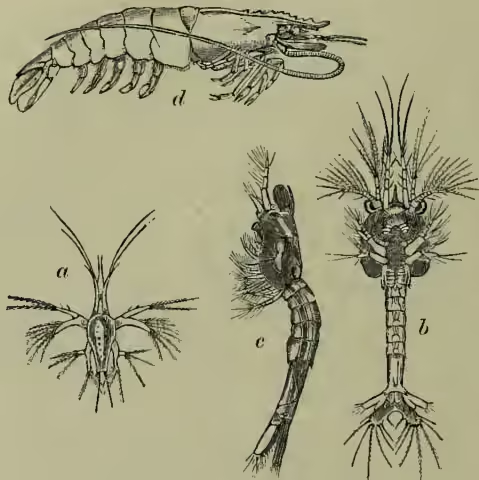
a, Nauplius; b, Zoæa; c, Mysis; d, adult.
Decapod Peneus, a shrimp-like creature, has its life-history still more drawn out. It quits the egg as a Nauplius, an unsegmented larva with three pairs of appendages, the first unforked, the other two pairs double-branched. These correspond to the first three appendages of the adult. The median eye is also a distinctive feature in the Nauplius larva. The Peneus Nauplius has with successive moulds first to become a Zoæa, and then a Mysis, and then an adult. It is as a Nauplius that the majority of lower Crustaceans leave the egg, but then they do not climb so high. To understand the circuitous life-history of a form like Peneus, we have to note that it begins in the Nauplius stage, at the level of the lowest Crustaceans, and gradually climbs through a series of higher and higher stages, each of which is represented permanently by some division of Crustaceans which have not risen higher. If the various grades from Nauplius up to Decapod adult represent successive historic levels, now exemplified in the classification of Crustaceans by those which were left behind at each lift, what the Peneus does is to recapitulate in its individual life-history the historic evolution of the class. This idea has been beautifully applied to Crustaceans in Fritz Müller's Facts for Darwin. The various grades of Nauplius, Zoæa, Mysis, and adult Peneus (overlooking intermediate ones) may be compared to stations which mark the gradual extension of the Crustacean line of advance. Peneus has to travel along the rails laid down by the ancestral history, and has to stop for variable periods at the successive stations between the starting-point and the terminus. Crabs skip over the Nauplius station, and like most other Decapods start at the Zoæa point; lobsters abbreviate still further, and begin as Mysis forms; the crayfish has found the shortest cut of all. Some of the lower Crustaceans never get far past the Nauplius stage, while others remain practically on the Zoæa grade. The life-histories of Crustaceans vividly illustrate how the individual life-history is a rehearsal of the historic evolution of the kind, or more technically, how ontogeny recapitulates phylogeny.
Habit of Life.—The acorn-shells fastened to the rocks, wafting in their food by their curled feet; the barnacles moored to floating logs and ship-bottoms; such extremes of parasitism as are illustrated by Sacculina on hermit-crabs; the hermit-crabs themselves, stealing the shells of Gasteropods, or entering into partnership with sea-anemones; the thousand minute and active water-fleas; the wood-lice, quite terrestrial; the brine-shrimps in the salt-pools; the fresh-water crayfish; the giant marine lobsters; the land-crabs, habituated to inland life, sufficiently suggest how varied are the habits of Crustaceans. Some Crustaceans form masking shelters for themselves out of Tunicates, or get covered over by a concealing growth of seaweed, sponge, hydroids, &c. A few forms are known to make a stridulating noise. The general intelligence of the class is probably considerable (see CRAB). On the whole the members of this class are active animals, but on each side of the medium activity of the majority there are extremes. Thus, not a few active marine forms are phosphorescent, while parasitism (to the extent of some 700 species) occurs in most of the subdivisions. Many of the parasites are very striking in the contrast between the free-swimming young and the ne plus ultra of degeneracy in the adults (see DEGENERATION, PARASITISM). Some of the interesting cases of Commensalism (q.v.) have been referred to under that title; while some of the external parasites show in the castration, &c. which they effect on their hosts, how real in such cases is the direct influence of the animate Environment (q.v.). The diet of Crustaceans is very varied; the majority are carnivorous and aggressive; many feed on dead creatures and organic debris in the water; others depend largely upon plants. They often lose limbs in fighting or otherwise, and have the power of replacing what they have lost.
Classification (after Claus).—(A) Entomostraca. Lower forms, small, simple, with variable number of rings and appendages, with not more than three appendages concerned in mastication, usually leaving the egg as a nauplius. (1) Phyllopoda: (a) Branchiopoda—e.g. Brine-shrimps (q.v.), Apus, Estheria, &c.; (b) Cladocera—the common 'water-flea' Daphnia, Moina, &c. (2) Ostracoda—common Cypris (q.v.), Cypridina. (3) Copepoda—common Cyclops (q.v.), Lernæa, &c. (4) Cirripedia—Acorn-shells, Barnacles (q.v.), Sacculina, &c.—(B) Malacostraca. Higher, larger forms, with nineteen segments, with more than three appendages concerned in mastication, usually quitting the egg at a higher level than the Nauplius: (1) Leptostraca, Nebalia, a primitive form with bivalve shell; (2) Arthrostraca, with free thorax, and no cephalothoracic shield, eyes sessile: (a) Amphipoda—Sand-hoppers (q.v.), Caprella, &c.; (b) Isopoda—Wood-lice (q.v.), Asellus, Tanais, &c. (3) Thoracostraca, with all or part of thorax fused to head, and with a cephalothoracic shield, eyes mostly stalked: (a) Cumacea, sessile-eyed—Cuma; (b) Stomatopoda, with gills on abdominal feet—Squilla; (c) Podophthalmata, with stalked eyes and large shield: (i) Schizopoda, with eight pairs of double thoracic feet—Mysis; (ii) Decapoda, with thorax fused to head, and last five thoracic feet not double; long-tailed
(Macrura)—e.g. Crayfish (q.v.), Lobster; short-tailed (Brachyura), Crabs.
Distribution in Space and Time.—(a) Deep-sea forms are very abundant, and often remarkable 'for their colossal size, their bizarre forms, and brilliant red colouring.' Blind species are known to occur in the depths, and others are brilliantly phosphorescent. (b) Pelagic surface Crustaceans (especially Schizopods and Entomostraca) are very abundant, and often form a large part of the food of fishes. They are often beautifully transparent, and hardly to be seen in the water. Less frequently they are brilliantly coloured (as in Sapphirina) or phosphorescent. Some of them are remarkable for their large eyes. One Amphipod Crustacean presents a curious mimicry of a Medusoid form. Decapods are most abundant in the warmer waters. (c) Crustaceans form an important part of the relatively sparse and uniform fauna of lakes. They occur both on the surface and at the bottom, the latter being generally more sluggish. The surface forms, at any rate, are usually perfectly transparent, with the exception of the eye. (d) The catalogue of terrestrial Crustaceans, which includes species of Amphipods, Isopods, and Decapods, is relatively a very short one.
The Crustacea date back to Cambrian times, but the highest forms (Decapods) were not firmly established till the Tertiary period. Some 800 fossil species, as against over 5000 living forms, are known. Some of the genera—e.g. Estheria—from the Devonian, are marvelously persistent, and survive from ancient epochs as still very successful and widely distributed forms. The Trilobites (q.v.) are not now regarded as true Crustaceans. (For distribution, see Heilprin, Inter. Sc. Series, 1887.)
Pedigree.—It is usually believed that Crustacea are descended from a primitive Phyllopod-like ancestor, and this from a segmented worm-type. The very constant occurrence of a Nauplius larva has led zoologists to regard it as representing a remote ancestor. The lines of differentiation chiefly consisted in the development and manifold modification of the fundamentally similar appendages, and in the perfecting of the exoskeleton as a base for muscular attachment. (See Herdman's Classification of Animals, Lond. 1885.)
Economic Importance.—Crabs, lobsters, crayfish, shrimps, prawns, &c. form part of our food-supply. Others are indirectly useful as important parts of the food of herrings and other fishes. Many are doubtless useful in purifying the water from organic debris, while others are the hosts of important parasites—e.g. the Cyclops species, which contains Dracunculus medinensis.
See ACORN-SHELLS, BARNACLE, BRINE-SHRIMP, CIRRI-PEDIA, COPEPODA, CRAB, CRAYFISH, CYPRIS, CYCLOPS, LOBSTER, PRAWN, SHRIMP, WATER FLEA, &c.; also COMMENSALISM, PARASITISM, PARTHENOGENESIS, &c., and references under above articles. For further details, consult general text-books of Brooks (Boston, 1882), Claus, Gegenbaur, Huxley, Rolleston and Hatchett Jackson; also Baird, British Entomostraca (Ray Soc. 1850); Balfour's Embryology; Bell, British Stalk-eyed Crustacea (Lond. 1856); Challenger Reports (several); Claus, Genealogy of Crustacea (1876); Dana, Crustacea of U.S. Exploring Expedition (Phila. 1852); Gerstaecker in Bronn's Thierreich; Huxley's Crayfish (1881); Milne-Edwards, Histoire Naturelle des Crustacés (Paris, 1834-40); the Monographs of the Naples Station (several); F. Müller, Facts for Darwin (1869); Sars, Fresh-water Crustacea of Norway (Christiania, 1867); Spence Bate and Westwood, British Sessile-eyed Crustacea (1863-68); Stebbing, A History of Crustacea (1893).