Egypt, a country in North-east Africa, extending from the Mediterranean to the first cataract of the Nile at Assouân, from 24° 6' to 31° 36' N. lat. The name is derived from the Greek Aigyptos, perhaps a transliteration of Hakeptah, 'the city of Ptah'—i.e. Memphis, or formed from the Sanskrit root gup, 'to guard,' as águpta, 'guarded about.' In Hieroglyphics and Coptic, it was called Kemi
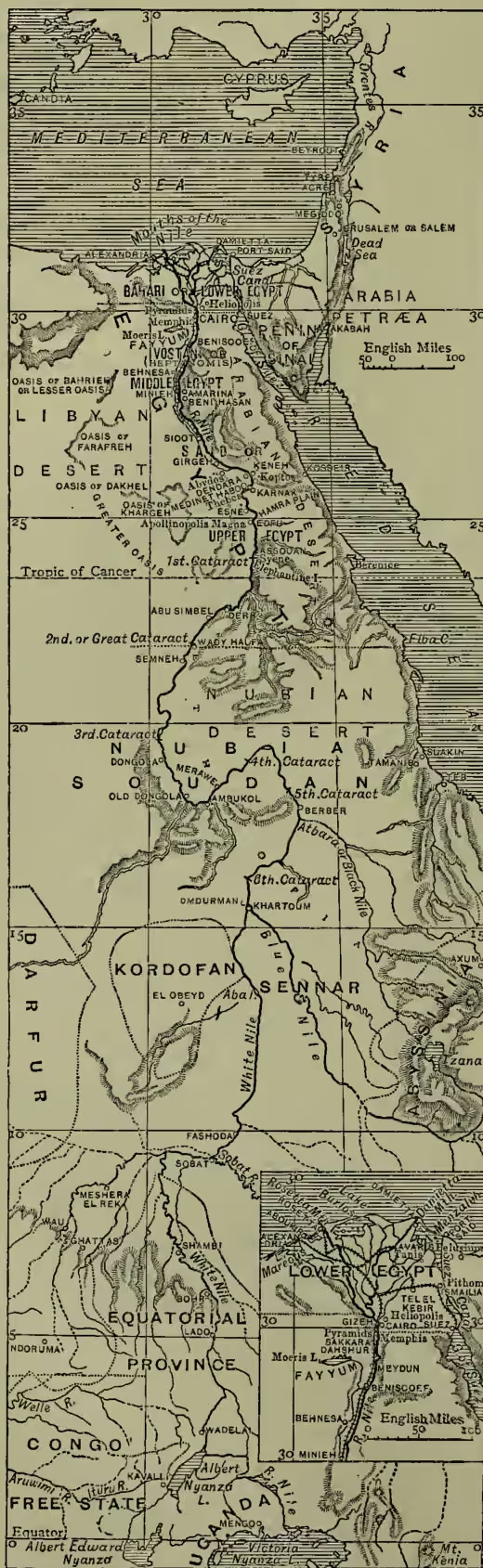
(Black Land), from the colour of the soil; and by the Hebrews Mazor, 'guarded' or 'fortified' (in the singular—i.e. Lower Egypt), or Mizraim (in the dual—i.e. Upper and Lower Egypt, but also used as a singular), modified by the Assyrians into Musr, and by the Persians into Mudraya. The name is still preserved in the Arabic Misr (vulgarly Masr), a word applied alike to the country and its capital, Cairo. Egypt is literally, what Herodotus termed it, 'the gift of the Nile,' dōron tou potamou; for it extends only so far as the annual inundation of the river spreads its layer of alluvial sediment, brought down from the washing of the Abyssinian mountains, turning the barren rock into cultivable soil, and then retreating to its normal limits, leaving the rich deposit to the influences of sun and air and human labour. Geologically and ethnologically, Egypt is confined to the bed of the flooded Nile, a groove worn by water in the desert; and the bordering deserts and the southern provinces of Nubia, Khartoum and the rest, towards the equator form no part of the Egypt of nature or of history, though from time to time they have been politically joined to it. Thus limited, Egypt occupies little more than 11,000 sq. m., or about a third of the area of Ireland.
The Nile after breaking through the rocky barrier at Assouân, pursues a northerly course, varied by only one considerable bend near Thebes, until, a few miles north of Cairo ( lat.), it divides into two main streams, terminating in the Rosetta and Damietta mouths, through which, after a course of 3300 miles, it pours during 'high Nile' some seven hundred thousand million cubic metres daily into the Mediterranean Sea. The other five mouths which existed in antiquity have silted up; and the triangular or -shaped district inclosed by them, and supposed by the ancients to have been recovered from the sea, formed the Delta, now called Lower Egypt. The basin of the Nile is bounded by the smooth rounded ranges of the Arabian hills (which, like the so-called Arabian desert, are not in the Arabian peninsula, but in Egypt, between the Nile and the Red Sea) on the east, and the Libyan on the west, neither rising as a rule higher than 300 feet above the sea-level, though in rare cases, as near Thebes, the eastern hills attain an altitude of 1200. The general appearance of the valley is thus described: 'In the centre the brown-toned river, turning reddish when swollen by the rains of the inundation; higher up on either side, but chiefly on the western, the bright green fields of waving corn, or beans, or lupin; then a border, still higher, of dusky barren rock; and then the slopes of the deserts—the long red and yellow and gray ridges of sand and limestone rock, generally low and tame in outline, and lying at some distance back from the river, but sometimes closing even to the very bank in bold headlands, scored by torrent-beds where water rarely flows, and then shearing away to the distance of several miles, and leaving a wide level plain of cultivable land' (Lane-Poole, Egypt). One great physical peculiarity of Egypt is the general absence of rain; occasional showers have indeed become more frequent of late years, but the land still depends for irrigation upon the annual overflow of the Nile. The climate is remarkably mild, especially south of the Delta and in the desert; from Cairo to Alexandria the air contains more moisture and is less salubrious, while the Mediterranean coast is subject to rain, and infected by the belt of salt-marshes. Everything in the Egyptian climate proceeds with regularity, even the winds. From June till February cool northerly winds prevail, the Etesian breezes that waft the traveller's dahabiya up the Nile; then till June comes a period of easterly, or, still worse, hot southerly sand-winds called the Khamâsin, or 'Fifties' (as blowing fifty days).
The simoom is a violent sand-wind, commoner in the desert than in the valley, but rare anywhere. Earthquakes are occasionally felt; and the temperature in winter in the shade averages to F., and in the heat of summer to in Lower Egypt, higher in the upper valley. The most remarkable phenomenon is the regular increase of the Nile, fed by the fall of the tropical rains, which commence in N. lat. in the spring, and falling first into the White, and then into the Blue Nile, reach Egypt in the middle, and the Delta at the end, of June. In the middle of July the red water appears, and the rise may be dated from that time; it attains its maximum (an average rise of 36 feet at Thebes, of 25 at Cairo) at the end of September, and begins to decline visibly in the middle of October, loses half its height by January, and subsides to its minimum in April. By the end of November, the irrigated land, over which the water has been carefully equalised by drains and embankments, has dried and is sown; soon it is covered with green crops, which are reaped in March. The state of the Nile, in fact, marks the season more accurately than the variation of temperature. Except in the dry air of the valley and desert, Egypt is by no means remarkably healthy; in addition to occasional visitations of plague and cholera, ophthalmia, diarrhoea, dysentery, and boils prevail, and European and even Nigritic races are with difficulty acclimatised. With prudent modifications of our modes of life, however, English people, even young children, thrive well in most parts, and for certain classes of invalids, for instance consumptives, the desert air is wonderfully recuperative.
Geology.—Egypt is separated from Nubia by a low hilly region about 50 miles broad from north to south, composed of granitic rocks. The same crystalline rocks extend up the shore of the Red Sea to near the opening of the Gulf of Suez, stretching inland for fully 30 miles. The scenery in this district is wild and rude, and the course of the Nile is frequently interrupted by cliffs and broken masses of granite, which form striking cataracts. The granitic region terminates at Assouân, the ancient Syene, whence most of the materials for the colossal monuments of Egypt were procured. The Arabian and Libyan ranges, on the right and left of the river, are alike composed of cretaceous strata, the predominant rock being sandstone, which is durable and easily worked, and was therefore extensively used in the erection of ancient temples, pyramids, and tombs. The cretaceous sandstone extends from the granitic rocks forming the first cataract at Assouân for about 85 miles to Esné, where it is covered by a limestone belonging to the upper chalk series. This continues on both sides of the valley for about 130 miles, when it is covered by a tertiary nummulite limestone, which forms the further prolongation northward of both ranges of hills. The easy disintegration of these beds renders the scenery in the limestone districts tame and monotonous; frequent tablelands occur, on one of which are built the three pyramids of Gizeh (q.v.), the material employed being the predominant limestone.
Over a large extent of Egypt these rocks are covered with moving desert sands, and in the flat lands bordering the Nile they are coated to a depth of about 30 feet (at the river's bank, thinning away towards the desert) with the alluvium brought down by its waters, which has formed the Delta at its mouth. This alluvium consists of an argillaceous earth or loam, more or less mixed with sand, and a quartzose sand probably derived from the adjacent deserts by violent winds. It is remarkable that this sedimentary deposit has no traces of stratification, and also that within short distances great variety is observed in what are apparently synchronous deposits. The increase of the deposit is estimated at about inches in a century. The rocks of Egypt afforded the stones used in its edifices and sculptures; granite, syenite, basalt (from Assouân), breccia diorite, verde antique, and fine red porphyry (from the mountains in the Arabian desert), sandstone and limestone (from the hills bordering the Nile), and alabaster (from Tell-el-Amârina). Emeralds, gold, silver, and copper, were formerly found near the Red Sea; and salt, natron, and—since 1850—sulphur are still among the mineral products of Egypt.
Natural History.—The signal peculiarity of the vegetation of the Nile Valley is the absence of woods and forests. Even clumps of trees (except palms) are rare, though some have been recently planted. The Pharaohs got their timber chiefly from the Lebanon, and modern Egypt is supplied from the forests of Asia Minor. The date and the doom palm, the sycamore, acacia, tamarisk, and willow are the commonest trees; the myrtle, elm, and cypress are rarer; the mulberry belongs to Lower Egypt. Among fruit-trees, the vine, fig, pomegranate, orange, and lemon abound; apricots, peaches, and plums are of poor flavour; Indian figs (prickly pears) and bananas have been naturalised; and water-melons are at once the meat and drink of the people in the hot days. Of flowers, the celebrated lotus, or water-lily, has supplied many ideas to Egyptian architects.
The lack of jungle or cover of any sort accounts for the poverty of the Egyptian fauna. The hyæna, jackal, wolf, fox, hare, rabbit, jerboa, lynx, ichneumon, and weasel are common enough; the antelope is the chief quarry; the wild ass and wild cat are almost extinct; and the crocodile, like the hippopotamus, scared by European rifles, is beating a retreat to the tropics. The ordinary beasts of burden are the ass and camel; the latter is always one-humped, and, like the draught buffalo and the horse, is an importation unknown to the ancient Egyptians prior to the 18th dynasty. The short-horned cattle, famous from the time of the Pharaohs, are seldom killed by the natives, and mutton is the staple butcher-meat in Egypt; goats also are common. The dog is considered unclean by Mohammedans, and is used merely as a scavenger and watch-dog. Of domestic birds, water-fowl were anciently the most numerous, and still abound; the small gallinaceous poultry we now see are probably not of older date than the Persian invasion. Pigeons have always been abundant. There are three or four varieties of vulture; eagles, falcons, hawks, and kites are common, as is also the Ibis (q.v.), conjecturally identified with the sacred ibis of which many fables have been related. The ostrich is sometimes seen in the desert. Of reptiles, besides the vanishing crocodile, lesser saurians—chamelcons and lizards—abound. The trionyx, or soft tortoise, is plentiful in the Nile. Serpents are numerous, and among these the dreaded cobra and the Cerastes (q.v.). The Nile is full of fish, generally of rather poor flavour; the best are the binny (see BARBEL), the bulty, the latus (one of the perch family), and the bayad or silurus. The Sacred Beetle (Scarabæus sacer) is one of the most remarkable insects. The scorpion's sting is sometimes fatal, and dangerous spiders (solpuga, erroneously called tarantulas by Europeans), to say nothing of minor insect pests, and locusts, remind us that the Plagues of Egypt are not merely ancient history.
Egypt is essentially an agricultural country, and in some parts, by the aid of regulated artificial irrigation, the rich alluvial deposit will bear three crops in the year. Wheat is the chief cereal; but barley, maize, durra, beans, lentils, clover, &c. are also largely grown, with very little trouble beyond the management of the water. The extensive culture of papyrus, which anciently supplied material for paper, has in modern times been superseded by that of the sugar-cane, cotton, indigo, and tobacco.
Divisions.—In ancient as in modern times Egypt was always divided into the Upper and the Lower, or the Southern and the Northern, country; and at a very early period it was further subdivided into a number of nomes, or departments, varying in different ages; forty-two was probably the usual number. A third great division, the Heptanomis, or seven nomes, preserved in the modern 'Middle Egypt' (Wustāni), was introduced at the time of the geographer Ptolemy. Each nome or department had a separate local municipal government of a nomarch or lieutenant-governor, besides governors of the cities and of the temples, scribes, judges, and other functionaries. Its limits were measured and defined by landmarks. In the 5th century A.D. Egypt was divided into Augusta Prima and Secunda on the east, and Ægyptica on the west, Arcadia (the Heptanomis), Thebais Proxima as far as Panopolis, and Thebais Supra to Philæ. Under the Mohammedans, the triple division into Misr el-Bahri (Lower Egypt), el-Wustāni (Middle), and es-Sa'id (Upper) has prevailed, but the number of subdivisions has varied; at present there are altogether thirteen provinces, of which half are in the Delta. For the divisions of the territory outside Egypt proper, annexed in 1876, and abandoned in 1885, extending as far south as the Victoria Nyanza, see SOUDAN.
The population of the country must have been large at the earliest period, as 100,000 men were employed in the construction of the Great Pyramid alone during the 4th dynasty, nearly 3600 years B.C. It has been placed at 7,000,000 under the Pharaohs, distributed in 1800 towns, which had increased to 2000 under Amasis (525 B.C.), and upwards of 3000 under the Ptolemies. In the reign of Nero it amounted to 7,800,000. The population in 1844 was 2,500,000; in 1859, 5,125,000; and in 1882, 6,817,265 in Egypt proper, or including Nubia, Dar-Fūr, and other dependencies, nearly 17,000,000. Seven-eighths of the inhabitants consist of native Mohammedans; the Copts (q.v.) are estimated at 300,000, and the rest are composed of Bedawis (Bedouins), Negroes, Abyssinians, Turks, Syrians, Greeks, Armenians, Jews, and Europeans. The dominant population appears, from the language, and from the physical conformation of the mummies, to have been of mixed origin, part Asiatic and part Nigritic; and there seems to have been an aboriginal race of copper colour, with rather thin legs, large feet, high cheek-bones, and large lips; both types are represented on the monuments. The statements of Greek writers that a system of castes prevailed in Egypt are erroneous. What they took for castes were really conditions of society, and the different classes not only intermarried, but even, as in the case of priests and soldiers, held both employments. As in all bureaucracies, the sons often obtained the same employments as their fathers.
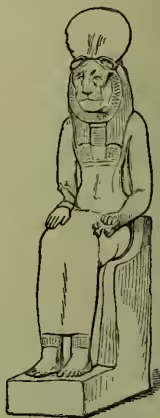
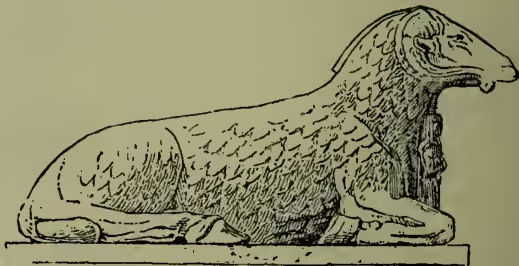
Religion.—The Egyptian religion was a philosophical pantheism, the various attributes of the Deity being divided amongst the different gods of the Pantheon. Unlike the Greek, where a god was honoured in a separate temple, each Egyptian divinity was accompanied by a put or 'company' of companion-gods. The principal nomes and cities had each a family group of gods, consisting of a parent deity, a wife and sister, and a son. Thus Ptah or Hephaestus, the eponymous and principal god of Memphis, formed a triad with the goddess Sekhet (fig. 1) or Bast, and Imhotep; at Thebes the triad was Amen-ra, Mut, and Khons; and at Apollinopolis Magna, Har-bahud (Horus), Hathor, and Har-pakhrut (Harpocrates). These triads were usually, if not always, accompanied by inferior deities completing the put; and personifications of the elements, passions, and senses were introduced. The worship of some triads, however, became universal—that of Osiris, Isis, and Horus being found all over Egypt at the earliest period. The gods, indeed, are stated by the Greeks to have been divided into three or more orders or systems. The gods of the Memphite order were Ptah, Ra, Shu, Seb, Osiris, Set or Typhon, and Horus; and Amen, Mentu, Atmu, Shu, Seb, Osiris, Set, Horus, and Sebak, according to the Theban system. Difficulties arise from the tendency to fuse different gods into one, particularly at a later period: Amen-ra, for example, being identified with Horns; and Horus, Ra, Khnum, Mentu, and Tum being merely considered the sun at different periods of his diurnal course. Very little light is thrown on the esoteric nature of the deities by the monuments, and the classical sources are untrustworthy; but the antagonism of good and evil is shown by the opposition of the solar gods and the great serpent Apap, a type of darkness, and the hostility of Osiris and Set or Typhon. Some of the gods were self-existent, others emanated from a father, and some were born of a mother only, while others were the children of greater gods. Their energies and powers differed, and their types, generally with human bodies, have often the heads of the animals which were their living emblems, instead of the human.
A few foreign deities became at the close of the 18th dynasty engrained into the religious system—as Bar, Baal; Ashtarata, Ashtaroth; Anta, Anaitis; Ken, Kiun; Reshpu, Reseph; Set, or Sutekh, sometimes identified with Baal. All the gods had human passions and affections, and their mode of action was material; they walked on earth, or sailed through ethereal space on boats. First amongst the deities comes Ptah, the opener, represented as a bow-legged dwarf or embryo, the Phœnician Pataikos, the creator of the world, the sun and moon, out of chaos (ha) or matter, to whom belong Sekhet, 'the lioness,' and Bast, Bubastis, lion-headed goddesses presiding over fire, and Nefer-Tun, his son, a god wearing a lotus on his head. Next in the cosmic order is Khnum—worshipped at Elephantine—the ram-headed god of the liquid element, who also created the matter of which the gods were made; and connected with him are the goddesses Heka the Frog, or primeval formation, Sati, or 'sunbeam,' and Anuka, alluding to the genesis of the cosmos. The Theban triad comprised Amen-ra (fig. 2), 'the hidden' power of the 'sun,' the Jupiter; Mut, the 'Mother' goddess or 'Matter,' the Juno; Nit, the 'Shuttle,' the Minerva; and Khons, 'Force' or Hercules, a lunar type. A subordinate type of Ammon is Khem or Amsu, 'the enshrined,' who, as Harnekh, or Powerful Horus, unites beginning and end, or cause and effect.
The solar system comprises Ra, the Sun, who, traversing the empyrean space of Gates, passes each hour a separate region, and, as he descends behind the west hills of the horizon, becomes Atmu, also a demiurge; while as Mentu he is the rising sun, and as Klepra, a scarab-headed god, the male creative or existent principle; and he is identified with
Amen, Khnum, and other deities. Day and night, Ra and his satellites pursue the Apap or Serpent Darkness with alternate success. The souls of the blessed come off from earth, and entering the boat of Ra, there enjoy the perpetual streams of light which emanate from his orb. From Ra or Helios spring Shu and Tefnet, Hathor and Mat. Seb or 'Time,' and Nut or the 'Firmament'—i.e. Kronos and Rhea, gave birth to Osiris, Isis, Nephthys, Set, and the elder Horus, a group of terrestrial and infernal deities. The myth of Osiris—destroyed by his wicked brother Set, and hewn in pieces, recovered by Isis, and avenged by Horus his son, embalmed by Anubis (fig. 3) and the genii of
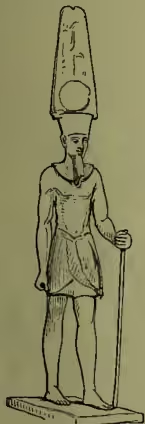
Amen-ra.
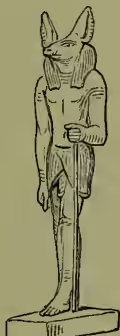
Anup or Anubis.
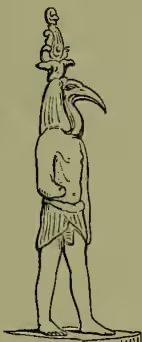
Thoth.
the dead, and defended by Thoth (fig. 4), the Egyptian Hermes, at the 'great judgment' before his accusers, Set and the conspirators—was the type of the judgment and future destiny of man, and all deceased were called by his name (see OSIRIS). Numerous inferior deities, such as Hapi, the Nile, appear either as other forms of the superior deities or local varieties of the myths. Each deity had its sacred animal, which received a local worship, and which was considered to be the 'second life' of the deity it represented. The special animal selected was installed in the adytum of the temple, and gave oracular responses. The most remarkable of these animals was the Apis bull of Memphis, whose worship had a national extension. The Egyptians believed in the transmigration of souls, and all not sufficiently pure to be admitted into the courts of the sun, or whose bodies had perished before the expiration of 3000 years (see EMBALMING), passed from body to body, having first descended to the Hades, and passed through the appointed trials and regions, endeavouring to reach the manifestation to light. In this progress, the soul was required to know and tell the names of the doors, regions, and their guardian demons through which it had to pass. The Sacred Bark (fig. 5), so frequently represented in the mural pictures, in which the mummy was ferried across the temple lake, or the Nile itself, to its tomb, was typical of that Boat of the Sun which would eventually bear the purified spirit to the Elysian fields. See TRANSMIGRATION, DEAD (BOOK OF THE).
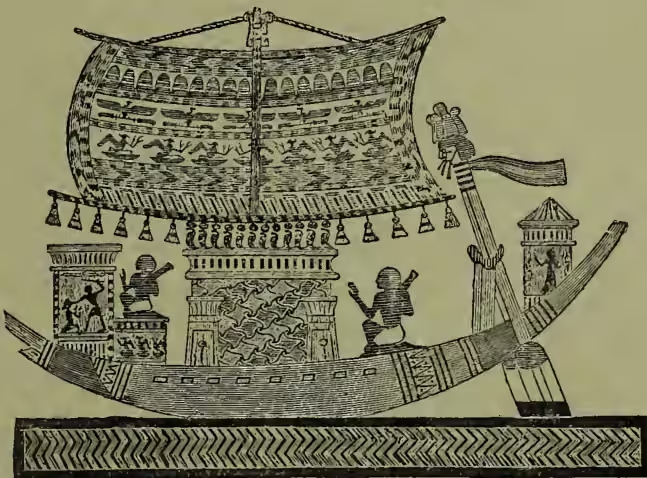
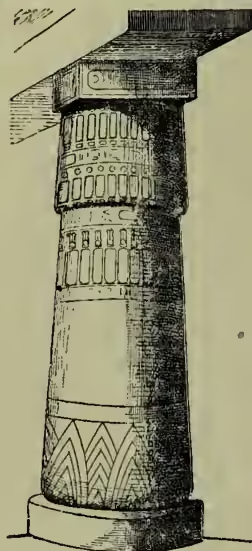
Religious Monuments.—The religious edifices of the Egyptians consist principally in tombs and temples. These are indeed the chief survivals of their marvellous architecture, for of their private houses (which were constructed almost exclusively of sun-dried brick) and military forts, &c., only the foundations as a rule remain. The Pyramids (q.v.) themselves are royal tombs, huge cairns reared to mark and to guard the sarcophagi of kings, with small temples dedicated to their shades in front. These and the smaller tombs around form the earliest class of Egyptian monuments. The next are the rock-tombs of the 11th and 12th dynasties, in which the subterranean character of the pyramid-vaults is retained in the deep well or mummy-pit; but an entrance chapel takes the place of the separate temple, and is sometimes, as at Beni-Hasan, decorated with a portico and proto-Doric columns, while the walls are adorned with pictures drawn from the daily life of the deceased, and forming a complete commentary on the manners and customs of the people. Finally, the fighting monarchs of the 18th and following dynasties of the Theban epoch effected a further change: here the temple stands to the tomb (which is excavated in the hill behind) as the entrance chapel does to the subterranean rock-tomb. Examples of this period abound at Thebes. In the Valley of the Tombs of the Kings in the Libyan Hills are the exquisitely painted grottoes of Rameses III. and others of his line, and below in the plain are the corresponding funereal or commemorative temples—the Rameseum, Amenophium, and others at Kurna and Medinet Habû. 'The Egyptian temple was not a place for congregational worship, but for priestly procession; and hence its chief characteristics are aisles and portals. Inside the great square crude brick wall, which surrounded everything, except perhaps the sacred lake over which the dead were ferried, an avenue of sphinxes—lions with men's or rams' heads—leads up to the first propylon, a gateway flanked by two tapered square towers, and often a couple of obelisks or colossal statues in front, or royal figures seated against the façade of the towers. Within this gateway is the great open court (peristyle), with colonnades of the peculiar Egyptian columns, with capitals of papyrus buds or flowers, and shafts sometimes tapered at the base and tied near the top like a bundle of reeds, or guarded in front by the standing figure of Osiris. Behind this court is the hypostyle or large hall of assembly, with a roof supported by a forest of columns; and between the two courts is a towered portal, and perhaps obelisks or statues. Finally, behind the second hall, separated sometimes by a vestibule, is the adytum or sanctuary, where the emblem of the god is kept in a mysterious darkness, penetrated only by the priests whose vestries and treasuries adjoin the holy of holies. The whole of the temple—walls, columns, roofs, gateways—is covered with sculptures and paintings representing the great achievements of the king who built the temple, and various acts of adoration performed by him in honour of the gods.
‘The great temple of Karnak at Thebes has a first propylon of a width of 360 feet, giving access to an open court, 329 by 275 feet, with columns on either side, and a double row in the middle to guide the procession. Another great portal admits to the hall of columns or hypostyle, the most magnificent work of its kind in Egypt. It is 170 feet long and 329 wide, and its ruined roof is upheld by 134 columns, 12 of them 62 feet high and 12 feet across, forming a great central aisle, and the rest 42 feet high and 9 thick. It was the work of Seti I. and his son Rameses II., and on its outside walls the sculptures tell the glorious history of these two warrior kings, how they fought against the Hittites, and the Ruten, and the Arabs, and the Syrians, and the people of Armenia, and charged them in their mighty chariots, and put them to flight, and took from them their strong cities. The battle scenes are vigorously drawn.’—Lane-Poole, Egypt. Karnak is a mass of ruins, however; some of its obelisks are fallen, and one from the neigh- bouring Luxor has been transplanted to Paris, just as one of the obelisks from Heliopolis was removed by Cleopatra to Alexandria, whence it has now changed its site to the Thames Embankment, while another has gone to New York. To see an almost perfect Egyptian temple, though of much later date, Edfu (q.v.) must be visited.
Ancient Civilisation.—When first the Egyptians appear on the page of history they are already possessed of a marvellously advanced civilisation, which presupposes thousands of years of development, even before the remote period, nearly 4000 B.C., when the pyramid builders reigned (for dates compare the next section, on Chronology and History). In the sciences, as early as the 4th dynasty, the notation of time, the decimal system of numbers, weights and measures adjusted to a pound of 1400 grains, the geographical division of the country, and the division of the year (of 365 days) into three periods (of four months of 30 days) and twelve months, were already known, while the form of the buildings implies a knowledge of geometry and its sister sciences. An empirical knowledge of astronomy was probably possessed; nor could the arts have reached such a high development without some acquaintance with chemistry; and tradition assigns a knowledge of medicine and anatomy to a still earlier age. The art of literary composition also existed in the 4th dynasty, for fragments of the religious or so-called Hermetic books of that age have reached us (see PAPYRUS); and Cheops himself was an author. The language of the period, although concise and obscure, was nevertheless fixed; and a code of manners and morals, under the 5th dynasty, has been handed down. For the Egyptian writing, see HIEROGLYPHICS. Architecture had attained great refinement at an early period; not only were the chambers and temples, and other edifices, squared and directed to face the cardinal points, but the use of a kind of false arch, or stones disposed so as to form an angle overhead to relieve superincumbent pressure, en décharge, was practised as early as the 4th, and the vault or arch was in existence in the 11th and 18th dynasties, the latter eight centuries before the Cloaca Maxima of Rome. The transport of enormous blocks of stone testifies to an early development of engineering skill. Columns were in use as early as the 4th dynasty; and in the 12th the so-called proto-Doric ones of Beni-Hasan, with their cornices and triglyphs, show that the Greeks derived this order of architecture from Egypt. The symmetrical arrangement of the temples, consisting of rectangular courtyards and hypethral halls of many columns built before the original shrine, with their gateways slightly converging to the apex, and their bold and severe lines, and the obelisk and the pyramid, forms admirably adapted to resist the inroad of time, not to mention the remarkably fine masonry, prove the high development architecture had acquired at the remotest age. Nor was sculpture less advanced, for long before the age of the mythical Dædalus the statues of the 4th dynasty, of nearly 4000 B.C., had been moulded with great accuracy to a fixed canon; and although their architectural employment had rendered their action conventional—such as the arms pendant, the left foot advanced, and the feet not detached but when in stone, with the part between them retained—and although the ears of pillar was fixed behind in standing figures, yet in portraiture they had attained to great perfection. The sculptures found at Meydûm, the celebrated figures of Rahotep and Nefert (possibly
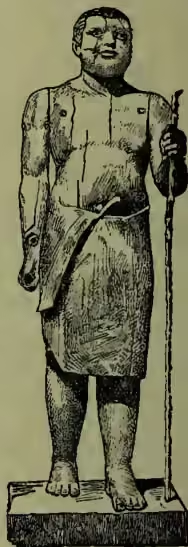
(Statuette in wood:
Boulaq Museum).
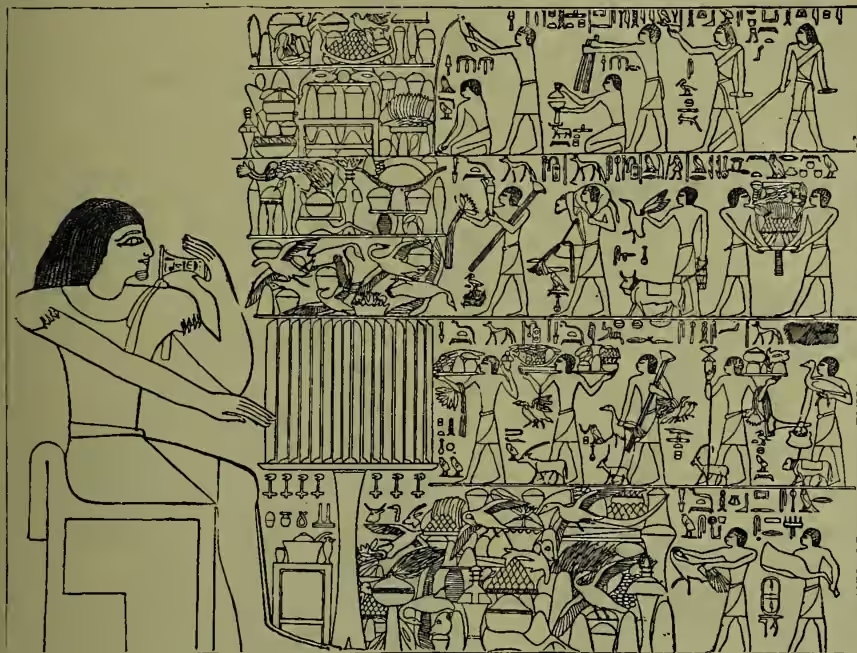
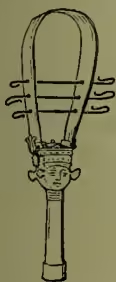
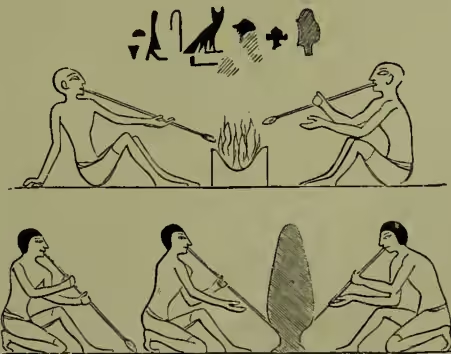
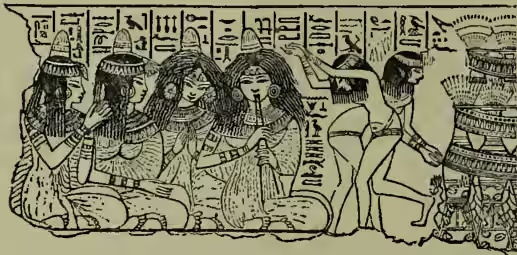
later than the rest here mentioned), the carved wooden statuette of the village sheikh (fig. 7), the chiselled statues of Khafra, all belonging to the remotest antiquity, prove the early Egyptians to have possessed extraordinary skill in the plastic arts; nor are these, the most ancient sculptures in the world, moulded in the conventional lines which characterised most of the later Egyptian representations of the human form. The lions and sphinxes of the later period, moreover, are often executed with a spirit surpassing the power of Greek artists. A peculiar kind of bas-relief prevailed in Egypt, the figures being sunk below the surface like the tambourines, flutes, cymbals, trumpets, and guitars are seen in the 18th, and the national instrument, the jingling sistrum (fig. 10), in the 4th. Many of the instruments are of great size, and must have produced considerable effect. Nor was the art of song wanting: measured recitations or chants occur on monuments of the 12th dynasty, while the lays of Maneros traditionally dated from a still earlier period. Poetry, indeed, was at all times in use, and the antithetic genins intaglio figures of a gem, but in slightly convex relief. This style, called incavo-relievato, or intaglio, has been most successful in preserving the hieroglyphs of the monuments. Bronze statues cast from moulds, and having a leaden or other core, were first made in Egypt, and subsequently introduced into Greece by Rhœcus. This art flourished best under the earlier dynasties, and had much degenerated in the 19th and 20th, although subsequently revived by the 26th. Painting appeared at the same age chiefly in tempera or whitewashed surfaces, although fresco was occasionally used; encaustic appears only under the Greeks and Romans. Painting, of course, was freer than sculpture, but yet had a rigid architectural character, and followed the same canon as sculpture, the colours used being generally the pure or primitive, and the background generally white. The architectural details of Egyptian temples and the hieroglyphs appear to have been always coloured, and this added additional charm to the sculptures. The religious papyri or rituals were also often embellished with elaborately coloured vignettes, resembling the illuminations of medieval manuscripts. Nor had the Egyptians attained less eminence in the art of music, the harp and flute appearing in use as early as the 4th, and heptachord and pentachord lyres as early as the 12th dynasty; besides which, drums, of the language suggested the application of the strophe and antistrophe, although it is not possible to define the metre. In the mechanical arts many inventions had been made; the blow-pipe, used as a bellows, appears in the 5th dynasty, bellows and siphons in the 18th. The saw, the adze, the chisel, press, balance, and lever appear in the 5th, the harpoon in the 12th, razors in the 12th, the plough and other agricultural implements in the 5th. Glass of an opaque kind is seen in the 4th, and dated specimens in the reign of Thothmes III. give the priority to Egypt (see GLASS). A glazed pottery or porcelain (see POTTERY), the potter's wheel, and the kiln, appear in the 4th; and the art of metallurgy, with the use of tin, at the same period. In the military art the Egyptians used at an early age defensive armour of shields, cuirasses of quilted leather, and helmets; while spears, clubs, maces, swords, daggers, bows, and hatchets formed their offensive weapons. For sieges they employed the testudo, ladders, torches and lanterns, and mines. The army was composed of infantry till the beginning of the 18th dynasty, when war-chariots were introduced; for, prior to that period, the ass only was known and used for transport; and carriages not having been invented, persons and goods were transported on the panniars of asses, or on a kind of saddle slung between two of these useful animals. War-boats no doubt existed at an early period, and are mentioned as early as the 12th dynasty; and sea-going vessels under the 11th, but no fleet till the 18th. The Nile, however, was constantly navigated by row-galleys with sails. An extensive commerce was carried on with neighbouring nations, and their tribute enriched the country with slaves, cattle, gems, valuable metals, and objects of curiosity. Rare animals were collected for ostentation. Under the earlier dynasties the chief occupation of the nation appears to have been rearing cattle, cultivating grain, indulging in banquets, fishing, fowling, and the chase; and the establishment of each noble contained in itself all the organisation and artificers necessary for its maintenance. How transactions were carried on without the use of money is not very clear, unless gold circulated moulded in the shape of rings adjusted to a given weight; but coin plate is mentioned by its pound (uten) and its ounce (kat). The Persians first introduced money (see NUMISMATICS). The wealth of families was, however, spent on the tombs and furniture of the dead, and the preparations for embalming, which were on so vast a scale that filial piety did not disdain to mortgage not only the sepulchres, but the very mummies of its ancestors (see EMBALMING). Amusements were various, from the singletick and juggling, the dance of the ghawāzi (fig. 12), the bull-fight, to draughts, dice, and mora. In fact, ancient Egypt had a material civilisation, which exerted all the requirements of industry, and forgot none of idleness. Pleasure was the object of existence, not, however, untempered by the voice of reason or the appeals of conscience, for the moral code was, theoretically at least, as pure as that of contemporary nations.
The civil government was administered by the three highest professions. The priests, distinguished by their superior knowledge, cleanliness, and godliness, had the ecclesiastical; the temples were ordered by high-priests and an inferior hierarchy, with overseers, and governors of revenues, domains, and donatives; and each temple, like a monastic institution, had its carefully subdivided organisation. The political and civil government was administered by royal scribes, or secretaries of state, who superintended the revenue, justice, foreign affairs, and all the interests of the executive. Sacred scribes attended to the ecclesiastical interests, and inferior scribes to the local interests. The public works, the collection of grain and of the linen dues, the cattle, workmen, wells, irrigation, had each their separate superintendents and scribes. The military force—of 410,000 men, at a later period, comprising all arms of the service—was ruled with severe discipline, and under the direction of nomarchs, colonels, captains, and lieutenants; while in the time of Rameses II. there were territorial regiments. The criminal and civil law was administered by judges, who held travelling assizes, and to whose tribunals the necessary officers were attached. The athlophoros or standard-bearer also transmitted the decrees of the royal chancery. The execution of deeds required so many witnesses that fraud evidently often occurred. The superior position of women in the social scale, notwithstanding the permission to marry within degrees of consanguinity usually forbidden, shows that the Egyptians reached a higher point of delicacy and refinement than either their western or eastern successors. Colossal in its art, profound in its philosophy and religion, and in possession of the knowledge of the arts and sciences, Egypt exhibits the astonishing phenomenon of an elevated civilisation at a period when the other nations of the world were almost unborn.
Chronology and History.—In the time of Ptolemy Philadelphus, in the 3d century B.C., Manetho of Sebennytus, high-priest of Heliopolis, who had the best records of his country at his command, drew up, at the request of the king, a history, in which he divided the space of time from Menes to the conquest of Egypt by Darius II. into 30 dynasties. The original work of Manetho has perished, but chronological epitomes have been preserved by Julius Africanus, a writer of 300 A.D., Eusebius, and Georgius Syncellus, 800 A.D., and a comparison of their statements, corrupted as they are, with the records of the monuments has clearly established the truth and authenticity of Manetho's authorities. The Hebrew Scriptures, Herodotus, Diodorus, Josephus, Eratosthenes, and others also contain chronological information, and the learned of Europe have long endeavoured to reconcile the conflicting statements of these authorities. Unfortunately, the information derived from inscriptions on the monuments is defective at certain periods, while in all the national custom of dating in kings' reigns only, without the use of the controlling date of any cycle, renders the subject still more obscure; for the Sothic cycle, or Dog-star period of 1461 'vague' and 1460 sidereal years of days, was not in official use. Even the famous Table of Kings at Abydos leaves us mystified, while the celebrated hieratic papyrus at Turin, belonging to the age of the 19th dynasty, which contained a system of chronology arranged on a principle of cycles and regnal years, has unfortunately suffered so much mutilation that it is impossible to reconstruct it satisfactorily; and we are obliged to arrange the history according to the dynastic successions of Manetho, without being always able to affix the precise duration of each dynasty, or to determine how many of them may have ruled contemporaneously.
Egypt was fabled to have been first governed by a dynasty of gods, who, according to Manetho and other Greek authors, were Hephæstus (Ptah), Helios the Sun (Ra), Sôs (Shu), Kronos (Seb), Osiris (Hesiri), Typhon (Set), and Horus (Har). These gods reigned 13,900 years, and were succeeded by the demigods and maues, whose sway occupied 4000 more years. It is singular that, with the exception of the Osirid saga related above, Egyptian mythology can hardly be said to exist; there are few or no legends about the gods. Their characters are differentiated, but their exploits are unsung.
(Boulaq Museum.)
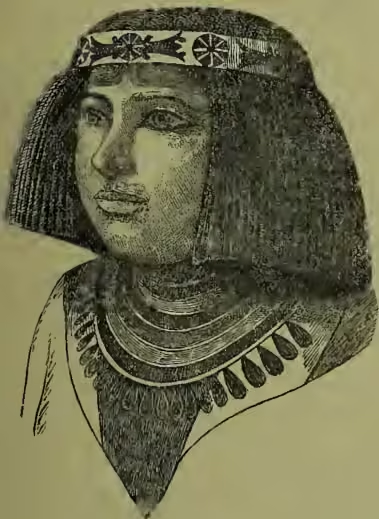
The epoch of Menes is the first human point in the history of ancient Egypt, and has been placed at 5004 B.C. by Mariette, 4455 B.C. by Brugsch, and 3892 B.C. by Lepsius, the three leading authorities. No contemporary monuments of Menes exist, but he is said to have been king of This (near Abydos); to have changed the patriarchal life of the nation, instituted laws and divine worship, and marched north and founded Memphis and the temple of Ptah, after diverting the course of the Nile by a dyke to make it a barrier against the Arabs on the east; and finally to have been devoured by a crocodile. He is clearly no legendary creation, but a real founder of a state. His first or second successor, Athothis, is said to have been a physician, and to have written treatises on anatomy, and to have built the palace of Memphis. Uenephes, the fourth of this line, is conjectured to have founded the Pyramid of Steps at Sakkara. This dynasty reigned about 250 years, and was succeeded by the 2d, supposed to have lasted about 300 years, of which no contemporary monuments remain. This dynasty, however, introduced the worship of sacred animals, and enacted that a woman might reign over the land. With the 3d dynasty, which endured about 200 years, from 3966 B.C. (Brugsch), monumental history properly begins: King Senofern conquered the Sinaitic peninsula, and opened the copper-mines of the Wady Maghara, where his name and portrait may be seen. He was probably buried in the Pyramid of Meydām, near which some tombs have preserved writings, pictures, and sculpture of his time, amongst others the famous seated figures of Rahotep and his wife Nefert (fig. 13), believed to be the oldest statues in the world. The 4th dynasty, also of Memphites, had an existence of 167 years (3733-3566 B.C.). Khufu, the Cheops of Herodotus, constructed the Great Pyramid at Gizeh, and rebuilt the Temple of Isis, hard by the Sphinx. Tradition, probably groundless, makes him a detestable and impious tyrant. Khafra (Cepherenes), his successor, built the second of the Gizeh pyramids, and Menkaure, or Mycerinus, the third. The so-called Book of the Dead (see DEAD, BOOK OF THE), or Ritnal, which dates from this period, and the high civilisation which Memphis had then attained, mark an epoch in Egyptian history, and the numerous tombs in the vicinity of the pyramids, constructed during this and the subsequent dynasty, exhibit a highly advanced state of civilisation and of art; the statues of Khafra (fig. 14) found near the Sphinx, carved in black diorite, are notable evidence of both artistic and mechanical skill; the cultivation of farms, the chase, the arts, enjoyed a great part of the attention of the Egyptians; but horses and wheel-carriages were alike unknown, although the simpler mechanical instruments had been invented.
The 5th dynasty was also Memphite, and con- sisted of nine kings, reigning about 200 years, of whom the last, Unas, built the truncated pyramid near Sakkara, now called the Mastabat-Faraūn, or 'Pharaoh's Seat.' The next dynasty, the 6th, probably belonging to a different part of Egypt and not specially Memphite, was more remarkable, and tombs and inscriptions of the period are found from Assouān to Tanis, and in the valley of Hammamat, leading from Coptos to the Red Sea. The great figure of this house is Pepi I., of whom, and his general Una, and his wars and expeditions and public works most interesting records remain. The pyramids of Dahshūr probably belong to his time. The dynasty ended, according to Manetho, with the fair Queen Nitocris, said to have been buried in the Third Pyramid of Gizeh, which she may have enlarged. Nitocris is the subject of various legends, and is believed by the Arabs to be a witch who still haunts the pyramid.
From the 6th to the 11th dynasty Egyptian history is almost a blank, but remains of the 11th, consisting of a line of monarchs called Entef and Mentuhotep, have been identified by the discoveries of their coffins at Thebes, and by the tablets referring to the construction of the fortress of Coptos and in honour of a local god. The successive reigns and monarchs of the 12th dynasty (from 2466 B.C.) are fixed by numerous monuments. Amenemhat I., the founder of the line, opened the quarries of Tura, embellished On or Heliopolis, and founded the temple of Amen at Thebes. The monuments of his son Osirtasen I. exist in the Fayyūm, at Beni-Hasan, and Heliopolis; he subjected some of the Ethiopian tribes. Osirtasen III. established the southern frontier at Semneh, which he fortified, and was subsequently deified in Nubia. Amenemhat III. excavated the Mœris Lake, in the Fayyūm, constructed the Labyrinth, and built the neighbouring pyramid. Another great blank occurs between the 13th and 18th dynasties. About 2000 B.C. the advance of the kings of Chaldea and Elam in Asia, or some revolution, precipitated the Hyksos or Shepherd Kings, who appear to have been a Tartar race, on Lower Egypt. These invaders overthrew the reigning dynasty of Lower Egypt, took Memphis by assault, and established themselves in the city of Avaris, subsequently called Tanis, where their monuments still exist (see reports of the Egypt Exploration Fund). Joseph was probably the vizier of one of these kings, Apepi, at Tanis; and 'storehouses' such as he built are still visible at Pithom (Tell-el-Maskhūta). But the Egyptian rulers of Upper Egypt overthrew their rule. Aahmes I. (Amosis), of the 18th dynasty (about 1700 B.C.), took Avaris by assault, besieged Sharuhan in Palestine, and attacked the Nubians. The Hyksos endeavoured to substitute the worship of Set for Ra, but Aahmes I. restored the ancient temples and the old religion. Amenhotep I., his son and successor, who reigned under the tutelage of his mother, an Ethiopian queen, continued the Ethiopian campaigns, and embellished Thebes. Thothmes I. carried his arms to
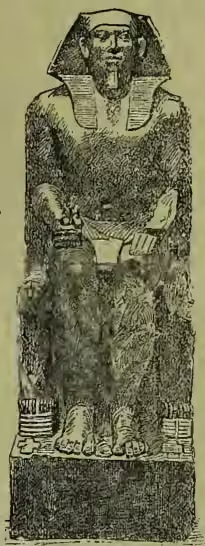
Statue of Khafra.
(Boulaq Museum.)
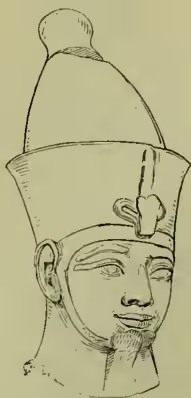
Head of Thothmes III.
Tombos, in the heart of Nubia, and as far as the Euphrates, and erected splendid buildings at Thebes. Thothmes II., who reigned under the guardianship of his sister-wife, Hatasu, defeated the Shasu or Arabs. His brother and successor, Thothmes III., elevated Egypt to the highest pinnacle of glory; and by the victory of Megiddo; in his twenty-third year, subjected the whole of Syria and part of Mesopotamia to his arms, receiving immense tributes from Kush and the Ethiopian races of the south, the islands of the sea, and Assyria, Babylon, Phœnicia, and Central Asia, and endowing the temples of Thebes with the revenues of tributary cities. A calendar preserved at Elephantine recording the heliacal rise of the Dog-star on the 28th Epiphi has been held to show that the year 1444 B.C. fell in his reign, but this seems historically a century too late. Thothmes III. (fig. 15) recovered the copper-mines of Maghâra, and adorned temples throughout Egypt. Amenhotep II. continued the conquest of the Ruten (Palestinians), took Nineveh by assault, and vanquished the Ethiopians. Amenhotep III. maintained the frontiers of the empire. At this period a heresy was introduced into Egypt, favoured by the Queen Taia. Amenhotep IV. became a worshipper of the Aten or solar orb, to the exclusion of the other deities of Egypt, especially of Amen-ra. The capital was removed to Tell-el-Amârina or Alabastron; the king changed his name to Akhunaten, and a succession of three heretical monarchs ruled Egypt for about thirty-three years, till Haremhebi or Horus restored the orthodox faith and the limits of empire.
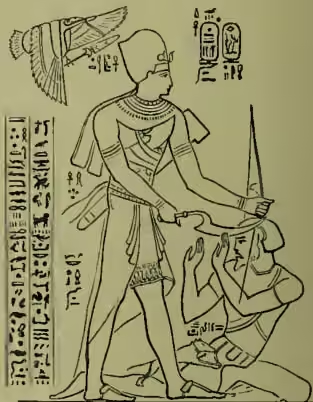
The link which connects the last monarchs of the 18th with the monarchs of the 19th dynasty has been lost; but Horus was succeeded by Rameses I.—the first of a long line of monarchs—who appears to have formed a treaty with the Khita or Hittites, and to have maintained the conquests of Egypt as far as Wady Halfa. He was succeeded by Seti I. or Sethos, who attacked the Remenu or Armenians, the Ruten, and the Shasu, who had again advanced to the Pa-khetem stronghold on the confines of Egypt. Naharana or Mesopotamia, and Sharu or Syria, Punt or Arabia Felix, and the opposite coast had also been invaded by his arms. The city of Atesh or Katesh, the supposed Cadytis, was also besieged by Sethos, whose Asiatic victories introduced into Egypt the worship of Baal and Ash-toreth. Tyre, Aradus, and Bethanath in Canaan were garrisoned by his forces. Egypt was also embellished with many noble monuments in his reign. He was buried in a deep excavated rock-tomb in the Bibân-el-Mulûk ('tombs of the kings'). Rameses II. (fig. 16), the son of Seti I., seems to have succeeded him at the very youthful age of seven. Four years later he defeated the Khita (Hittites, q.v.) and their Syrian confederates at the battle of Katesh, in which many of the princes and officers of the Khita were drowned in the river Arunata or Orontes. The battle continued two days, and the panegyric of an Egyptian scribe, Pentaur, has invested Rameses with the power of a god. The war lasted four years, and the king took Shaluma or Salem, the ancient site of Jerusalem, and other cities. In his twenty-first year a treaty of peace and extradition was established between the Egyptians and Hittites, and Rameses married a Hittite princess. It is the tablet of this monarch which is found at the Nahr-el-Kelb, the Pass of the Lycus, near Beyrout. This monarch subjected Ethiopia, which had revolted, to his arms, reimposed the tribute, and placed the country again under the government of the princes of Ethiopia, or Egyptian vice-roys. He also established a fleet on the Mediterranean. His name and reputation formed the basis of the legendary Sesostris; the exploits of the monarchs of the 18th dynasty, and probably of his successors, being united with his fame. The reign of Rameses, although it exhibits a decline of art, yet demonstrates Egypt to have been in the height of its glory; and his epoch appears to have been about 1322 B.C., a special calendar having been sculptured to record the coincidence of the heliacal rising of the Dog-star and 1st Thoth, or commencement of the fixed and canicular (sidereal) year. His place of burial is uncertain—perhaps in the vaults of the Ramesseum. His thirteenth son, Merientpah or Meneptah, succeeded him upon the throne, transferred the capital to Memphis, successfully contended with the Tamahu and the Rebu, or Libyans, and appears to be the Amenophis of Manetho, and the Pharaoh (q.v.) of the Exodus. He introduced the heretical worship of Set, or Typhon, and was succeeded by Seti II. and others, whose inglorious reigns close the 19th dynasty.
The connection of Rameses III. with the previous dynasty is obscure. He warred chiefly with the Philistines and other maritime tribes of Greece and Asia Minor, and gained naval victories in the Mediterranean, and repeated the conquest of Ethiopia. He was followed by the splendid but inglorious line of the Ramessids, the sixth of whom gained victories in Ethiopia. The fall of this dynasty appears to have been owing to internal revolution, as their Tanite successors held the office of high-priests of Amen-ra at Thebes. They held the government for a hundred and thirty years, and maintained relations with foreign countries, one of the monarchs having married a princess of the Ruten. The 22d dynasty is rather confused. They were also high-priests of Amen-ra. Shashank I. is the biblical Shishak. His invasion of Israel with 12,000 chariots and 60,000 cavalry is recorded on the portico of the Bubastites at Karnak. The other monarchs of this line, Osorkon I., Takelot I., and their successors, have left no remarkable records, except Osorkon II., who adorned the splendid Temple of Bubastis, discovered by Mr Naville while working for the Egypt Exploration Fund; and the dynasty, which appears to have been of foreign origin, is more chronologically than historically important, the attack on Jerusalem falling about 930 B.C. The 23d, Tanite, dynasty, which succeeded it, exhibits a decadence in Egypt, and was succeeded by the 24th dynasty, consisting of a single monarch, the celebrated Bekenrenf or Bocchoris, who reformed the laws, but having been taken prisoner by the Ethiopian Sabaco, of the 25th dynasty, was burned alive. From this period, the history of Egypt becomes involved with that of Judæa and Greece. Tirhaka came to the assistance of Hezekiah against Sennacherib, and added to the temple of Gebel Barkal in Ethiopia. According to the Assyrian cuneiform inscriptions, the Ethiopians were expelled by the Assyrians, and the country was placed under various nomarchs. This state of affairs was closed by the rise of Psammitichus I., of the 26th dynasty, who, by the aid of Greek mercenaries, overthrew the other petty princes. His age marks a revival in art, and restoration of the old constitution of the empire. His successor, Nekao or Necho II., planned the canal across the Isthmus of Suez, from which he desisted, warned by the advice of an oracle, after having lost a vast number of men in the attempt. Under his reign, the Phœnician navigators first passed the line. After defeating Josiah, king of Judah, and conquering Palestine, he was himself defeated by Nebuchadnezzar at Carchemish. Psammitichus II. carried his arms into Ethiopia. Apries, his successor, having lost all the conquests, was deposed by Amasis, his successor, and strangled. Amasis favoured in different ways the Greek colonies in Egypt, married a Cyrenæan wife, and conquered Cyprus, but incurred the enmity of Cambydes, who overthrew his son and successor at the battle of Pelusium (527 B.C.). Cambydes treated Egypt with considerable moderation, but after an unsuccessful expedition against the Ethiopians, lost his reason, stabbed the bull Apis, and committed various atrocities. His successor, Darius I., governed Egypt with more prudence; but Xerxes I. and Artaxerxes I. had successively to reduce it to subjection, which they did in spite of assistance rendered to it by the Athenians. The 27th dynasty of Persians was followed by another Saite line, the 28th, who still held ground against the Persians. The 29th, Mendesian, dynasty of Nephertes and Achoris maintained a Greek alliance; and the 30th, Sebennytic, consisted of Nectanebes I. who successfully resisted Pharnabazus and Iphicrates, of Teos who employed Agesilans, and of Nectanebes II. who fled into Ethiopia before the Persians (340 B.C.).
From this time Egypt remained a province of Persia till its conquest by Alexander the Great, who founded Alexandria (332 B.C.). Subsequently Egypt passed under Greek rule, and the language of the government, and the administration and philosophy, became essentially Greek. The court of the Ptolemies became the centre of learning and philosophy; and Ptolemy Philadelphus, successful in his external wars, built the Museum, founded the library of Alexandria, purchased the most valuable manuscripts, engaged the most celebrated professors, and had the Septuagint translation made of the Hebrew Scriptures, and the Egyptian history of Manetho drawn up. His successor, Euergetes, pushed the southern limits of his empire to Axum. Philopator (221–204 B.C.) warred with Antiochus, persecuted the Jews, and encouraged learning. Epiphanes (204–180 B.C.) encountered repeated rebellions, and was succeeded by Philometor (180–145 B.C.) and Energetes II. (145–116 B.C.), by Soter II. and Cleopatra till 106 B.C., and by Alexander (87 B.C.), under whom Thebes rebelled; then by Cleopatra Berenice, Alexander II. (80 B.C.), and Neos Dionysus (51 B.C.), and finally by the celebrated Cleopatra. After the battle of Actium (31 B.C.) Egypt passed into the condition of a province of Rome, governed always by a Roman governor of the equestrian, not senatorial, rank.
The most important events in Egypt under the Roman rule were—the introduction of the Julian year by Augustus (24 B.C.), the visit of Vespasian to Alexandria (70 A.D.), and that of Hadrian (122), the development of the Gnostic heresy, the visit of Caracalla (211), the conquest of Egypt by Zenobia (270), the revolt of Firmus (272), the persecution of Diocletian (304), and the rise of Manicheism, the great Arian controversy in the reign of Constantine, the rise of asceticism, magic, and astrology, and the final destruction of paganism (379).
At the division of the empire (395), Egypt fell to the Eastern empire, and at its fall had become one of the great patriarchates of the Christian church; but owing to the religious feuds of the Jacobites and Melchites it became a province of Persia (616) for twelve years. The Coptic governor, John Mukowkis, governed Egypt in the name of Heraclius at the period of the Arab invasion (639), and, perceiving in the invaders a means of escape from the detested rule of the Greeks, submitted, after a perfunctory resistance, to the Arab general, 'Amr ibn el-Asi, who took Alexandria (641), and soon made the whole country a province of the calif 'Omar.
History since the Mohammedan Conquest.—Although Alexandria was retaken by Constans II., the Arabs drove him out, and Egypt remained an appanage of the califat, and was ruled by Arab governors. One of these, Ahmed ibn Tûlûn, made himself practically independent, annexed Syria, and founded the dynasty of the Tûlûnis (868–905), renowned for its luxury and noble buildings. Another governor followed his example, and established the dynasty of the Ikhshîdis (935–969). This in turn gave place to the heretical (Shi'ah) line of the Fâtîmî Califs (q.v.), who advanced from their capital at Kayrawân, conquered Egypt, and founded modern Cairo (969), with some of the principal mosques and the Azhar University (see CAIRO). One of this line, the mad calif El-Hâkim, was the founder of the sect of the Druses (q.v.), who still pay him divine honours, and expect his return to rule the world. The reign of El-Mustansir was marked by civil war, persecution of Christians, and a fearful famine which lasted seven years, and depopulated whole quarters of Cairo. The Fâtîmis were deposed by the Kurd general, Salâhed-dîn (1169–93), son of Ayyûb, commonly called Saladin (q.v.), who fortified Cairo and built the citadel. He waged war against the Crusaders, and annexed the greater part of Syria and Mesopotamia. In 1213 the Crusaders made an attack upon Egypt and took Damietta, but the Ayyûbî sultan, El-Kâmil, nephew of Saladin, utterly defeated Jean de Brienne, and drove the invaders away. The attempt of St Louis, thirty years later, ended in the surrender of the French king and all his army to the Mamelukes (Mamlûks). It was the last of Saladin's line, Es-Sâlih Ayyûb, who introduced this famous bodyguard of Turkish Mamelukes, or white slaves, who, on his death, usurped the supreme power (1250). For more than two centuries and a half Egypt was governed by a succession of slave kings, called the Bahri or Turkish and the Burji or Circassian Mamelukes. These kings, who succeeded each other chiefly by virtue of force of arms, were distinguished for their valour, their administrative powers, their luxury, and their encouragement of the arts. They fought for the holy places of Palestine, and gallantly drove back the Mongol hordes; they exchanged embassies with France and Venice, with Persia and Abyssinia; and presented one of the most startling anomalies of history, the 'spectacle of a band of disorderly soldiers, to all appearance barbarians, prone to shed blood, tyrannous to their subjects, yet delighting in the delicate refinements which art could afford them in their home-life, lavish in the endowment of pious foundations, magnificent in their mosques and palaces, and the noblest promoters of art, of literature, and of public works, that Egypt had known since the days of Alexander the Great' (Lane-Poole, Art of the Saracens). Cairo (q.v.) is still full of their monuments, and Arabic literature owes them much. In 1517, however, this brilliant series of rulers came to an end on the conquest of Egypt by the Ottoman sultan, Selim I.
Nearly three centuries of weak and corrupt government by Turkish pashas, varied by faction and rebellion of the Mameluke chiefs, bring us to the French invasion of Bonaparte in 1798. His conquest of Alexandria, and victory near the Pyramids over the Mamelukes, led to the temporary subjection of the country, from which the French were, however, soon expelled by the British in 1801, when the country was restored to the Porte. The accession of the Albanian soldier Mohammed 'Ali to the pashalik in 1805 imparted a galvanic prosperity to Egypt, by the merciless destruction of the turbulent Mamelukes (whom a disastrous British expedition in 1807 vainly sought to restore), the formation of a regular army, the increase of security, the improvement of the irrigation, and the introduction of the elements of European civilisation. In 1816 Mohammed 'Ali reduced part of Arabia to his sway by the generalship of his son Ibrahim; in 1820 he annexed Nubia and part of the Soudan, and from 1821 to 1828 his troops, under Ibrahim, occupied various points in the Morea and Crete, to aid the Turks in their war with the insurgent Greeks. The Egyptian fleet was annihilated at Navarino, and Ibrahim remained in the Morea till forced to evacuate by the French army, under Maison, in 1828. In 1831 Ibrahim began the conquest of Syria, and in the following year totally routed the Ottoman army at Koniya, after which the Porte ceded Syria to Mohammed 'Ali on condition of tribute. War breaking out again, the victory of Nisib in 1839 would perhaps have elevated him to the throne of Constantinople; but the quadruple alliance in 1840, the fall of St Jean d'Acre to the British, and the consequent evacuation of Syria, compelled him to limit his ambition to the pashalik of Egypt. In 1848 Mohammed 'Ali became imbecile (he died in 1849), and his son Ibrahim sat on his throne for two months, when he died, and was succeeded by 'Abbâs Pasha, Mohammed 'Ali's grandson, superseded in turn by Sa'id Pasha, youngest son of Mohammed 'Ali, in 1854. M. de Lesseps now obtained the co-operation, hitherto withheld, of the Egyptian government in his scheme of the Suez Canal (q.v.), which was opened in 1869. Sa'id was succeeded in 1863 by his nephew, Isma'il, son of Ibrahim, who, by a firman purchased from the Sultan, took in 1866 the hereditary title of Khedive. The same firman made the succession to the throne of Egypt direct from father to son, instead of descending, according to Turkish law, to the eldest male of the family; and in 1872 the Sultan granted to the Khedive the rights (withdrawn in 1879) of concluding treaties and of maintaining an army, and virtually gave him sovereign powers. Thus secure on an hereditary throne, Isma'il began a series of vast internal reforms, built roads, bridges, lighthouses, laid down railways and telegraphs, reconstructed the postal service, improved the harbours at Suez, Port Sa'id, and Alexandria, supported education, and introduced mixed courts of law. Extending his dominions southward, he annexed Dar-Fûr in 1874, and in that and the following year further conquests were made. Through Sir Samuel Baker and Charles Gordon, governors of the Soudan, the Khedive endeavoured to suppress the slave-trade in his dominions. In order to provide funds for his vast undertakings, in 1875 he sold to Great Britain 177,000 shares in the Suez Canal for £4,000,000. The condition of the Egyptian finances, however, loaded by heavy loans, was almost hopelessly involved; various distinguished financiers were sent from England to endeavour to arrange a solvent system, and after many inquiries and several failures, a dual English and French Control was established, and the finances were placed entirely under European management. A promise of constitutional government ended in 1879 in the summary dismissal of Nubar Pasha's ministry, and this brought about the peremptory interference of the European governments. The Khedive, who declined voluntarily to abdicate, was, at the instance of the western powers, deposed by his suzerain the Sultan in June 1879, and Prince Tewfik, Isma'il's eldest son, was proclaimed Khedive.
A Law of Liquidation, for regulating the conditions of the public debt, was passed at the instance of five European powers in 1880. In the next year came the military revolt under Arâbi Pasha, who demanded from the Khedive an immediate change of ministry, and the increase of the army to 18,000 men. The Khedive yielded. Growing dislike to European interference and to the presence of European officials secured Arâbi a large measure of popular support, when, as War Minister, he dominated the Khedive, and ultimately defied his authority. He was practically a military dictator, and in 1882 British and French war-ships were despatched to Alexandria to overawe the rebels, but their appearance was followed in June by rioting and massacres of Europeans in the streets. Meanwhile Arâbi was strengthening the fortifications. The British admiral demanded that the work should be discontinued. Arâbi persisted; the French sailed away in dismay; and the British ships bombarded the fortifications (11th July). The Egyptian troops were suddenly withdrawn from Alexandria, whereupon the city was plundered and partly burned by Egyptian rioters; while the British admiral, Sir B. Seymour (Lord Alcester), was apparently unable to land a force to restore order until the third day, when he occupied the city until the arrival of troops under Sir A. Alison, who kept Arâbi in check behind his lines at Kafr Dawar. Meanwhile Sir Garnet Wolseley hurried out with more troops from England, and other regiments (some of sepoys) were despatched from India; the point of debarkation was Ismailia, on the Suez Canal; and in twenty-five days the British forces under Wolseley had traversed the desert, utterly defeated the main body of Arâbi's army at Tell-el-Kebir, and occupied Cairo. Arâbi was tried, pleaded guilty, and was banished to Ceylon. The authority of the Khedive being thus restored, most of the British troops were withdrawn, and measures taken for the reorganisation of the country. The French, who had been associated with England in what was known as the Dual Control, took no share in the bombardment, in the military expedition, or in direct co-operation with England in the re-arrangement of Egyptian affairs on a fair basis. The aim of the English Cabinet was to secure, as soon as possible, a firm and lasting government under the Khedive, but a large measure of interference with the Egyptian government was for the time being inevitable. Lord Dufferin proceeded to Cairo after the war, and drew up a constitution which has not, so far, been severely tested; and Sir E. Baring continued the task of organisation. But the attempt to persuade the Khedive's government to rule according to British ideas, and to get British officials and their Egyptian colleagues to work smoothly together, led to repeated crises and changes of plan. A conference of the great powers in 1884 did not sanction the English scheme for managing Egyptian finance; and Britain had consequently to resume her exclusive responsibility in Egypt. Whatever good was accruing to Egypt under British rule was seriously marred by the severe visitation of cholera which occurred in the summer of 1883, when 150,000 persons perished and still more by the rebellion in the Soudan, of which the end even now is not to be foreseen.
The Rebellion in the Soudan.—Arâbi's revolt and its consequences loosened the hold of Egypt on the Soudan (q.v.), which by Baker's annexations in 1874 and following years had gradually extended to the shores of the Victoria Nyanza. A wide-spread rebellion broke out in Dar-Fûr and Kordofan under Mohammed Alumed, calling himself the Mahdi, a word meaning 'the guided by God.' The doctrine of the Mahdi, a kind of Mohammedan Messial, is explained under the article ISMAILIS; see also MOHAMMEDANISM and KARMATHIANS. The modern Mahdi, however, is not necessarily a descendant of Ali, or a resuscitated Imam; but he puts himself forward as a prophet whose mission is to free Islam from external enemies and re-establish the pure primitive faith. Mohammed Ahmed was born at Dongola about 1843, educated near Khartoum, and then spent fifteen years in fasting and retirement in the island of Aba, whence he at length sent emissaries to preach the doom of Turkish rule in the Soudan, and the advent of the true Mahdi. An attempt of Raûf, the governor-general, to suppress this propaganda was resisted with bloodshed in August 1881, and thenceforward the movement spread rapidly. In January 1883 Sennâr revolted, and the Mahdi occupied El'Obeyd. An army now sent against him by the Egyptian government under an English officer, Hicks Pasha, was annihilated near El'Obeyd in November 1883. The Mahdi's influence extended to the Red Sea shores. An Egyptian force under Consul Moncrieff was routed with severe loss in the same month near Suâkin, and Baker Pasha was twice disastrously defeated at Teb and Tamanieb, early in 1884; but these reverses were afterwards wiped out by the hard-won successes of a British expedition under Sir G. Graham. Meanwhile, in January 1884, General Charles George Gordon (q.v.) had gone at the request of Mr Gladstone's government as English representative to Khartoum, to secure the withdrawal of the Egyptian garrisons from the Soudan, Egypt having, on the advice of England, agreed to give up all her possessions in the Soudan save the Red Sea littoral. Gordon, though supported by only one other English officer, gallantly maintained his position in Khartoum against the Mahdi's followers, and even ventured successfully on the aggressive. He had found, however, that he had attempted an impossible task; he could not leave the garrisons to fall into the hands of the Mahdi, and he required reinforcements of British troops before he could drive the latter from the neighbourhood of Khartoum. Timidity and indecision marked the whole of the policy of the English government, both towards the Soudan and the Red Sea littoral. At last, too late, in October 1884, an English expedition under Lord Wolseley was despatched to Khartoum, and, selecting the difficult and tedious route up the Nile, arrived in touch of Khartoum only to learn that the heroic Gordon had been assassinated two days before (26th January 1885). Wady Halfa became practically the southern limit of Egyptian territory; though till 1889 Dr Schnitzer (q.v.), better known as Emin Pasha, held out nominally for Egypt in the equatorial territory. The Mahdi (q.v.) died in 1885. Dongola was reoccupied after a triumphant Anglo-Egyptian expedition in 1896; and the advance to Khartoum began in 1897. France, jealous of the English occupation, has repeatedly thwarted British plans; and the question of 'scuttling' out of Egypt before the country is put into a stable condition became matter of controversy in English politics. Britain's worst enemies do not deny that wonders have been worked in the administration of justice, improvement of the finances, the extension of agriculture and commerce, and increased and improved irrigation, while the burdens on the fellahin have been greatly lightened (both in oppressive taxation and forced labour), the whip having been abolished.
Statistics of Modern Egypt.—The area of Egypt proper is now (its southern frontier having reverted to Wady Halfa) about 400,000 sq. m.; at the census of 1882 its population was 6,817,265, and of 1897, 9,734,405. With the territories in Central Africa now no longer Egyptian, the area of the Egyptian dominions was estimated at 1,150,000 sq. m., with a population of 17,000,000. The chief towns of Egypt proper are Cairo (pop. 400,000); Alexandria (250,000); Damietta (35,000); Tanta (34,000); Assiout (32,000); Mansourah (27,000); Fayoum (26,000); Damanhour (24,000); Zagazig (19,000); Rosetta (17,000); Port Sa'id (16,500); Suez (11,000). There are in Egypt about 100,000 foreigners, including 40,000 Greeks, 20,000 Italians, 18,000 Frenchmen, and 8000 Englishmen (exclusive of the army). The administration is carried on by native ministers, under the Khedive, with the assistance of a financial adviser appointed by Britain, without whose assent no decision involving finance can be taken. The Egyptian army is under the command of an English general, and officered partly by Englishmen and partly by Egyptians; its total strength is 13,700, while the English army of occupation, which, since the rebellion of 1882, had remained in Egypt, had a strength of 4300. The revenue in 1894 was £10,561,000, the expenditure £9,756,000. The total debt of Egypt amounted in 1895 to over £104,000,000. The annual tribute to Turkey is £696,000. The total exports (chiefly cotton, cotton-seed, beans, sugar, and grain) vary from £12,000,000 to £14,500,000 a year (of which about two-thirds go to Britain); the imports (mainly cotton goods and other textiles, machinery, and coal) from £8,200,000 to £9,500,000 (mostly from Britain). The railway system embraces over 1250 miles; and there are nearly 2000 miles of telegraph lines.
See SOUDAN, NUBIA, KORDOFAN, DAR-FÛR, BAKER, GORDON, HARAR, &c. For descriptions of some of the most important monuments, see ABU-SIMBEL, ABYDOS, ALEXANDRIA, DENDERA, EDFU, ESNÉ, FAYÛM, MEMPHIS, OBELISK, PHILE, PYRAMID, THEBES.
For further information on Egypt, its history, antiquities, and present condition, see Bunsen, Ägyptens Stelle (1844-57); Lepsius, Denkmäler (1849-74) and other works; Sharpe, History of Egypt (1846); the works by Brugsch (q.v.); Sir Gardner Wilkinson, Manners and Customs of the Ancient Egyptians (1847; new ed. by Birch, 1879); Mariette, Monuments of Upper Egypt (1877); Maspero, Histoire ancien des Peuples de l'Orient (1878), and Egyptian Archaeology (Eng. trans. 1887); A. B. Edwards, A Thousand Miles up the Nile (1878); Lane, Modern Egyptians (1836, new ed. 1871); McCoan, Egypt as it is (1877); Rawlinson's History of Ancient Egypt (1881), and Ancient Egypt ('Story of the Nations' series, 1887); S. Lane-Poole's Egypt (1881), and Art of the Saracens (1886); Dicey, England and Egypt (1881); Ebers, Egypt, Historical and Descriptive (Eng. trans., new ed., 2 vols. 1887); De Leon, Egypt under its Khedives (1882); Villiers Stuart, Egypt after the War (1883); Sir Mackenzie Wallace, Egypt and the Egyptian Question (1883); the Memoirs of the Egypt Exploration Fund (founded 1883); Darmesteter, The Mahdi (1885); Journals of General Gordon (1885); Sir C. Wilson, From Korti to Khartûm (1885); C. Royle, Egyptian Campaigns, 1832-85 (1886); Fraser Rae, Egypt To-day (1892); A. Milner, England in Egypt (1892); the history of Egypt, ancient and modern, by Flinders Petrie and others (6 vols. 1895 et seq.); Murray's and Baedeker's handbooks; DEAD (BOOK OF THE); Prince Ibrahim Hilmy, The Literature of Egypt (Lond. 1886-88).