Feathers, modified outgrowths of integument, characteristic of birds, and belonging to the same series of skin-structures as the scales of fishes and reptiles and the hairs of mammals. Even Aristotle suggested the parallelism of fish-scales and bird-feathers, and modern knowledge of the development has proved the fundamental similarity or homology of all the three types of integumentary outgrowth. Feathers must have been very early acquisitions of birds, since the most ancient form we know of—Archæopteryx from Jurassic strata—already possessed them.
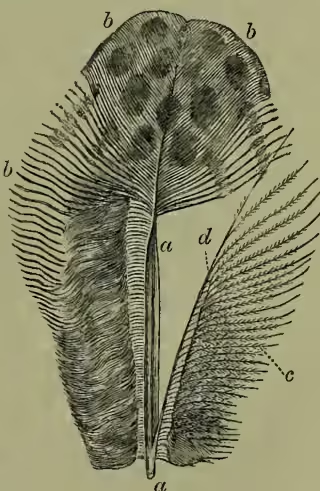
Structure.—An ordinary feather exhibits two principal parts—axis and bars. The axis is divided into a bare, hollow, inferior portion—the quill, and a barb-bearing, solid, upper part—the shaft. At its base the quill is partly imbedded in a small sac of the skin, and shows at the very end a small aperture for the entrance of the nutritive vascular pulp. The bars or small plates, which together form the vane, are linked together by pointed lateral barbules, which may be again interlocked by minute hooklets. Each barb with its barbules is thus itself like a little feather. In the ostrich family the barbs, though possessing barbules, are free, and the familiar loose plume results. In a great many birds the quill bears a second shaft, rising at the base of the vane. This is usually small, but in the cassowaries and a few other birds main shaft and 'aftershaft' are almost equal, and the feather is thus distinctly double.
Relation to the Skin.—Only in a few birds—e.g. the ostrich tribe and the penguins—do the feathers occur all over the surface; usually they are restricted to 'feather-tracts' between which the skin is bare or at most downy. Each feather is imbedded in a sac, readily obvious on a plucked bird, and with this sac are associated muscle fibres, more or less abundant, serving to erect the feather. Unlike hairs, feathers have no sebaceous glands associated with them; they are, however, anointed by the secretion of the 'green-gland' on the tail.
Kinds of Feathers.—The most conspicuous feathers clothing a bird are such as have been above described—'contour feathers,' or penna. Among these, however, there are down-feathers or plumes, in which the barbs remain soft and free from one another. These are the first feathers, for a time abundant on young birds, but gradually for the most part ousted and replaced by the ordinary forms. Besides these are still simpler and smaller feathers with a long shaft and a rudimentary brush of barbs—the 'filoplumes.' In addition to these common forms there are numerous peculiar modifications of restricted occurrence. Thus, in herons and some other birds small down-feathers occur, 'the summits of which break off into a fine dust or powder as fast as they are formed,' and give rise on certain parts of the skin to 'powder-down patches.' In many aquatic birds an almost fur-like down is very common, the minute component feathers having only a slight development of shaft. In great contrast are a few strong quills on the cassowary's wing, where the long shaft is quite destitute of barbs.
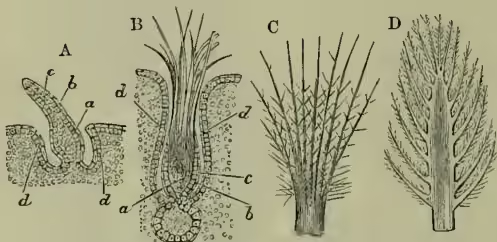
Development.—The cells of the under-skin or dermis multiply and push out the epidermis into a papilla. As the papilla elongates into a cone, its rapidly, giving rise to a series of radial folds along a central axis, which extend inwards towards the pulp, and are externally bounded by the horny layer. These folds then become cornified and separated from the surrounding cells, and by a gradual drying of the central pulp-substance give rise to a tuft of horny rays, which are, however, at first bound together by the enclosing outer layer. After hatching, the sheath is shed and the barbs set free; the undivided lower part remains as the quill; the barbs develop barbules; the result is an embryonic down-feather.
The more permanent feathers have an essentially similar history. From the base of the first follicle a second is formed; the growing papilla within the latter ousts the embryonic feather and replaces it; one of the rays formed as above described 'becomes rapidly thickened, and forms the main axis or stem, to which the barbs are attached on each side.' The result is an ordinary penna or contour-feather.
Growth and Shedding.—When in process of formation, feathers are of course genuinely alive; the vascular nutrient core of dermis keeps up the supply. They grow with great rapidity, and in some birds attain a length of more than two feet. When fully formed, however, the pulp dries and shrivels, and the feathers become virtually dead from tip to base. They usually last only one year, being replaced by a fresh growth, which generally occurs at the end of the reproductive period. This process of moulting is in a general way equivalent to the 'skin-casting' of reptiles and the shedding of hair in mammals, but its physiology is not yet understood. Involving no little expenditure of vital energy, generally occurring after the already severe strain of reproduction, brooding, and parental care, moulting is frequently associated with mortality, but when successfully accomplished is obviously of great advantage in repairing the injuries of the past and in equipping the birds afresh for migratory flight or the ordinary business of life (see BIRD).
Colour.—Feathers excel hairs and scales in the richness and variety of their colouring. This is usually most prominent in the male birds, but is emphasised in many cases only when sexual maturity is attained. Very often the bright colouring is acquired along with other decorations in a spring moult before the breeding period. The colour is due to the presence of pigment, but is greatly enhanced by physical peculiarities, such as markings on the barbs and the occurrence of air-spaces (see PIGMENT).
In regard to the general physiology of feathers but little can be said. Their utility as a clothing for the skin and as organs of flight is evident enough, but the conditions determining the historic and individual development of these most highly-evolved skin-structures are quite obscure. It is noteworthy, however, that this climax of integumentary outgrowth occurs in animals living a very active life, with the highest body-temperature, and with peculiarly thin skin almost devoid of the usual glands.
Industrial Uses.—Feathers are still largely used as Quills (q.v.) for writing, for holding the sable hairs of artists' brushes, and for toothpicks. Much more important is their use for stuffing beds, quilts, and cushions, when dried and cleaned; the feathers and down of the Eider-duck (q.v.) being most highly esteemed, and after them those of geese, swans, and poultry. The feathers of most kinds of birds are used for personal ornament, often after being washed, bleached, dyed, curled, or made up. Ostrich (q.v.) feathers are the most notable for ornamental purposes, and it is for its feathers alone that it is reared. Other feathers for various kinds of ornament are those of the American ostrich or base sinks and becomes surrounded by a moat-like depression, the feather-follicle or sac. The core of the cone, consisting of dermis, is a nutritive pulp; the sheath of the cone, consisting of epidermis, forms the feather. But here as elsewhere the epidermis has two layers—an outer or horny, an inner or Malpighian stratum (see SKIN). The inner layer forms the real feather; the outer layer is only a protective sheath which is eventually shed. 'The cells of the Malpighian layer multiply rhea, adjutant, bird of paradise, humming-bird, albatross, grebe, and penguin (see the articles on these various birds). The value of ornamental feathers and bird skins imported into the United Kingdom exceeds £2,000,000 in some years. Feathers are often wrought into artificial flowers.
See BIRD, FLIGHT, HAIR, PIGMENT, SKIN, FLOWERS (ARTIFICIAL). Nitzsch, Pterology, trans. by Schater, Ray Soc. (1867); R. Wiedersheim and W. N. Parker, Comparative Anatomy of Vertebrates (Lond. 1886); Huxley, 'Tegumentary Organs,' Todd's Cyclop., vol. v. (1859); T. Studer (Development), Zeitschr. wiss. Zool., vol. xxx.