Fig (Ficus), a genus of trees and shrubs belonging to the order Urticaceæ (sub-order Moraceæ), characterised by the remarkable inflorescence in which that normal checking of the flowering axis which reduces the elongated spike to the flat capitulum has gone so far as to render this positively concave, the apex thus coming to be at the bottom of a cup (see INFLORESCENCE). This axis almost closes upon the small internal flowers, save for a small opening at the apex, and becomes succulent and fruit-like. It is always monoecious or dioecious. The male flowers, which in the monoecious species develop round the opening of the fig, have three or five stamens, and the female, which arise on the sides and bottom, a bilobed stigma, but the ovary contains only a single seed, which becomes stony. For fertilisation, see CAPRIFICATION, and FLOWERS. There are about 300 species, some of them very large trees. Almost all belong to tropical and subtropical countries, of the vegetation of which they often form a most important feature. They abound in India, in every jungle and hilly situation, to the most northern Himalaya, and some of them are cultivated about every village. Both F. religiosa (the Peepul) and F. Rumphii are held in veneration by the Hindus. The most notable species are the Common Fig (see below); the Banyan (q.v.); the Peepul (q.v.), Bo Tree, or Sacred Fig of India; the Sycamore (q.v.); and the India-rubber Fig (F. elastica). See INDIA-RUBBER. The leaves of some species are entire, those of others are lobed. Several species of fig exhibit the character, for which the banyan in particular has become celebrated, of sending roots straight down to the ground from their spreading branches, and thus multiplying the apparent stems, by which a vast canopy of branches and foliage is supported. The East Indian Caoutchouc or India-rubber Tree is remarkable for the exposure of its main roots, which rise in masses above ground, extending on all sides from the base like great writhing snakes. Some figs are creeping or trailing shrubs, with slender stems, covering heaps of stones, or ascending trees like ivy. Besides the common fig, many species yield edible fruits, although none of them are nearly equal to it in value. The milky juice of several species is bland and abundant, as of F. Saussureana, which has therefore been ranked among Cow-trees. In other species the milky juice is very acrid. That of the common fig produces a burning sensation on the tongue. That of F. toxicaria, a native of the Malayan islands, is used for poisoning arrows. Lac (q.v.) is gathered from some species. The leaves of F. politoria are so rough that they are used for polishing wood and ivory in India. The juice of the fruit of F. tinctoria is used in Tahiti to dye cloth: the colour is at first green, but being acted on by the juice of a Cordia it becomes bright red. The bark supplies cordage, of which fishing-nets are made.
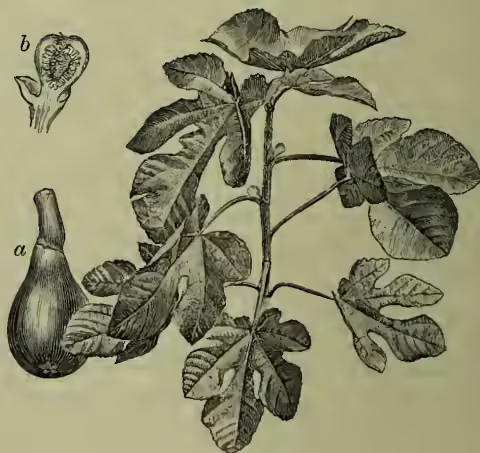
a, fruit; b, section of fruit.
The Common Fig (Ficus carica) is a native of the East, as the specific name (from Caria) imports; but it is now cultivated throughout the whole of the south of Europe, and is even found naturalised there. Its cultivation has also extended to many warm countries. In North America it is seldom to be seen farther north than Philadelphia; and it is not sufficiently hardy to be a common fruit-tree in Britain, although even in Scotland figs may occasionally be seen ripened on a wall; and in the south of England fig-trees are sometimes grown as standards, and a few small fig orchards exist. It seems to have been grown in England by the Romans, but was not reintroduced until 1525, when Cardinal Pole brought several trees to Lambeth from Italy. Protection is given in some way during winter. Near Paris, and in some other parts of the continent of Europe, fig-trees are so trained that the branches can be tied in bundles and laid along the ground, when they are covered with litter and earth, or, as in the case of the celebrated fig-tree of Roscoff (Finistère), the branches are trained over a vast area of pillared framework. The fig is a low deciduous tree or shrub (15-25 feet), with large, deeply-lobed leaves, which are rough above and downy beneath. The branches are clothed with short hairs, and the bark is greenish. The fruit is produced singly in the axils of the leaves, is pear-shaped, and has a very short stalk; the colour in some varieties is bluish-black; in others, red, purple, yellow, green, or white. The varieties in cultivation are numerous. In warm climates the fig yields two crops in the year—one from the older wood (midsummer shoots of the preceding year), and a second from the young wood (spring shoots of the same year); but in colder regions the latter never comes to perfection. Fig-trees are propagated by seed, by suckers, &c.; very frequently by layers or by cuttings. In Britain they are often to be seen in greenhouses, and grow well in pots. If the soil of the open border is too rich, root pruning must be adopted, although liquid manure may be given while the figs are swelling. Figs may be eaten 'green' (i.e. ripe) or dried, and the latter form an important article of food in the Levant; in more northern regions they are used for dessert, or for medicinal purposes, being applied to gumbols and other sores, and also administered in pulmonary and nephritic affections, and to relieve habitual constipation. The pulp contains about 62 per cent. of grape-sugar. Figs are either dried in the sun or in ovens built for the purpose. Great quantities are annually imported into Britain from the Mediterranean. The best are mostly brought from Smyrna. Greece and various parts of Italy also export figs. The finest kinds are tightly packed in boxes; others are crowded into sacks of matting, or strung, by a hole in the middle, on strings of bast. In the Levant, Portugal, and the Canaries a spirit is distilled from fermented figs. In some places figs roasted and ground are used to produce the so-called fig-coffee; the excellence of the Vienna coffee is sometimes attributed to an admixture of ground figs.
The fig has been reckoned among the most valuable fruits since the earliest times; thus, it is mentioned with corn, wine, and oil as one of the leading riches of the promised land. The Athenians, too, seem to have largely subsisted upon figs, especially before the culture of cereals became general; and a fig-tree was the device of the city. It appears that special officers were appointed to denounce illicit export or engrossing of figs, the 'sycophants,' whose title came to acquire such different meaning. But it must be noted that the word 'sycophant' in this its literal sense is not found in any ancient author. See Solms-Laubach, Domestikation des Gewöhnlichen Feigenbaums (Göttingen, 1882).