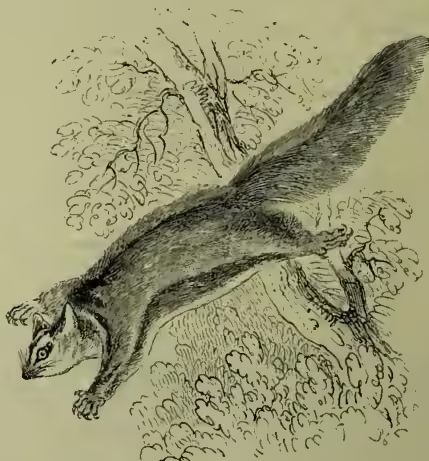
FLYING SQUIRREL (Pteromys and Sciuropterus), two genera of squirrels (Sciuridae), the members of which have a fold of skin extended from the flanks between the fore and hind legs, by means of which they are enabled to take extraordinary leaps, gliding for a great distance through the air. The tail may also aid to support them in the air, as well as to direct their motion, its hairs being often extended laterally in a sort of feathery expansion, as in some of the flying phalangers. The genus Pteromys is especially well represented in the Indian region; Sciuropterus predominates in the north. The commonest Old-World species, the Polatouche (S. volans), from north-eastern Europe and Siberia, is about the size of a rat, grayish-ash colour above, white below, the tail only half the length of the body. It lives solitarily in the forests where birches abound, is nocturnal in habit, vegetarian in diet. The most common North American species, the Assapan (S. volucella), abundant from the Gulf of Mexico to Upper Canada, is fully 5 inches long, with a tail of 5 inches additional, fur included. The general colour is brownish-gray, lighter beneath. In gliding from tree to tree it descends obliquely and with very rapid motion, perhaps for a distance of 20 yards, and always lands of course at a considerably lower level than that at which it started. The flying squirrels are all arboreal and nocturnal, and feed not only on nuts and young shoots of trees, but also on small birds. Some forms are readily domesticated; the fur is sometimes substituted for that of other squirrels. See SQUIRREL.