Fungi. The early botanists 'considered the fungi to be lusus naturæ and no plants at all,' and regarded their strange and fitful appearance without flower or apparent seed as the strongest argument for spontaneous generation. The bland wholesomeness of some, yet frightful poisonousness or destructiveness of many others, with their consequent world-old association with that crude and fanciful pharmacy in which ancient medicine and witchcraft were so inseparably intermingled, not a little enhanced these mysteries. Hence, although in Sterbeeck's Theatrum Fungorum (1675), the first published book entirely devoted to cryptogamic plants, there is an excellent account and many figures of fungi, it was not, and indeed could not be, until after that primary task of natural science initiated by Linnæus—the compilation of the 'System of Nature,' the orderly descriptive catalogue of natural things—had made considerable progress in almost all other directions, that its chapter dealing with the fungi was fully commenced. From about 1780 onwards we have illustrated cryptogamic floras essentially of the modern type, which not only soon reached tolerable completeness for the more obvious forms, but with the introduction and improvement of the microscope even made rapid progress with that description of the multifarious minor forms which is even now far from ended. It thus became known that some were produced from reproductive cells or spores, just like a plant from its seed; hence for this Linnean school, whose central monument is the works of Fries, each new form was, naturally enough, simply a new species to be described. The identification, however, of the fern and its prothallus (see FERNS) as phases of a single life-history, and the thorough reinterpretation of the higher cryptogams and their unification with the flowering plants thereupon effected by Hofmeister, naturally gave a fresh impetus to the study of the remaining lower groups of algae and fungi. For fungi, this new movement was headed by Tulasne, who from 1851 onwards showed that many of the different form-species hitherto described were actually nothing more than the phases of a single protean life-history. Tulasne essentially relied upon the actual anatomical continuity of different adult forms, upon finding reproductive structures hitherto regarded as specifically distinct on one and the same vegetative body or mycelium; while De Bary confirmed and extended these results by the complementary method of cultivation from the spore. Tulasne's new doctrine of 'the pleomorphism of the fungi' aroused storms of controversy; but the bigoted conservatism of the systematists in the defence of their results, and the exaggerated speculation and practical blundering of the younger school in the reinterpretation of them, gradually subsided as the just claims of each obtained mutual recognition; and thanks to many workers, but especially to the exact labours of De Bary and his many pupils, the classification and morphology of fungi have thereafter been in harmonious progress.
It was long before any satisfactory definition of fungi was possible, their association with algae (themselves scarcely better known) at first resting merely upon the negative characters which excluded both from the higher plants. Their physiological peculiarities, however, were more apparent; and their definition as a 'natural order' (or, as it gradually appeared, a vast class) was accepted as 'embracing all Thallophytes which do not vegetate by means of intrinsic chlorophyll.' The progress of research demonstrated the remote distinctness of some types of these from others, and the intimate relationship of certain fungi to particular algae of which they seemed to be merely the colourless forms. Hence it was argued, especially by the physiologist Sachs, that such forms were no more entitled to separate classification apart from the algae than were the very various types of flowering plants—e.g. dodder and broom-rape—which merely agree in having lost their chlorophyll through parasitism, apart from the ordinary green plants to which they are respectively akin. Abandoning, then, the physiology of the vegetative system, he proposed a classification of the algae and fungi according to their degree of reproductive development (see ALGÆ). This was, however, going too far, and systematists have returned to the more conservative proposals of De Bary, who excludes entirely from the fungi the Bacteria (q.v.) and the Myxomycetes, and, while recognising that certain fungi are doubtless merely the colourless representatives of particular algal groups, yet vastly simplifies the subject by insisting upon 'an Ascomycetous series or main series of fungi,' albeit with more or less doubtfully related outlying forms.
At the outset of this great series are usually described two orders (sometimes united as Oomycetes), both closely related in vegetative and reproductive type to such simple algae as Vaucheria (see ALGÆ). These are the Peronosporæ, including such well-known moulds of living plants as Phytophthora infestans (see POTATO, p. 356), Cystopus candidus (White Rust of cruciferous plants), also Pythium and Peronospora. The allied Saprolegnia (see SALMON) gives its name to the other family.
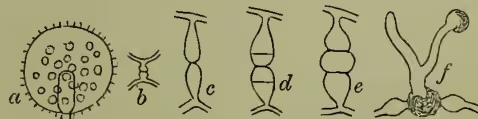
Of the Zygomycetes the commonest type is Mucor mucedo, the common white mould of dead organic matter, particularly horse-dung, a form easily cultivated and in every way peculiarly suitable for beginning the study of fungology. Starting with a spore, this germinates into a filament or hypha, which remains unicellular like that of the preceding forms, and grows and branches rapidly through the nutrient material or solution, the whole growth of hyphae being termed the mycelium. Soon erect hyphae begin to bud from the older hyphae of the mycelium; the tips of these enlarge into spherical heads, which become separated off as distinct cells, the future sporangium, by a partition which grows, however, inwards, into the interior of the enlarging spherical head, as the columnella. The protoplasm of the sporangium is meantime dividing into a multitude of tiny cells, which surround themselves with cell-walls as spores, while the mineral waste products of this active change are deposited in the common sporangial wall, rendering it exceedingly brittle. This readily breaks, scattering the spores, which immediately recommence the same development.
Sooner or later, however, a more evolved process of reproduction is needed, and two adjacent hyphæ conjugate much as in Spirogyra (see fig. 1, b-c, and ALGÆ, fig. 4). The resultant zygospore after a period of rest germinates with only a rudimentary mycelium, and immediately reproduces the characteristic asexual sporangium. Empusa, of which E. musce is largely fatal to house-flies in autumn, is the type of the analogous order Entomophthoreæ. The Chytridiaceæ are an order of minute fungi of which the life-history is fundamentally similar to that of the Protococcaceæ among algae.
The Ustilagineæ are a large family, parasitic on phanerogamous plants. Their mycelium ramifies through the intercellular spaces of the host, and forms also densely-woven masses of spore-bearing hyphæ, which show various degrees of differentiation as compound sporophores, so foreshadowing those of higher fungi. These spores produce a short mycelium, of which the branches conjugate in pairs, while the new mycelia thereafter arising re-enter the plant and in time produce new asexual spores. Some are formidable pests of agriculture (Ustilago, Tilletia).
ASCOMYCETES proper.—The mycelium is always composed of multicellular hyphæ, which in the higher forms interweave into the stroma or thallus, which assumes various characteristic forms and bears the short reproductive hyphæ, which in turn bear the spore-mother cells or asci. These are usually tubular, and on reaching full size their protoplasm collects at the top, and the nucleus
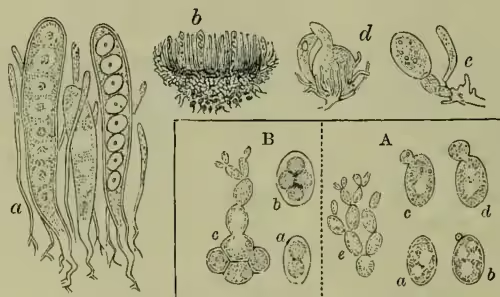
a, asci, with barren filaments (paraphyses); b, section of fructification surface (hymenium); c, preparations for the sexual process which precedes the development of the fungus-body; d, fertilisation, with upgrowth of an enveloping tissue, the incipient sporocarp.
Fig. 2a.—Yeast (Saccharomyces cerevisiæ):
A, a, b, c, d, early stages of budding; e, later stages; B, starved yeast cell, dividing at a to form four ascospores at b; c, subsequent germination on return to nutritive fluid.
divides repeatedly, usually producing eight nuclei, which collect protoplasm around them, and, developing cell-walls, become perfect ascospores. In all save a few of the lowest forms (Eremascus, Exoascus, &c., which are accordingly grouped as Gymnoasci) the fructification is in distinctly developed sporocarps. In these, besides the ascogenous hyphæ with their asci, there is an envelope derived from distinct hyphæ of the stroma, which also send in amongst the asci a multitude of barren filaments, the paraphyses. The aggregate of asci and paraphyses is termed the hymenium (see fig. 2, a, b). Tulasne and De Bary have shown with tolerable certainty (despite the doubts of Van Tieghem and Brefeld) that the whole fructification arises in consequence of a conjugation of similar hyphæ in the lowest forms (Eremascus), or the sexual union of dissimilar ones in higher forms (e.g. Peziza, fig. 2, c, d).
A brief systematic enumeration of the orders and leading illustrative forms of Ascomycetes will be found of service :
(1) Gymnoasci.—Asci not forming definite sporocarps with envelope (Eremascus, Exoascus).
(2) Discomycetes (800 species).—Sporocarp with envelope, but hymenium completely uncovered, at least at maturity. The most important genus is Peziza, of which the shallow cup-like sporocarp is open from the beginning, though in the allied Ascobolus the envelope encloses the hymenium during development and bursts, scattering the spores. Bulgaria resembles this, but is gelatinous. In Dermatia the cup is leathery or horny. In Stictis the hymenium is almost withdrawn into the stroma, while in Placidium the sporocarp only breaks out and opens when ripe. In a second but less important family the sporocarps are leathery and black, elliptical, linear, or winding; of these Hysteria the commonest is Rhytisma acerinum, which forms the large black spots that appear upon almost every leaf of the common maple towards autumn. The Helvellacei represent an opposite type of development; the large sporocarps are stalked, with club or hat shaped hymenia, open and uncovered by the envelope from the beginning. Many are important as esculent, notably the morels (Morechella esculenta, deliciosa, &c.), also Helvella esculenta. The mycelium of Rasteria hypogea, found on dead and diseased vine-roots, is the 'pourridé de la vigne' of wine-growers.
Among the Discomycetes the life-history is often rendered more complex by the mycelium constricting off acrospheres from the tips of erect filaments, these acrospheres readily reproducing the mycelium. This stage of Peziza Fückeliana was formerly known as Botrytis cinerea; and many other acrosphere-bearing moulds still await similar identification. Vegetative hyphæ also frequently interweave into dense resting masses or sclerotia, as also in the species just named, and those may either redevelop acrosphere-bearing hyphæ or (after a winter) give rise to true hymenial cups. Acrospheres, too, may be developed either upon isolated hyphæ or in pseudo-hymenial groups, which may be open or flask-shaped (pycnidia). Nor are the many possibilities of 'pleomorphic' variation thus opened up by any means confined to the Discomycetes.
(3) Pyrenomycetes.—This is a large order of small and inconspicuous fungi, in all respects representing a further differentiation of the Discomycete type, primarily in the deepening of the shallow cup-shaped hymenium into a deep flask with minute apical opening (perithecium), but also in a more varied development—the most extreme among fungi—of pleomorphism or alternation of generations. The number of species is hence very uncertain. Besides the important Ergot (Claviceps purpurea, see ERGOT), and its curious ally Cordyceps, which attacks caterpillars, moths, wasps, &c., with its fructification, thus forming the extraordinary 'animal-plants' and 'vegetating insects' which so perplexed the early naturalists, any of the common forms into which the old (and once all-comprehensive) genus Sphæria has been broken up will serve as type, conveniently Nectria, common in red patches upon dead wood. Some form parasitic patches within lichens.
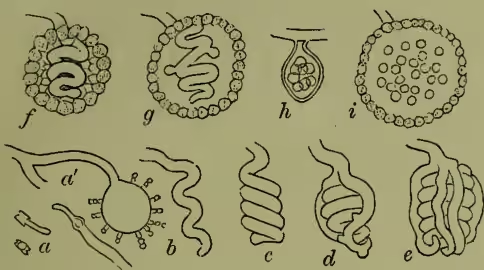
(4) Perisporiaceæ.—In these the perithecia are completely closed capsules which fall to pieces on ripening; there are no paraphyses. The mycelium is thread-like, and acrospheres are frequent. Of the 100 species some are notable pests, witness Erysiphe and others, commonly grouped as Mildew (q.v.), Oidium Tuckeri, a pestilent vine disease, &c. Easily distinguished by the dark or inconspicuous mycelium are the species of Fumago. To this group also belongs Eurotium, of which the common Bread Mould (E. Aspergillus-glaucus) is a type commonly put before the botanical student, from the comparative facility with which the sexual process, which sets in after prolonged multiplication by ascospores, can be observed, with its resultant development of the perithecium and its asci (see fig. 3).
(5) Tuberacei.—In this group, as in the preceding, the hymenium is permanently without external opening, but the chambers become narrow, coiled, and branched, and the whole complex sporocarp thus attains an extreme complexity. Most are subterranean, and are best represented by the important genus Tuber (see TRUFFLE). With this (or sometimes in the last group near Elaphomyces) is to be reckoned the very common mould of jam, bread, &c. (Penicillium glaucum); it rarely, however, attains full development beyond the acrospore-bearing form.
(6) Lichenes.—As the majority of lichen-forming fungi belong to the Ascomycetes, the lichens are very commonly now described under this head by recent writers. Yet not only the time-honoured distinctness of this group, but its remarkable variety and interest make separate treatment still expedient, hence see LICHENS.
Besides the large number of forms in which the existence of an acrosporous phase as yet rests upon analogy alone, De Bary reckons as 'doubtful Ascomycetes' such forms as Laboulbenia, Exoascus, and also the important species which excite alcoholic fermentations, Saccharomyces (fig. 2a). See YEAST, FERMENTATION.
From forms in which the characteristic mode of reproduction of the Ascomycetes is only doubtfully represented we readily pass to those in which it does not appear at all, but in which multiplication occurs only by acrospores or basidiospores, which may be of various forms. One group, however, we have to consider in which the sporocarp, here termed an aecidium, so closely resembles that of an Ascomycete as to induce De Bary and most writers to reckon it with these rather than with the following series.
(7) The Uredineæ or Aecidiomycetes.—These are the Rust fungi, a remarkable series of parasitic moulds, formerly associated with the Ustilagineæ, which they somewhat resemble in habit, but from which they differ in structure and life-history. The alternation of generations is remarkably complete and well differentiated, the different forms having constantly been reckoned in distinct genera, which are as yet by no means fully criticised. The most familiar case is that of the Rust of wheat (Puccinia graminis), in which the generation found on the barberry was described as Aecidium berberidis. Other important forms are known as Uredo sp. &c.; to this group is also reckoned the coffee disease of Ceylon, Hemileia vastatrix. The life-history of the group will be understood by reference to RUST.
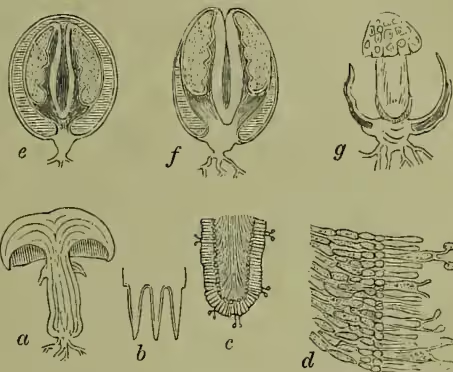
BASIDIOMYCETES.—We now come to the Basidiomycetes proper, which derive their name from the basidia which segment off or 'abjoint' the spores (fig. 4, d). These are usually non-parasitic and have generally large and well-developed sporocarps; they are divided into two main groups.
A. HYMENOMYCETES.—Hymenium exposed upon the surface of the sporocarp. (a) Tremellini.—Gelatinous with basidia each bearing only one spore; often arising laterally—Auricularia (Jew's Ear), Tremella (q.v.). (b) Hymenomycetes proper, not gelatinous, two to six spores arising on each basidium (fig. 4, a—d).
In the simplest forms the sporocarp is erect or branched, and bears a hymenium over its whole surface. Of this small group of (1) Clavariini many species of Clavaria are common.
(2) In the allied Thelephorei the hymenium forms also a simple smooth surface, but is restricted either to the upper or under surface; in the latter case the fungus may be sessile or stalked, and have a distinct 'hat' or pileus (Thelephora, Stereum, &c.).
(3) In the Hydnei the hymenium becomes differentiated in various irregular and discontinuous forms, which may be warty, bristly, or comb-like.
(4) In the Polyporei the hymenium is continuous, but with many more or less tubular depressions. Here belong several important genera, notably Boletus (q.v.), Polyporus (see AMADOU), Fistulina (q.v.), as well as the pestilent Merulius lachrymans (Dry Rot, q.v.).
(5) In the immense group of Agaricini (1200 European species) the series culminates, the hymenium being arranged in regular radiating lamellae or gills. Most important of course is the genus Agaricus and Mushroom (q.v.), which is broken up into many subgenera (Amanita, Armillaria, &c.). Cortinarius, Hygrophorus, Russula, Lactarius, Coprinus, Cantharellus (chantrelle), Marasmius are also important. Many of these are edible, others again poisonous.
B. GASTEROMYCETES.—Here the spores arise quite as in Basidiomycetes; but the hymenia are completely enclosed within the fungus-body. Of this the outer layer (peridium) becomes differentiated from the deeper substance (gleba). Both layers may undergo very remarkable histological and anatomical modifications, and these changes of ripening often result in the sudden acquirement of the most extraordinary forms. Hence, although the species are by no means so numerous (about 550), there are 70 genera. These are mostly large fungi, often edible, at least in the young state; few are positively poisonous.
(1) Of the mostly subterranean and truffle-like Hymenogastrei, one genus, Gautiera, affords an interesting transition from the Hymenomycetes, its hymenial depressions remaining open and uncovered by any differentiated peridium. In the remaining types (Hymenogaster, &c.) the gleba contains many closed internal hymenial chambers, but remains continuous with the simple peridial coat.
(2) The Sclerodermai differ little from the preceding, save in the more differentiated peridium, from which the gleba dries away in a brittle network, lining the chambers, which become filled with spores. Scleroderma vulgare is sometimes used as an adulterant of truffles, but is commonly regarded as inedible.
(3) In the simplest Lycoperdinei or puff-balls the gleba may remain unchambered, but the tissue of the gleba usually breaks up into a woolly mass of dried hyphæ; hence the peridium when broken on ripening discloses a dusty mass of threads and spores (Lycoperdon, Bovista). See PUFF-BALL.
(4) In another series, the Phalloidei in the widest sense, we have a very singular series of forms. This begins with the simple earth-star (Geaster), which is essentially a puff-ball with outer and inner peridium, of which the outer opens into radiating lobes. In Batarrea, the gleba, covered with the inner peridium, becomes raised upon a long stalk; in Phallus (see fig. 4, e, f, g) the outer peridium, fibrous outside, becomes gelatinous within, while the stalk pushes the gleba through the inner peridium also, as a naked cap from which the spores drop away; while in Clathrus it is the inner peridium which expands as a large network.
(5) In the last series, that of Nidularici, the external peridium opens, disclosing several separate 'peridioles,' each containing a hymenial tissue, which breaks down into a mass of spores. These are the 'bird's-nest fungi' (Cyathus, Nidularia, &c.). The origin of the Gasteromycete sporocarp from its mycelium appears to be without any sexual process, but by a process of direct growth and differentiation of an upgrowth upon its mycelium. In Hymenomycetes a sexual process has been sometimes described, but not with absolute certainty. We know, however, how constantly the abundant nutrition of an organism leads to the relapse from sexual to asexual multiplication.
As an appendix to this outline of classification, it is necessary to note that we not unfrequently find sterile mycelium forms, to which any definite systematic position frequently cannot be given. Such are, for instance, the well-known Racodium cellare of wine-cellars. There has been much dispute over the nature of the complex strands of Rhizomorphæ, now regarded as belonging for the most part to Agaricus melleus, while the old genus Sclerotium has long been recognised as a resting state of many diverse forms—e.g. Ergot.
Germination.—Most spores are capable of immediate germination: such are most ascospores (gonidia), almost all ascospores, and most spores of Hymenomycetes. Some, however, require a period of rest: such are most oospores, zygospores, winter spores, &c. Although some spores perish almost immediately, many others exhibit considerable powers of resistance to heat, cold, drought, &c.; those of some moulds have been germinated from herbarium specimens three to ten years old. For germination we require a reasonable temperature, varying with the species, with supply of oxygen and moisture; nutritive matter may also be necessary. Many spores, however, have never as yet been observed to germinate at all, notably those of the truffle and some other Ascomycetes, of most
Gasteromycetes, and of a few Hymenomycetes, including even the common mushroom.
Nutrition and Mode of Life.—The characteristic absence of chlorophyll renders the fungus unable to decompose carbonic anhydride. Hence it must depend upon organic compounds already formed. Almost any soluble carbon compound, not too poisonous or too fully oxidised (such as formic or oxalic acid, urea, &c.), will, however, serve for this, and similarly with most nitrogen compounds, even urea. The constituents of the ash can also be obtained from a wide range of substances. Penicillium grows best in a solution of proteid (peptone) and sugar, yet can be grown, of course with diminishing vigour, upon a whole series of poorer solutions, down to ammonium acetate. All of course give off carbonic acid in respiration, and a few are remarkably phosphorescent.
Such facts help us more clearly to understand the wide range of habitat presented not only by the different members of the group, but by the same species. Those fungi which normally obtain their organic matter from the dead organic matter of decaying bodies are termed saprophytes, while those which obtain them from living plants or animals are termed parasites. The former is doubtless to be regarded as the primary state of things, and includes the great majority of fungi, yet many normal saprophytes exhibit 'facultative parasitism,' and conversely normal parasites may exhibit 'facultative saprophytism.' Many saprophytes require a specific substratum—e.g. dung, feathers, &c.—just as many parasites have only a single host; others again have a very wide range of habitat. The chemical effects of the growth of fungi, with which, for physiological purposes, we may also reckon the Bacteria (q.v.), upon organic substances are outlined under FERMENTATION and PUTREFACTION. The relation of specific parasites to their hosts, besides mention in the various special articles, such as ERGOT, MILDEW, and RUST, is more generally treated under PLANTS (DISEASES OF) and PARASITIC PLANTS; the pathological bearings (the GERM THEORY) at GERM, and articles there cited. That remarkable adjustment of fungus and host which rises beyond the pathological level into the healthy and permanent mutual adaptation known as Symbiosis (q.v.) is described, for the association of fungus and alga, under LICHENS; that of fungus-mycelia with the roots of phanerogamous trees is the so-called Mycorhiza.
Uses of Fungi.—Of species used in medicine, the only one now of importance is Ergot (q.v.): the narcotic use of the Siberian fungus has also been described under AMANITA. Amadou (q.v.) and Moxa (q.v.) are old sources of tinder, and Polyporus squamosus, cut in slices, was much used for razor-strops. But the chief use of fungi is for food and in the manufacture of Ketchup (q.v.).
Although few fungi are used as food, and most popularly regarded as poisonous, the positively dangerous species are really by no means very numerous. Yet the risks of incautious gathering must not be understated, since not only are some edible fungi liable to be confounded with poisonous forms, but some normally wholesome forms acquire poisonous properties under particular circumstances, although whether this be due to definite variation or to the chemical changes of incipient decomposition remains doubtful. Hence our common mushroom is excluded from the Italian markets. There is no certain rule which can supersede the need of experience and caution in discriminating wholesome from unwholesome forms, the popular beliefs—e.g. that the latter only will discolour a silver spoon if stirred with it while being cooked, or that they are more readily deliquescent—being without foundation. Nor does colour or odour afford any certain test, for, although most forms of gaudy exterior or readily changeable internal colour may be suspected, and all fetid ones of course avoided, some poisonous ones are quite inconspicuous and inoffensive. Again, some which are pungent and acrid while raw become bland and wholesome when cooked; maceration in vinegar or brine produces a similar effect.
The importance of fungi as an article of diet is naturally minimised in Britain through the prevailing ignorance and the consequent excessive distrust; in France, and especially in Italy, they are of much greater importance. The culture of the Mushroom has, however, of late years become increasingly frequent, while on the Continent that of a number of other species has long been practised with more or less success, as notably of Agaricus, Boletus, &c., and more recently of the truffle. The leading edible fungi have already been noted, and are also in most cases the subject of separate articles; it may suffice therefore here to bring together the most important. Besides the Mushroom, its immediate congeners, and its closer allies, such as the Chantrelle (Cantharellus cibarius), we have among the Hymenomycetes a number of species of Boletus and of Polyporus, also Fistulina hepatica, and several species of Lactarius, Hydnum, and Clavaria, with Marasmius oryzae. Among Gasteromycetes, the puff-balls (Lycoperdon, Bovista), in the young state. Of Ascomycetes, the Morel, Helvella, with Verpa, some of Peziza, &c., and, of course, above all others, the Truffle. Cyttaria Darwinii, which grows on beeches in Tierra del Fuego, forms an important article of native diet.
Poisonous Effects and Treatment.—Noxious species may produce sometimes irritant, sometimes narcotic effects. The effects appear soon after the meal, and may be manifested by giddiness, dimness of sight, and debility. The person may seem intoxicated, and there may be singular illusions of sense, while even spasms and convulsions may appear in the most serious cases. In most cases, however, recovery takes place, especially if vomiting be early induced. Hence emetics should be administered as promptly as possible, and castor-oil also given freely.
For general accounts of fungi, see the leading textbooks of botany, notably Goebel's Outlines of Classification (Oxford, 1887), and those of Van Tieghem and Luerssen; or, very conveniently, Bennett and Murray's Cryptogamic Botany (Lond. 1889). The central work is De Bary's Comp. Morphol. and Biol. of Fungi, &c. (Eng. trans. Oxford, 1887). Systematic information must be sought in works such as Saccardo's Sylloge Fungorum, and the various cryptogamic floras, such as M. C. Cooke's Handbook of British Fungi (2d ed. 1887), his Illustrations of British Fungi (2d ed. 6 vols. 1884-88), or Stevenson's Mycologia Scotica and Hymenomycetes Britannici. Leunis, Synopsis der Pflanzenkunde, vol. iii., is also of service. For esculent fungi, see Badham, Esculent Funguses of England (1863); W. G. Smith, Mushrooms and Toadstools (1879).