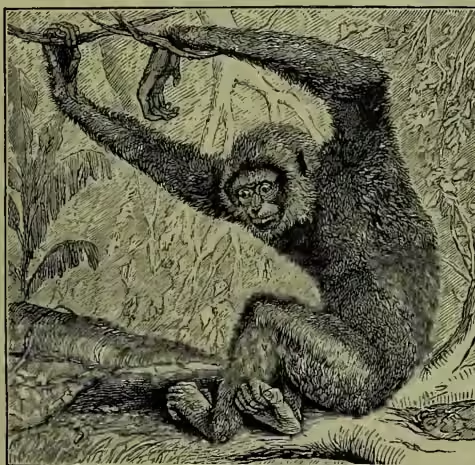
Gibbon (Hylobates), a genus of tail-less anthropoid apes, natives of the East Indies. They are nearly allied to the orangs and chimpanzees, but are of more slender form, and their arms so long as almost to reach the ground when they are placed in an erect posture; there are also naked callosities on the buttocks. In this respect they differ from the other Anthropoid Apes (q.v.), and are allied to some of the Catarrhini; in other respects also the Gibbons are the lowest among the anthropoid apes, and connect them with the Catarrhini. The gibbons are inhabitants of forests, their long arms enabling them to swing themselves from bough to bough, which they do to wonderful distances, and with extreme agility. They cannot, however, move with ease or rapidity on the ground. The conformation of the hinder extremities adds to their difficulty in this, whilst it increases their adaptation to a life among the branches of trees, the soles of the feet being much turned inwards. None of the gibbons are of large size. There are some eight or ten species. The Common Gibbon, or Lar on (H. lar), is found in some parts of India, and in more eastern regions. The Active Gibbon (H. agilis), found in Sumatra, is particularly remarkable for the power which it displays of flinging itself from one tree to another, clearing at once, it is said, a distance of forty feet. The Wow-wow (H. leuciscus) is a gibbon found in Malacca and the Sunda Isles. H. leucogenys is from Siam. The Hoolock (H. Hoolock) is a native of the Garrow Hills. The Siamang (H. syndactylus), a Sumatran species, differs from the rest of the genus in having the first and second fingers of the hinder extremities united together up to the second joint; it resembles the Orang (q.v.), and differs from the true gibbons in having a large air-sac opening into the windpipe. All the gibbons are of gentle disposition, and easily domesticated. At present the gibbons are confined to south-eastern Asia and some of the larger islands bordering upon the continent, but it is possible that Dryopithecus found fossil in Tertiary strata of the south of France, of the size of a man, is referable to the same group. See figure of the skeleton at ANTHROPOID APES.