Gold (symbol Au, atomic weight 196) is perhaps the most widely and universally sought product of the earth's crust. In the very earliest writings which have come down to us gold is mentioned as an object of men's search, and as a commodity of extreme value for purposes of adornment and as a medium of exchange. The importance which it possessed in ancient times has certainly not lessened in our day. Without the enormous supplies of gold produced at about the time when the steam-engine was being brought into practical use it is difficult to imagine how our commerce could have attained its present proportions; and but for the rush of immigrants to the gold-fields in the beginning of the second half of this century Australia might have remained a mere convict settlement, and California have become but a granary and vineyard.
On the score of geographical distribution, gold must be deemed a common metal, as common as copper, lead, or silver, and far more common than nickel, cobalt, platinum, and many others. Theorists have propounded curious rules for the occurrence of gold on certain lines and belts, which have no existence but in their own fancy. Scarcely a country but has rewarded a systematic search for gold, though some are more richly endowed than others, and discoveries are not always made with the same facility. The old prejudices, which made men associate gold only with certain localities, hindered the development of a most promising industry even within the British shores. Despite the abundant traces of ancient Roman and other workings, the gold-mines of Wales were long regarded as mythical; but recent extended exploitation has proved them to be among the richest known. This is notably the case in the Dolgelly district, where considerable gold occurs, both in alluvial gravels and in well-formed quartz veins traversing the Lower Silurian Lingula beds and the intruded diabasic rocks called 'greenstone' in the Geological Survey. A peculiarity of the veins is the common association of magnesian minerals. The gold is about 20 or 21 carat fine, and often shows traces of iron sesquioxide. So long ago as 1861 some £10,000 worth of gold per annum was taken out of the Cloghan mine by imperfect methods. Some samples have afforded 40 to 60 ounces per ton—a most remarkable yield. There are probably many veins still awaiting discovery.
To quote another European example, Hungary afforded the Roman conqueror fabulous riches, and will yet produce untold wealth, when the capitalist shall condescend to look so near home. Statistics concerning the annual gold output of the world are for many reasons only approximately correct. In countries where a royalty is payable on the gold mined 'returns' are sure to be much below the actual yield; while in uncivilised lands no record is kept. Therefore it is not easy to arrive at a computation of the yearly production. But it is certain that the tendency in 1881-90 was toward a decline rather than the contrary. This is due to the fact that the enormous placer deposits of many regions had to a great degree been worked out; and, though vein-mining was extended as the placers failed, the extraction of gold from the vein-stuff was a slower and more costly operation, requiring a larger expenditure of capital and employing more labour. Thus, the great yields obtained between 1850 and 1870, reaching 30 to 40 million pounds sterling annually, were the result of extensive placer operations that gradually ceased. In 1881-90 the average production was £21,738,000. But the development of gold-mining was such that in 1896 the production was more than double, approximately £45,000,000, distributed thus: United States, £10,800,000; Australasia, £8,988,000; Transvaal, £8,604,000; India, £5,911,000; Russia and other countries (including British Guiana, British Columbia, &c.), £10,697,000. This did not include any gold from the enormously rich field of Klondyke, &c., in the upper Yukon valley, which began to attract notice only in that year. Other recent developments were those in the Transvaal (q.v.) and Western Australia (q.v.). From 1850 till 1896 the total gold production was estimated at 300,000,000 ounces, with a value of £1,163,000,000. For the appreciation of gold and the economic questions thence arising, see BIMETALLISM. See also GILDING, GOLD-BEATING.
Geologically, as well as geographically, gold is widely dispersed. The early geologists propounded theories concerning the age of gold deposits which did as much to retard the development of gold-mining as to promote it; for while they indicated certain formations as being probably auriferous, and drew attention to them, they, on very slight grounds, pronounced other formations to be positively non-auriferous, and thus dissuaded prospectors from studying beds which almost accidentally have been found to be rich in gold over enormous areas and to great depths. In the light of modern explorations it would be unsafe to say that any formation must a priori be barren of gold. On the contrary, its presence may be always anticipated, if not in workably paying quantity, until its absence has been proved.
The origin of gold-bearing mineral veins is inseparably connected with that vexed question, the origin of mineral veins generally (see ORE-DEPOSITS). Suffice it to say here in brief that, while one class of geologists ascribe it exclusively to igneous agencies, another class as stoutly defend a theory of aqueous solution. It is not unreasonable to suppose that the truth lies between the two parties—that some deposits are due to plutonic and others to aqueous origin. Gold has been found and worked in rocks of undoubted igneous origin and of primary age. It has also been found in the interstices of a lava ejected within historic times. On the other hand, its presence has been proved in the water of the seas surrounding the British Islands, and in the deposit formed by hot springs now in activity. Speaking broadly, a gold deposit may be of any geological age, from that of the oldest rocks to that of rocks still in course of formation. But hitherto its presence in notable quantity has been chiefly proved in connection with certain formations. Taking the sedimentary rocks in chronological order, the chief auriferous regions may be classified as follows: Metamorphic rocks afford the chief gold-supplies of Nevada, South Dakota, Siberia, Hayti, India, Japan, and New Caledonia. Laurentian rocks are auriferous in West Africa, Brazil, and Canada: Cambrian in Nova Scotia and Brazil. Silurian is the great gold formation of Australia, and figures in New Zealand, French Guiana, and the Andes. Devonian age is ascribed to some of the gold of Cornwall, Siberia, and Australia. The coal-measures of Queensland, partly of Carboniferous and partly of Permian age, enclose the Gympie goldfield; and some of the gold beds of New Zealand, New Brunswick, Nova Scotia, New Mexico, Ladakh, India, New South Wales, and Somersetshire are of Carboniferous age. The Jurassic formation has not proved of much importance, but affords some gold in Europe and Mexico. Triassic rocks are abundantly gold-yielding in California and Mexico. Chalk is probably as little associated with gold in men's minds as is coal, yet the Cretaceous rocks of California, South Dakota, New Zealand, Queensland, Afghanistan, and Hungary afford large supplies of the precious metal. The Tertiary gravels of the western states of America and of Australasia have been the source of the enormous yields of placer gold from those countries, and embrace thousands of square miles of Miocene, Pliocene, and Post-pliocene beds resulting from the erosion and disintegration of the gold-carrying veins of the older rocks.
Of the igneous rocks with which gold is associated, diorites hold a foremost place in Hungary, Nevada, New South Wales, Victoria, Queensland, South America, Italy, the Urals, India, Turkestan, New Guinea, and New Zealand. Granite, syenite, and gneiss are auriferous in Colorado, Virginia, Carolina, South America, Canada, Australia, Turkestan, Asia Minor, Hungary, and Siberia. Porphyritic rocks carry some of the gold of Queensland, Victoria, New Zealand, Borneo, and South America. The serpentine of Queensland and Newfoundland have yielded gold; while the trachytes of New Zealand, South Dakota, Mexico, Queensland, and Hungary are important gold-carriers.
By far the most common matrix of vein-gold is quartz or silica, but it is not the only one. To pass by the metals and metallic ores with which gold is found (because it will be more convenient to deal with them when speaking of the treatment necessary to release the gold), there are several other minerals which serve as an envelope for the precious metal. Chief among them is lime. Some of the best mines of New South Wales are in calcareous veins. Sundry gold reefs in Queensland, New South Wales, Victoria, and Bohemia are full of calcite. Dolomite occurs in Californian and Manitoban mines; and apatite, aragonite, gypsum, selenite, and crystalline limestone have all proved auriferous, while in some cases neighbouring quartz has been barren. Felspar in Colorado and felsite magnesian slate in Newfoundland carry gold.
The physical conditions under which gold occurs are extremely variable. Popularly speaking, the most familiar form is the 'nugget,' or shapeless mass of appreciable size. These, however, constitute in the aggregate but a small proportion of the gold yielded by any field, and were much more common in the early days of placer-mining in California and Australia than they are now. The largest ever found, the Welcome Nugget, discovered in 1858 at Bakery Hill, Ballarat, weighed 2217 oz. 16 dwt., and sold for £10,500, whilst not a few have exceeded 1000 ounces. The origin of these large nuggets has been a subject for discussion. Like all placer or alluvial gold, they have been in part at least derived from the auriferous veins traversing the rocks whose disintegration furnished the material forming the gravel beds in which the nuggets are found. But no mass of gold has ever been discovered in a vein equal in size to many of the nuggets unearthed from the gravels. Hence has arisen a theory that in the course of ages nuggets have 'grown' in the gravels—that is to say, nodular fragments of gold have gradually accumulated and attached to themselves smaller fragments with which they came in contact, and perhaps helped to cause the re-deposition of gold held in suspension or solution by mineral waters which have percolated through the superincumbent mass of gravel. Gold nuggets have been artificially formed in the laboratory by decomposing solutions of the chloride or sulphide. In the earliest experiments organic matter was added to effect the decomposition—e.g. a piece of wood; but it has been found that the presence of organic matter is by no means necessary, and that fragments of pyrites and other mineral bodies common in auriferous formations are very suitable nuclei on which the gold accumulates in a concretionary state, resembling natural nuggets.
The more common form of alluvial gold is as grains, or scales, or dust, varying in size from that of ordinary gunpowder to a minuteness that is invisible to the naked eye. Sometimes indeed the particles are so small that they are known as 'paint' gold, forming a scarcely perceptible coating on fragments of rock. When the gold is very fine or in very thin scales much of it is lost in the ordinary processes for treating gravels, by reason of the fact that it will actually float on water for a considerable distance.
Vein-gold is often crystalline in structure, the elementary form being cubical. In some localities too, notably in Hungary, it assumes most beautiful leaf-like forms, such fetching a high price among collectors for mineral cabinets. In the ores of other metals, such as pyrites, galena, &c., gold very commonly occurs as an accessory, but cannot be detected except by assay. Whether, as in all other cases, the gold exists in the native state in such ores is open to some doubt. It is never found absolutely pure; some silver is always present as an alloy, and occasionally also bismuth, lead, and tellurium.
From what has been already said it will be evident that gold-mining must be an industry presenting several distinct phases. These may be classed as alluvial mining, vein-mining, and the treatment of auriferous ores.
In alluvial mining natural agencies, such as frost, rain, &c., have, in the course of centuries, performed the arduous tasks of breaking up the matrix which held the gold, and washing away much of the valueless material, leaving the gold concentrated into a limited area by virtue of its great specific gravity. Hence it is never safe to assume that the portion of the veins remaining as such will yield anything like so great an equivalent of gold as the alluvials formed from the portion which has been disintegrated. As water has been the chief (but not the only) agent in distributing the gold and gravel constituting alluvial diggings or placers, the banks and beds of running streams in the neighbourhood of auriferous veins are likely spots for the prospector, who finds in the flowing water of the stream the means of separating the heavy grains of gold from the much lighter particles of rock, sand, and mud. Often the brook is made to yield the gold it transports by the simple expedient of placing in it obstacles which will arrest the gold without obstructing the lighter matters. Jason's golden fleece was probably a sheepskin which had been pegged down in the current of the Phasis till a quantity of gold grains had become entangled among the wool. To this day the same practice is followed with ox-hides in Brazil, and with sheepskins in Ladakh, Savoy, and Hungary. This may be deemed the simplest form of 'alluvial mining.' If the gold deposited in holes and behind bars in the bed of the stream is to be recovered, greater preparations are needed. Either the river-bed must be dredged by floating dredgers, worked by the stream or otherwise; or the gravel must be dug out for washing while the bed is left dry in hot weather; or the river must be diverted into another channel (natural or artificial) whilst its bed is being stripped. The first-named method is best adapted to large volumes of water, but probably is least productive of gold, passing over much that is buried in crevices in the solid bed-rock. The second plan is applicable only to small streams, and entails much labour. The third is most efficient, but very liable to serious interference by floods, which entail a heavy loss of plant.
In searching for placers it is necessary to bear in mind that the watercourses of the country have not always flowed in the channels they now occupy. During the long periods of geological time many and vast changes have taken place in the contour of the earth's surface. Hence it is not an uncommon circumstance to find beds of auriferous gravel occupying the summits of hills, which must, at the time the deposit was made, have represented the course of a stream. In the same way the remains of riverine accumulations are found forming 'terraces' or 'benches' on the flanks of hills. Lacustrine beds may similarly occur at altitudes far above the reach of any existing stream, having been the work of rivers long since passed away.
So far, account has been taken only of gravels lying practically within view. But in many instances an enormously thick covering of more recently distributed material, resulting from the denudation of non-auriferous rocks, hides the earlier gravel, which is auriferous. Such a phenomenon was not suspected until the first instance of the kind was discovered by some miners who, in following a gravel patch formed by an existing watercourse, were led to burrow into the side of the adjacent hill, under which the golden ground continued to be found, and then men realised that the modern stream was only redistributing the rich accumulation made by a river belonging to a system that had ceased to exist. As prospecting extended and became a subject for scientific study, such instances rapidly multiplied, and to these 'deep leads' or 'dead rivers' is due the bulk of the placer gold found in Australasia and California. Generally the watersheds in the extinct system run at right angles to the present, so that operations often extend under modern hill-ranges. A more surprising discovery was that many of the ancient river-beds had been filled up by flows of volcanic rock, and in not a few cases several streams of molten matter had at varying intervals displaced the river, which afterwards resumed its course and its habits, so that the extraordinary feature is encountered of several superposed beds of auriferous gravel alternating with layers of lava.
Another form of alluvial digging occurs in Western America and New Zealand, where the sea washes up auriferous sands. These are known as 'ocean placers' or 'beach diggings,' and are of minor importance.
Whilst most placers have been formed by flowing water, some owe their origin to the action of ice, and are really glacial moraines. Others are attributed to the effects of repeated frost and thaw in decomposing the rocks and causing rearrangement of the component parts. Yet another class of deposits is supposed to have been accumulated by an outpouring of volcanic mud. And, finally, experts declare that some of the rich banket beds of the Transvaal became auriferous by the infiltration of water containing a minute proportion of gold in solution.
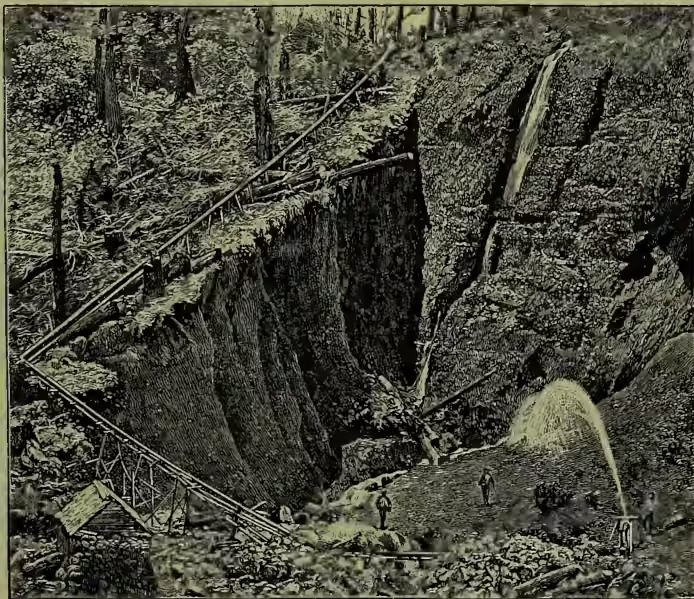
In all cases the recovery of alluvial gold is in principle remarkably simple. It depends on the fact that the gold is about seven times as heavy, bulk for bulk, as the material forming the mass of the deposit. The medium for effecting the separation is water in motion. The apparatus in which it is applied may be a 'pan,' a 'cradle,' or a 'tom,' for operations on a very small scale, or a 'sluice,' which may be a paved ditch or a wooden 'flume' of great length, for large operations. The modus operandi is the same in all: flowing water removes the earthy matters, while obstructions of various kinds arrest the metal. As a rule it is more advantageous to conduct the water to the material than to carry the material to water. In many cases a stream of water, conveyed by means of pipes, and acting under the influence of considerable pressure, is utilised for removing as well as washing the deposit. This method is known as 'piping' or 'hydraulicizing' in America, where it has been chiefly developed, but is now forbidden in many localities, because the enormous masses of earth washed through the sluices have silted up rivers and harbours, and caused immense loss to the agricultural interest by burying the rich riverside lands under a deposit that will be sterile for many years to come. The plan permits of very economical working in large quantities, but is extremely wasteful of gold. The water-supply is of paramount importance, and has led to the construction of reservoirs and conduits, at very heavy cost, which in many places will have a permanent value long after gold-sluicing has ceased. These large water-supply works are often in the hands of distinct parties from the miners, the latter purchasing the water they use. To give an example of the results attained in alluvial mining, it may be mentioned that in a three-months' working in one Victorian district in 1888 over 33,500 tons of wash-dirt were treated for an average yield of 184 grains of gold per ton, or say, one part in 700,000. Where water cannot be obtained recourse is had to a fanning or winnowing process for separating the gold from the sand, which, however, is less efficacious.
Vein-mining for gold differs but little from work- ing any other kind of metalliferous lode. When the vein-stuff has been raised it is reduced to a pulverulent condition, to liberate the gold from the gangue. In some cases roasting is first resorted to. This causes friability, and facilitates the subsequent comminution. When the gold is in a very fine state, too, it helps it to agglomerate. But if any pyrites is present the effect is most detrimental, the gold becoming coated with a film of sulphur or a glazing of iron oxide. The powdering of the vein-stuff is usually performed in stamp batteries, which consist of a number of falling hammers. While simple in principle, the apparatus is complicated in its working parts, and is probably destined to give way to the improved forms of crushing-rolls and centrifugal roller mills, which are less costly, simpler, more efficient, and do not flatten the gold particles so much. One of the most effective is that by Jordan. When the vein-stuff has been reduced to powder, it is akin to alluvial wash-dirt, and demands the same or similar contrivances for arresting the liberated gold and releasing the tailings—i.e. mercury troughs, amalgamated plates, blanket strakes, &c.; but, in addition, provision is made for catching the other metalliferous constituents, such as pyrites, which almost always carry a valuable percentage of gold. These pyrites or 'sulphurets' are cleansed by concentration in various kinds of apparatus, all depending on the greater specific gravity of the portion sought to be saved.
Of the metals and minerals with which gold is found intimately associated in nature are the following: antimony, arsenic, bismuth, cobalt, copper, iridium, iron, lead, manganese, nickel, osmium, palladium, platinum, selenium, silver, tellurium, tungsten, vanadium, and zinc, often as an alloy in the case of palladium, platinum, selenium, silver (always), and tellurium. The methods of separation vary with the nature of the ore and the conditions of the locality. In the case of sulphides of some of the base metals the sulphur can be oxidised by burning in suitable kilns, so as to afford sulphurous or sulphuric acid, leaving the gold and other metals in the 'cinders,' whence they can be recovered by solution. Where the base metal is volatile it may be obtained by condensing the fumes. To get rid of the sulphur and arsenic in the ore (with or without utilising them) is generally the first step, and is most commonly performed in some kind of furnace. This done, the 'sweet' cinders are subjected to the action of chlorine, which forms a soluble chloride with the gold, easily separable by washing with water. There are many ways of effecting this, some being the subjects of patent rights, for which very large sums have been injudiciously paid by the British public. Sometimes the washing and chlorination are combined in one operation by placing salt in the furnace; but in many cases this has led to enormous loss of gold by volatilisation. This question is too complicated for discussion here, but may be studied in Lock's Practical Gold Mining (1889), which contains also a complete bibliography of the subject.
The most important physical and chemical properties of gold are as follow: In malleability it stands first of the metals, and its ductility is remarkable, hence it may be beaten into leaves not exceeding of an inch thick, and quite translucent, and 1 grain in weight may be made to cover 56 square inches of surface, or drawn into a wire 500 feet long. Its specific gravity is about 19.2 when fused, or 19.4 when hammered, being less than platinum and iridium. Its colour and lustre in the concrete form are sufficiently familiar, but when thrown down from solution in a minute state of division it appears brown, and seen by transmitted light while held in suspension the atoms exhibit a purple tint, as also when it is volatilised. In softness it approaches lead, and in tenacity it ranks below iron, platinum, copper, and silver; yet a wire only of an inch thick will support 150 lb. It is an excellent conductor of heat and electricity. Its fusing-point is 2016° by Daniell's pyrometer. When pure it is difficult of volatilisation, requiring the intense heat of an oxy-hydrogen flame, or a strong electric current. It was long thought to be practically non-volatile in the heat of an ordinary furnace; but, as has been already stated, under certain conditions it is very readily vaporised, and immense losses have been incurred in consequence.
Having but little affinity for oxygen, gold is not affected by exposure to the air; but two oxides may be formed artificially—the protoxide, AuO, by decomposing gold protochloride with a potassic solution, and a teroxide, AuO3, or auric acid by boiling terchloride with magnesia or carbonate of soda. Silica, on the other hand, attacks it with avidity, forming a silicate which is extremely insoluble in water, but decomposes with age. Sulphuretted hydrogen combines with gold at ordinary temperatures to form a sulphide, which is soluble in alkaline sulphides, and slightly so in pure water. A bisulphide is obtained by passing sulphuretted hydrogen through a cold solution of terchloride; and a double sulphide of gold and potash is produced by heating gold in a very fine state with sulphur and carbonate of potash, constituting the porcelain gilding known as 'Burgos lustre.' Gold is affected by selenic acid, and is dissolved by iodine and by hyposulphite of soda. It is not affected by alkalies, nor by hydrochloric, nitric, or sulphuric acid alone; but is rapidly dissolved by aqua regia (nitro-hydrochloric acid), and by any substance liberating chlorine. Two chlorides are known: a proto salt, AuCl, and a ter salt, AuCl3, the latter forming reddish-yellow solutions with water, ether, and alcohol. Gold is volatile in the presence of chlorine at all temperatures between boiling water and white heat, and cannot be recovered by condensation, but only by decomposition of the volatile chloride. Gold chloride and sulphide remain in solution in presence of excess of sulphuretted hydrogen and an alkaline carbonate, the gold gradually depositing as the carbonic acid escapes. Gold solutions are precipitated by oxalic, tartaric, citric, and other organic acids; also by wood, bark, charcoal, and other organic matters, the gold being thrown down in a pulverulent form, and recoverable by burning. Gold is also precipitated by iron sulphate, and by sulphur dioxide in the presence of water, as a metallic powder; further, by copper sulphide, which, when converted into sulphate, yields the gold in a metallic state highly favourable for collecting. Mineral sulphides (e.g. pyrites) decompose gold solutions, and collect the gold in a coherent form; they similarly attack gold chloride volatilised in the roasting furnace, and absorb it.
Gold forms many alloys with other metals. Those occurring in nature have been already mentioned; their importance is very small industrially. But another alloy, that with copper, is of prominent value, being the basis of gold coinages. The admixture of copper lessens the density, but increases the hardness and fusibility of the alloy, rendering it better suited to the purpose. The proportion of copper in standard gold coin varies, being 8.33 per cent. in Great Britain, and 10 per cent. in France and the United States. In Great Britain, since 1816, gold is the only legal tender for sums above forty shillings; in many other countries gold coin is latterly coming into extended use where formerly silver only was employed. The market price of gold bullion varies with its purity: pure gold (24 carat) is worth £4, 4s. 11½d. per oz., while 22 carat fetches only £3, 17s. 10½d., and 20 carat £3, 10s. 9½d. (see BIMETALLISM, CURRENCY, MONEY). The readiness with which gold alloys with mercury is very largely utilised in collecting the scattered fragments of the precious metal, in treating auriferous sands and rocks, and, on a smaller scale, in gilding. The conditions governing perfect amalgamation of crude gold demand most minute attention from the miner. The fanciful alloys of gold made by jewellers are chiefly:
| Red gold..... | = | 75 parts fine gold | + 25 parts copper. |
| Dead leaf gold.. | = | 70 " " " | + 30 " silver. |
| Green gold..... | = | 75 " " " | + 25 " " |
| Watergreen gold | = | 60 " " " | + 40 " " |
| Blue gold..... | = | 75 " " " | + 25 " iron. |
See ALLOYS, AMALGAM; also ASSAY, METALLURGY, MINING. Gold may and often does cost more to produce than it is worth. In Victoria, where it is economically worked, the total average of gold produced per head of all engaged in gold-mining was in 1887 only £96, 17s. 2d.; so that the gold miner's wage may safely be set down as lower than those given in the colony for many other kinds of work. Among notable gold discoveries are those in California in 1848; Australia (New South Wales and Victoria) in 1851; British Columbia, 1858; New Zealand and Nova Scotia in 1861; South Africa (Transvaal and Sutherland-shire, 1868; Western Australia, 1870; South Australia, 1886; Klondyke, 1896. The enormous output of the Transvaal (q.v.) and Western Australia (q.v.) led, in 1895-96, to wild speculation.
Fulminating gold is an extremely explosive green powder made from teroxide of gold and caustic ammonia.—Purple of Cassius is a compound of gold and tin used in colouring Glass (q.v.).—Mosaic gold is sulphide of Tin (q.v.).
See, besides the writer's work above mentioned, T. K. Rose, The Metallurgy of Gold (1894); H. Louis, Handbook of Gold Milling (1894); and works by T. S. G. Kirkpatrick (1890) and Macdermott and Duffield (1890).