Machine Gun may be defined as a weapon mechanically loaded with fixed ammunition from a hopper or frame, so as to fire a succession of projectiles from a rest or carriage, in contradistinction to hand weapons, such as Repeating (or magazine) Rifles (q.v.) and Revolvers (q.v.).
Machine guns may be divided into two classes—the mitrailleuse, which discharges a stream of bullets not much exceeding 1 inch in diameter, and the revolving cannon or quick-firing gun, which throws an explosive shell of several pounds weight. The first class includes rifle-calibre guns for use against troops, and naval guns firing steel shot capable of piercing the sides of a torpedo boat. The second is an improvement on ordinary Cannon (q.v.), though perhaps sometimes considered less suited to all the contingencies of a campaign, in consequence of the comparatively delicate nature of the mechanism employed.
A breech-loading Requa battery (an improved Ribaudequin or organ gun), consisting of thirty-one rifle-barrels arranged in three parallel rows, loaded simultaneously by means of a set of chambers, and fired at once by a single cap, has been in the Rotunda Museum at Woolwich since before 1830. A Requa battery was used at the siege of Charleston in 1863, and seems to contain the germ of such inventions as the Gardner and Nordenfelt machine guns, while those like the Gatling and the Hotchkiss revolving cannon seem traceable to the early patterns of revolver-pistol. The first of such weapons to be used in field operations was the Gatling, which was tested in the American civil war, and exhibited in the Paris Exhibition of 1867. This weapon (fig. 1) usually has ten barrels and ten locks, revolved round a fixed axis by means of a handle or crank. In addition to revolving with the barrels, each lock is at the same time gradually pushed forward, so as to carry the cartridge into the barrel, close the breach, and fire the charge as soon as the barrel comes under the sights. It then commences to move backwards, drawing with it the empty cartridge-case, so that, when one revolution of the barrels is complete, the open breech is brought under the drum from which a second cartridge falls into it. Thus, when the ten-barrelled gun is in action, there are always five cartridges going through the loading process and five others being gradually extracted; and this goes on as long as the gun is fed with cartridges, which may be done either by hand, or, as is more usual, by means of a drum fixed above the barrels, as shown in fig. 1. This type of machine gun cannot fire a volley, but the rapidity of its fire is limited only by the movement of the handle.
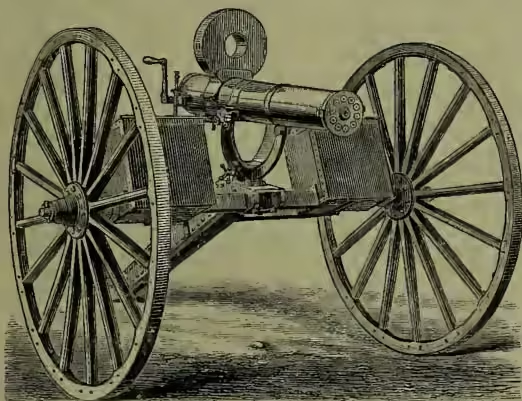
Medium size Gatling, mounted on Field Carriage.
It can also be worked with a slight swaying action, when firing rapidly, so as to spread the bullets over a certain amount of lateral space, like water from a fire-hose, and give much the same effect as a volley. The weapons first used fired one hundred bullets each minute, but improved mechanism enables the newer types to fire ten times that number, and to give good results at ranges of 3000 yards. The barrels are of various calibres up to 1.2 inches; and larger sizes could be made. A few Gatling guns were used in the Franco-German war of 1870, the Russo-Turkish war of 1877-78, the Chileno-Peruvian war of 1877, and the British campaigns in Ashantee, Zululand, Egypt, &c.
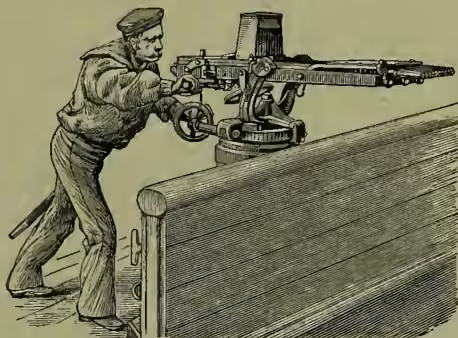
Nordenfelt-Palmcrantz Gun, inside Bulwark Mounting.
The Montigny mitrailleuse, adopted by the French army, and used by them in large numbers during the campaign of 1870, consists of thirty-seven rifle-barrels permanently enclosed in an iron cylinder. These are all loaded simultaneously at the breach by means of a metal frame, in which the cartridges are carried, and can be discharged independently or all at once by the action of a crank-handle. Reloading takes five seconds, and ten discharges can be fired per minute. The bullets have no lateral spread, and the effective range is not much over 1000 yards. Numbers of these weapons were secretly manufactured in France previous to 1870, and, on the outbreak of war in that year, were issued to the artillery in place of their field-guns, without any instruction having been given to the men in working them. Formed into batteries of ten pieces, they were expected to beat off both artillery and infantry; but the concentrated shell fire of the former destroyed them at long ranges, and the rapid movements of the latter often enabled them to capture the mitrailleuses without serious loss. The failure of this weapon brought all machine guns into disfavour; but when protected from artillery fire in savage warfare, their great value for certain purposes, such as flanking the ditches of fortresses, defending defiles, bridges, &c., and naval operations, has since been fully recognised, and very many improved types have appeared.
The Nordenfelt-Palmcrantz system (fig. 2) is particularly useful in the tops of ships. The 1-inch calibre gun, firing steel bullets, is capable of piercing the sides and boilers of torpedo boats at 300 yards. It consists usually of four or more horizontally arranged barrels, and the firing handle on being moved forwards and backwards discharges them all, if moved rapidly, in a succession of volleys, if slowly, in a succession of single shots. The number of aimed shots per minute fired at sea varies from one hundred with the 1-inch to ten with the 3-inch gun.
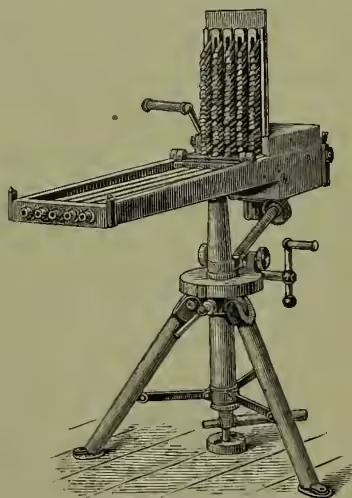
Fig. 3 shows another form of rifle-calibre machine gun designed by Captain Gardner, late U.S.A., for use with a field army. The operations of loading, firing, and withdrawing the empty cartridge-cases are performed automatically by the breech mechanism, worked by a crank-handle. The cartridges are fed in from an upright frame or carrier.
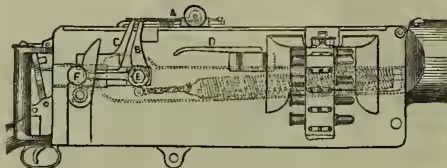
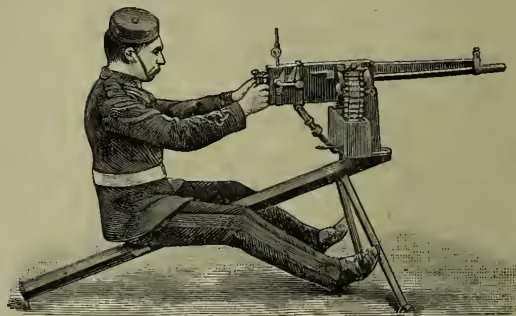
The Maxim automatic machine gun has a single barrel surrounded by an outer case, the space between being filled with water to prevent heating. The breech end of the gun recoils after discharge (the first cartridge being fed in and fired by hand), causing the arm B (fig. 4) to strike the fixed point C, thus imparting to the crank-shaft E a rapidly accelerated rotation, and making the crank-handle F strike the buffer-spring D, which brings it to a state of rest. The rotation of the crank-shaft E also rotates the fusee (shown dotted round E) attached to the chain, and thereby winds it up, so that, when the crank-handle F rests on the buffer D, the spiral spring (dotted) is not only extended 1 inch (due to the recoil), but further elongated by the winding up of the chain on the fusee. After the crank-handle F has been brought to rest against the buffer D, the action of the spring is first to pull back the recoiling portion into the firing position, and then to unwind the chain from the fusee, thus rotating the crank-shaft back into its original position. The cartridges are carried on a broad linen belt, to which fresh lengths can be attached, and which is carried round by the mechanism. The accelerated motion of the crank draws back the lock sufficiently to allow the old cartridge to drop out, while the spiral spring causes the lock to come forward quicker than the recoiling portion of the barrel, so that at the same instant as the barrel resumes the firing position the lock closes the breech with a new cartridge and fires it, the recoil setting up the same action again. The gun may be arranged for firing single shots by hand on pressing a button, or to continue firing shots at any required interval of time. As many as 620 rounds per minute have been fired from this gun, and accurate shooting obtained up to 3000 yards. Fig. 5 shows a rifle-calibre Maxim gun, which, with its tripod, only weighs 70 lb. A 3-pounder gun has also been designed on the same principle. All the mechanism is carefully covered in to protect it from grit and dirt, but it can easily be taken to pieces and cleaned.
The Hotchkiss revolving cannon is similar to the Gatling gun, inasmuch as it consists of five barrels revolving round a central axis, but there is only one lock for all five, instead of one for each barrel, and the rotatory motion of the barrels is intermittent instead of continuous. Each turn of the crank-handle loads one barrel and fires another, while an empty cartridge-case is being extracted from a third. The mechanism is in few parts, which are large, strong, and serviceable, with only one spring, and that a large flat one. The breech-piece is solid.
The calibres of the revolving cannon vary from 1.5 inch to 2 inches, but the same inventor has made a 6-pounder quick-firing single-barrelled field-gun.
The projectile is either a steel shot for naval purposes or an explosive shell. As many as eighty rounds per minute have been fired from the revolving cannon, the cartridges being fed in from a hopper-frame, and good results obtained at a range of 5460 yards.
By an order of 1888, a detachment with two machine guns was made part of the war establishment of every brigade of infantry or cavalry in the British army. Each infantry detachment consists of an officer, two non-commissioned officers, and nine men, and is accompanied by a forage-cart and ammunition-cart carrying 6640 rounds for the guns, 1500 more being on each gun-carriage. Two men are sufficient to work each gun, the remainder are drivers and a servant. In the cavalry detachment there are fifteen men, of whom two are servants, seven drivers, and six for working the guns and to act as horse-holders. The ammunition-wagon carries 13,340 rounds of rifle-calibre cartridges.
The mitrailleuse form of machine gun thus takes a definite place in the armament of European troops, not as a substitute for field artillery, against which, if unprotected by cover, it can never stand, but as an auxiliary to infantry and to cavalry acting independently, in positions where rifle-fire is most efficacious. It will also be useful for long range rifle-fire, and perhaps in lieu of an infantry escort to guns when moving rapidly to the front, besides those purposes which have already been alluded to. The shell-firing machine gun and the quick-firing gun, on the other hand, will perhaps supersede the ordinary artillery pieces of similar calibre. The one-pounder shell machine gun (called 'Pom-pom' by the soldiers, from its sound) proved of effectual service in the Transvaal war, 1899-1900.