Rifles. The object of rifling any weapon, whether cannon or small-arm, is for the purpose of causing the projectile, when fired from such weapon, to rotate round its axis, and thus to impart steadiness to it in its passage or flight through the air. The subject of rifled cannon has already been dealt with under the head of Cannon (q.v.); in this article, therefore, it is intended to deal only with the question of rifles as applied to small-arms, whether military or sporting. The idea of imparting steadiness to the projectile and thereby increasing the accuracy of fire is one which has exercised the minds of scientific artillerists and gunmakers from a very early period in the history of firearms. The cause of inaccuracy when firing a spherical ball from a smooth-bore firearm may be briefly explained as follows: in all muzzle-loading arms the projectile must be smaller in diameter than the bore of the gun, otherwise it could not enter and be rammed home from the muzzle; the projectile therefore rests on the bottom of the barrel, and its centre is below the axis of the bore. When the gun is fired part of the gas generated by the explosion of the powder escapes over the top of the ball, causing a downward pressure on it; as this pressure is removed during its passage down the barrel the ball impinges on the top side of the barrel, and so on, up and down and from side to side, until it leaves the muzzle of the gun; the direction of its flight is therefore not in line with the axis of the bore, but is determined by its last impact against the side of the barrel. To overcome this inaccuracy the idea suggested itself to cut grooves in the bore of the barrel which by gripping the ball would cause it to rotate round its axis and to leave the barrel more nearly in line with the axis of the bore.
The first authenticated instance we have of a rifled small-arm being actually used was in the year 1563, when the Swiss government issued an edict to the following effect: 'For the last few years the art of cutting grooves in the chamber of the guns has been introduced with the object of increasing the accuracy of fire; the disadvantage resulting therefrom to the common marksman has sown discord amongst them. In ordinary shooting matches marksmen are therefore forbidden under a penalty of £10 to provide themselves with rifled arms. Every one is nevertheless permitted to rifle his military weapon and to compete with marksmen armed with similar weapons for special prizes.' In the later half of the 16th century Augustus Kutter of Nuremberg brought out a rifle the grooves of which were in a spiral form, and to him is due the idea of this form of rifling. In 1662 a cleric, the Bishop of Munster, invented elongated projectiles for use in such arms, but whether in conjunction with a rifled arm or simply with the idea of improving the accuracy of a smooth bore is not known. In 1729 Lautmann, a Russian, brought out a pamphlet advocating the advantage of firing with balls of an elliptical form with a cavity at the base so as to augment considerably the impetus imparted to the projectile when fired from a rifled arm. Lautmann undoubtedly lit upon the true theory, and had his idea been worked out to a practical result the armies of Europe would in all probability have been armed with rifles a hundred years sooner than they actually were. But Lautmann, like so many other inventors, was in advance of his age and did not live to see the correctness of his theory vindicated.
In 1750 Wild brought out a rifle with six grooves having one turn in the length of the barrel, from which he fired balls weighing eighteen to the pound, wrapped in an envelope of greased linen, the object of the linen being to fill up the bore and to impart the necessary rotatory motion to the bullet; but nothing came of his invention. And again in 1770 experiments, which were not successful, were made at Metz with elongated bullets.
The adoption of rifles into the British service dates from about the year 1800, when the old 95th Regiment, which later became the Rifle Brigade, were armed with 'Baker's rifles,' so called from the name of the inventor. There were two patterns of this arm, one with eleven and the other with seven grooves, the twist of rifling being one turn in 136 inches. The weight of the rifle was 8 lb. 9 oz. and its length 3 feet 9½ inches; the length of the barrel was 2 feet 6 inches, and bore '.705'. The bullet was spherical; before being rammed home it was wrapped in a greased patch, there being a cavity in the butt for carrying these patches. After firing a few rounds the barrel became so foul that it was difficult to ram the bullets home; a wooden mallet was therefore served out with each rifle to drive the ball down the barrel. This rifle remained in the British service till about the year 1835, when it was superseded by 'the Brunswick rifle,' the invention of Major Berner in the Brunswick army. The barrel of this arm was rifled with only two grooves having one turn in the length of the barrel; the bullet, which was spherical, was 'belted'—the belt fitting into the grooves in the barrel—this method being adopted to give the bullet a spin. A grease patch was also used with this rifle; it added greatly to the difficulty of loading, as it made it extremely difficult to see whether the belt on the bullet was properly placed in the grooves or not. This rifle was the first arm in the British service which had a percussion-lock, and it was not till the year 1842 that a percussion musket was generally adopted for the service. A rifle of a similar design was about the same time adopted in Russia and in some of the German principalities.
In 1837 a rifled arm was adopted in France for the use of the 'Chasseurs' or rifle regiments. This arm was rifled in the chamber on a system invented by Captain Delvigne of the French army. The diameter of the chamber was slightly smaller than the calibre of the bore; the ball was driven into the rifling, but not sufficiently far to crush the powder. In 1841 the Prussians discarded their old muzzle-loading smooth-bore musket, and introduced in its stead an arm which, besides having a rifled barrel, was also made to load at the breech, and in a few years the whole Prussian army was armed with the celebrated 'Zündnadelgewehr' or needle-gun. This arm, the invention of Dreyse (q.v.), is a bolt-gun, the needle being contained in the bolt; to load, give a smart blow to the handle of the bolt to release it from its fastening, then draw back the bolt and insert the cartridge, close the bolt and lock it by turning the handle down to the right. The act of closing the bolt compresses the mainspring and holds back the needle, which is released in the usual way on pulling the trigger. The cartridge is a peculiar one. There is a papier-maché plug called 'Zündspiegel,' in which is imbedded the bullet in the form of an egg. The percussion-cap is fixed in the rear of the plug; behind the plug is the powder charge. The powder, the plug, and the bullet are all enclosed in a paper cartridge-case, which is tied in front of the bullet. On firing the gun the needle presses through the powder charge and strikes the cap in the plug so that the charge is ignited from the front, the idea being that by this means the bullet is less likely to be detached from its bed in the papier-maché plug, which latter takes the rifling and imparts rotation to the projectile, the diameter of which is .54 of an inch, whereas the calibre of the barrel is .61 of an inch.
During some experiments at Spandau in 1846 so many needles were broken that the continuance of the arm in the service was in great jeopardy; but its efficacy in quelling disturbances in the troublous times in 1848 and 1849 was so great that in the year 1850 a further large number of arms was made, and the system was further extended by the introduction of carbines on the same model. In 1842 the Austrians armed their rifle regiments with a rifle. Thus we see that by the year 1842 all the great powers of Europe had armed a part of their troops with rifles, and that by 1846 the whole of the Prussian army was not only so armed, but that their arms also possessed the great superiority over all others of being breech-loaders. Another point in which the Prussians had a superiority over other nations was that they had a complete cartridge combining in one case the projectile, the powder charge, and the percussion-cap—the introduction of a breech-loader enabling them to have a capped cartridge instead of having to place a cap on the nipple for each discharge. Those who are old enough to remember the old percussion-lock with the capping and uncapping of the nipple will appreciate the immense advantage that was gained by the introduction of a capped cartridge.
The vast superiority of the Prussian needle-gun over the rifles in use in other countries gave a great impetus to the spirit of invention, and in 1849 Captain Minié (q.v.), of the French army, brought out a rifle called the Minié rifle; this arm was first introduced into the French, and subsequently, about 1851, into the English army. Up to this date rifles were only issued to rifle regiments, but with the introduction of the Minié rifle it was intended to discard the smooth-bore altogether and to arm the whole army with rifles. The adoption of the Minié rifle was a great step in advance; it was the first time the spherical bullet was discarded in favour of one of a cylindro-conoidal form. The bullet had a hollow base in which was placed an iron cup; on the explosion of the powder this cup forced the bullet into the grooves of the rifling. The separate grease patch was discontinued, lubrication being obtained by greasing the paper in which the bullet was wrapped with a mixture of tallow and beeswax. The rifle weighed 9 lb. 13 oz.; its length was 4 feet 7 inches. The barrel weighed 4 lb. 13½ oz. and was 39 inches long; the diameter of the bore was .702", the number of grooves three, having a twist of one turn in 36 inches. The charge of powder was 2½ drams, or nearly 70 grains, and the weight of the bullet was 680 grains. The rifle was sighted to 1000 yards. A description of it has been given in some detail for the sake of comparison with the rifles of the present day. All the English infantry regiments which proceeded to the Crimea were armed in the first instance with this rifle, and a large proportion of the French army also had a rifle constructed on the same principle, though varying in detail from the English pattern. This gave the allies an immense advantage over their Russian adversaries, who were still, with few exceptions, armed with the old smooth-bore.
But the Minié rifle was cumbersome and heavy, and as early as 1852 experiments were made with a view of obtaining a better weapon. The result of these experiments led to the introduction of the Enfield Rifle, Pattern 1853, so called from the Royal Small-arms Factory at Enfield Lock, from which factory the rifle was first introduced. The principal point of difference between this arm and the Minié was the great reduction in the diameter of the bore from .702" to .577". This reduction of the bore enabled the barrel to be made very much lighter without in any way impairing the arm as a shooting weapon; in fact it shot very much better, as the bullet was better proportioned. And, while the powder charge remained the same, the bullet was reduced in weight from 680 to 535 grains; by this means the initial velocity was greatly increased and the height of trajectory diminished at all ranges. The lubrication of the bullet was the same as in the Minié. There were two descriptions of this rifle, the long and the short; the long was issued to the regiments of the line, and the short to rifle and light infantry regiments. A carbine was also constructed on the same principle for issue to the cavalry and Royal Artillery. The issue of this rifle and ammunition to the native troops in India was the occasion of the Indian Mutiny of 1857, it being believed that the grease round the bullets was cows' and pigs' fat purposely supplied to defile Hindus and Mohammedans alike.
But while the armies of Europe, with the exception of the Prussian, were all armed with a muzzle-loading rifle more or less on the principle of the Minié, experiments were being continually carried on with the view of obtaining a good breech-loader. It was not, however, till the Danish war of 1864 that the very vast superiority of the breech- over the muzzle-loader was brought prominently home to the authorities. The need was urgent, but in order to give time to discover a really satisfactory breech-loading rifle it was determined in the first instance to convert the Enfield into a breech-loader by attaching the Snider breech-action to the Enfield barrel. The old arms were readily converted, and a large number of new arms were made on this principle, so that by the time of the Franco-Prussian war the whole English army was armed with the Snider breech-loader, and during the winter of 1871-72 the militia and volunteers also received these arms; but it was perfectly well understood that the introduction of the Snider breech-loader was only intended to fill the gap until a more perfect and more efficient weapon could be devised; and after a most exhaustive series of trials, which had been conducted for some time by a special committee appointed for the purpose, the Martini-Henry rifle was in the year 1871 recommended for adoption in the English army.
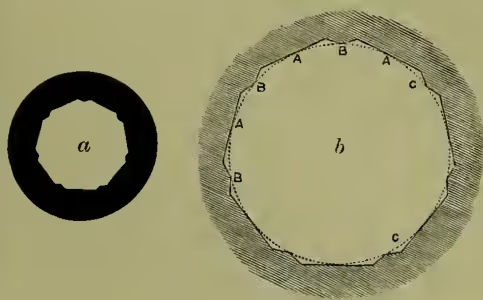
The manufacture commenced shortly afterwards, and the first issue of rifles of this pattern to the troops was made in 1874. The Martini breech-action has already been described under the head of Breech-loading (q.v.). The barrel was the invention of Mr Alexander Henry, a gunmaker of Edinburgh. The calibre is .45", and the form of the rifling is peculiar. Fig. 1 represents an end section of a barrel rifled on this system. There are seven grooves, having a complete turn in 22 inches, cut in the barrel, forming seven plain surfaces at AA. These are tangential to the periphery of the projectile which is represented by the dotted circle C. In addition to the bearing surfaces thus obtained there are seven angular projections, BB, extending inwards from the ends of the grooves on plain A. Thus in its passage down the bore the bullet has fourteen bearing surfaces at AA...BB, and it expands into the spaces left between A and B, and thus obtains its rotatory motion. Whilst these transformations were going on in England the French had adopted the Chassepôt rifle in 1869, superseded in 1874 by the Gras; the Germans in 1871 discarded the needle-gun and adopted the Mauser (see BREECH-LOADING); the Austrians after their war with Prussia in 1866 adopted in 1868 the Werndl rifle; the Italians adopted the Vetterli in 1871; the Russians adopted the Berdan rifle, Mark I., in 1867, superseded in 1871 by Mark II. of the same rifle; the Americans adopted the Springfield, whilst the minor states adopted breech-loaders of various designs and patterns. It is unnecessary in this article to give a full description of all these rifles, most of them having the bolt breech-action, a drawing of which may be seen under the head of Breech-loading (q.v.), and the tables at the end of the article give all essential particulars in connection with the more important arms.
At the time of its introduction the Martini-Henry rifle was probably the finest military rifle in Europe; it is extremely accurate either at long or short ranges; its bullet has great penetrative power. The rifle is simple and does not easily get out of order. But, while the Martini-Henry rifle was more accurate at all ranges and had a higher terminal velocity and lower trajectories at long ranges than the rifles of the continental armies, these rifles had a higher muzzle velocity and lower trajectory up to ranges of 500 yards. This was due to two causes: first, because the proportion of powder to bullet was greater in the foreign than in the English cartridge; and secondly, because the value of was also greater—this being the mathematical expression used in England to denote the power of the air to retard bullets in their flight, where is the diameter of the bullet in inches and its weight in pounds; therefore the smaller the value of the fraction the less power has the air to retard the flight of the bullet, and vice versa. The heavier the bullet can be made in proportion to its diameter, the better able it will be to maintain its velocity at long ranges. It was determined to endeavour to remedy the defect referred to above, so that the English rifle should be superior to all others in all particulars at all ranges. To do this it was necessary to maintain the low value of and to increase the proportion of powder to bullet; this led to the introduction of the Enfield-Martini rifle, in which the Martini action was maintained, but the calibre of the barrel was reduced to .40". Owing to the high muzzle velocity obtained—viz. 1570 feet—the trajectory was very flat and the shooting exceedingly accurate. Several thousands of these arms were made, but before they were issued to the troops a far more important change was determined on—viz. the introduction of a magazine rifle. A magazine rifle may be described as one which has attached to it a magazine or case or hopper containing four or more cartridges which are fed one by one into the barrel by mechanism in connection with and actuated by the breech-action; and the primary object of a magazine arm is to enable the soldier at a critical moment to fire a certain number of consecutive shots without having to reload from the pouch.
The great importance of a magazine arm was first practically demonstrated in the American war between the North and South in 1861, when one regiment of the northern army, armed with a magazine rifle, successfully resisted the attack of a force at least three times as numerous armed with the ordinary single loader, simply on account of the great rapidity of fire. And again in the war between Turkey and Russia in 1877 the constant repulse of the Russian assaults on the Turkish lines before Plevna was in a great measure, if not mainly, due to the fact that the Turks were armed with the Winchester repeating rifle, which enabled them to mow down the Russians by hundreds as they crossed the open to the assailant. In the United States there were at that time several systems already in practical use, and after the experience of the Turkish war the question was seriously taken up by most of the European governments. By the end of the year 1879 the French government had adopted the Kropatschek magazine rifle for the navy; the Germans were experimenting with a Manser rifle converted to take the Lee magazine; the Austrians were experimenting with the Kropatschek and the Spitalski; in Italy the Bertoldo rifle had been issued to some few regiments for trial; in Switzerland the troops were armed with the Vetterli repeater; and in Norway and Sweden a repeater on the German principle was on trial. The matter was then taken up by the English government, and a committee was appointed by the War Office to consider the whole question. Although the number of magazine rifles is legion, the magazines themselves are all modifications of one or other of a few principal systems or types, which may for convenience be divided under the following heads:
(1) Those with the magazine in the fore end of the stock under the barrel; (2) those with the magazine under the breech-action; (3) those with the magazine above and at the side of the breech-action; (4) those with the magazine in the butt of the stock; (5) those with the magazine in a circular form round the breech-action.
Type No. 1 may be described briefly as follows: The magazine consists of a metal tube fixed in the fore end of the stock, and capable of containing eight or more cartridges. The tube or magazine is loaded by drawing back the bolt of the breech-action and inserting the cartridges one by one into the tube at the breech end, there being a catch to retain them when once inserted; the insertion of the cartridges gradually compresses a long spiral spring contained in the tube, so that when the tube is full the spring is completely compressed, and is exerting its force on the whole column of cartridges in the direction of the breech end of the barrel, the base of one cartridge being always pressed against the bullet of the one next behind it. The action of unlocking and drawing back the bolt withdraws one cartridge at a time from the magazine, and places it in front of the bolt; and the action of closing the bolt forces the cartridge into the barrel. As each cartridge is thus withdrawn for loading, the column of cartridges within the tube is pressed back as already described, leaving another cartridge in position to be withdrawn for loading. There is generally a stop or 'cut-off' which, when applied, prevents the bolt from acting on the magazine, so that the arm may be used as a single loader on occasions when it may not be considered either necessary or desirable to bring the magazine into play.
In type No. 2 the magazine can either be detachable and carried in the soldier's pouch, to be attached to the rifle when required for use, or it can be a fixture on the arm itself. In either case the magazine consists of a metal box containing from six to ten cartridges, according to the size of the cartridge. The cartridges, which are inserted at the top of the box or magazine, compress a spring in the magazine which is generally either in a zigzag form or in the form of a C. In this type of magazine the cartridges lie on the top of one another, and not bullet to base as described in No. 1 type. They are held in the magazine by a catch or 'cut-off,' and when this is applied the rifle can be used as a single loader. On withdrawing the cut-off and drawing back the bolt, the spring in the magazine forces one cartridge up in front of the bolt, which, on being pushed home, forces the cartridge into the barrel. By a mechanical contrivance, only one cartridge at a time can be forced up out of the magazine.
In type No. 3 the magazine can also be either detachable or a fixture on the rifle. In magazines of this type no spring is necessary to force the cartridge out of the magazine, which is loaded by dropping the cartridge in at the top. At the bottom of the magazine, on the side next the body of the rifle, there is a slot, with a corresponding slot in the body or shoe of the breech-action. On drawing back the bolt one cartridge passes out of the magazine through these slots into the shoe, and just in front of the bolt, by the force of gravitation alone. The cartridge is then forced into the barrel by the action of closing the bolt. There is also a cut-off with magazines of this type to prevent cartridges passing through the slots when it is not required to use the magazine.
In No. 4 type various attempts have been made from time to time to utilise the butt of the stock by hollowing it out and converting it into a magazine. In this system the cartridges are brought up one by one into the loading position by a ratchet actuated by the bolt. As the bolt is drawn back the ratchet is also forced back, and hooking on to a cartridge brings it forward as the bolt is pushed home again.
In type No. 5 the cartridges are contained in a cylinder placed around the breech-action of the rifle. A spring acts on these cartridges and brings them up one by one in front of the bolt, the act of closing forcing the cartridge into the barrel. There are objections to the two types Nos. 4 and 5 which have prevented the adoption by any government of a magazine arm constructed on these systems; it is unnecessary therefore to describe them further. Of the arms previously referred to as being under trial by various European governments at the close of the year 1879 the Kropatschek is an example of type No. 1, the Lee magazine of type No. 2, the Jarmann of type No. 3. There is no example of type No. 4, but the Spitalski is an example of type No. 5.
The Germans were the first to re-arm the whole of their infantry with a magazine rifle; but, pending the result of trials which were being carried on with small-bore rifles and smokeless powder, they determined in the first instance to convert the then existing Mauser rifle into a magazine arm, as this would require no change of ammunition, the magazine being placed in the fore end of the stock as described under the head of No. 1 type. But it was generally understood that in order to derive the full benefit from a magazine arm the soldier would have to carry more ammunition, and, as it was not desirable to add to the weight of his equipment, this could only be done by reducing the weight of the cartridge.
A reduction of bore, therefore, became almost a sine quâ non, as by that means only could a sensible reduction be made in the weight of the bullet, and with it of the cartridge. But this led to fresh difficulties. It is quite impossible in the space available for this article to discuss fully all the difficulties which had to be overcome either as regards cartridge-case, bullet, powder, rifling, &c., but it may be stated that it was generally conceded that the ordinary charge of loose black powder could not be used in a rifle with a bore less than .40" on account of the difficulty of overcoming the fouling which would take place in a small bore, and also on account of the difficulty of making a suitable cartridge-case. Therefore the question of the explosive to be used had to be considered in connection with the question of the reduction of bore. The Swiss were the first to arrive at a practical solution of the difficulty. Two rifles were brought out in Switzerland very similar to one another, and merely differing in points of minor details. One was the Rubin rifle, having a calibre of .295 inch. The powder charge consisted of 70 grains of black powder compressed into a solid pellet, and the weight of the bullet, which was nickel coated, was 217 grains. The force of the powder was very greatly increased by compression, and, the proportion of powder to bullet being very high, a muzzle velocity was obtained of no less than about 1850 feet; and the value of being 2.8 the velocity was well kept up at all ranges. The other Swiss rifle was the Hebler. The calibre of this rifle was the same as the Rubin—viz. .295 inch; the charge was 74 grains of compressed black powder, the weight of nickel-plated bullet 225 grains; both these rifles had magazines on the Lee principle.
Experiments were carried on in England with both these rifles, and the results were such as to warrant the committee, which had been investigating the subject, to recommend in the year 1887 the adoption of a magazine rifle for the English army, of which the following is a brief description. The barrel is rifled on the Metford principle (fig. 2, C), in which there are no corners nor angles to hold the fouling. The twist of the rifling is one turn in 10 inches, the bore of the barrel is .303 inches, and its length 30.20 inches.
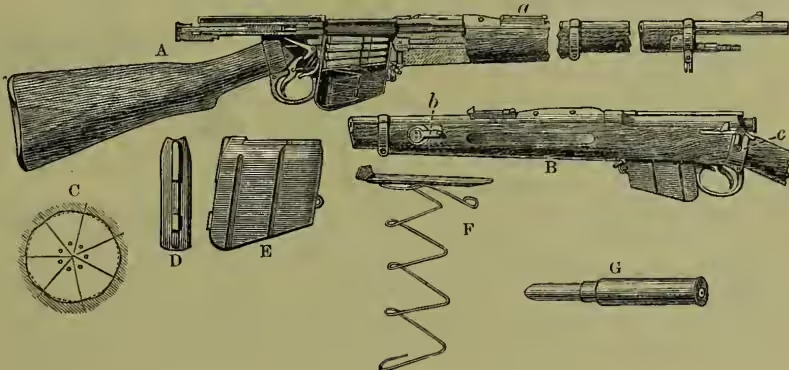
The bolt breech-action which has been adopted for the rifle is a modified form of the Lee bolt. The Lee magazine (fig. 2, D, E), as first adopted (Mark I.), holds eight cartridges, and is detachable—i.e. it can be carried on the arm itself or in the soldier's pouch; its position on the arm is immediately in front of the trigger-guard underneath the body of the breech-action, in which a slot or opening is cut through which the cartridges are fed up by a spring ready to be pushed into the barrel by the closing of the bolt. There are two turned-in lips (fig. 2, D) at the mouth of the magazine under which the heads of the cartridges are inserted when filling it; the rim of the cartridge projecting sufficiently to be caught by the bolt. These lips prevent the cartridges from being shot out by the spring, and hold the head down till the bullet has entered the chamber of the barrel. A cut-off is provided to enable the arm to be used as a single loader; this is a plate pivoted at one end, and it is pulled out by means of a thumb-piece projecting on the right side. When it is thus pulled out the magazine is in action, but when pushed in the plate partly covers up the aperture through which the cartridges pass out of the magazine, and forms a bed on which to place the cartridges by hand. The magazine, which fits into a slot cut in the stock under the opening in the body, is held in position by a catch. This can be withdrawn by a small trigger in front of the main trigger, when the magazine is released. The magazine can only be filled by one cartridge at a time; these can be passed into it through the slot in the body of the breech if it is desired to fill the magazine when attached to the rifle. The spring (fig. 2, F) which forces the cartridge up is in the form of a coil flattened at the side. The rifle has two sets of sights, the ordinary back sight (fig. 2, Aa) being graduated to 1900 yards; but for longer ranges there is a pair of sights consisting of a dial sight (fig. 2, Bb) on the left side of the fore end of the stock, and a short arm (fig. 2, Bc) near the trigger, at the end of which is a small hole. The weight of the rifle is 9 lb. 6 oz., and length 49.5 inches. The bayonet, weighing 15 oz., is in the form of a short knife having a blade 12 inches long. The cartridge (fig. 2, G) for this rifle consists of a solid drawn brass cartridge-case, in which is inserted a pellet of 70 grains of compressed black fine-grain powder. After insertion of the powder pellet the case is necked so as to reduce the diameter at the mouth of the case to .312 inches. The latest pattern of Lee-Metford rifle (Mark II.), issued in 1898, has various modifications, the principal being that the magazine holds ten cartridges instead of eight, and black powder is superseded by cordite.
The smallness of the bore necessitated a long bullet, in order to get the necessary weight, and a quick twist in the rifling; it was found that an ordinary hardened lead bullet could not stand the strain, and therefore the bullet, which weighs 215 grains, is composed of a hardened lead core inserted into an envelope of cupro-nickel turned over at the end to prevent the gas on the explosion of the pellet getting up between the envelope and lead core. The length of the bullet is 3.05 inches, and diameter .312 inches. It is pressed into the mouth of the cartridge-case, which holds it firmly. A packet of ten of these cartridges weighs 10 ounces. The muzzle velocity obtained with the powder pellets is 1830 ft.-seconds; but with the cordite powder about 2000 ft.-seconds. When firing at 500 yards range the highest point of the trajectory above the line of sight is 5 feet, whereas that of the Enfield-Martini .40-bore rifle is 6 feet, and of the Martini-Henry .45-bore rifle 8 feet 7 inches.
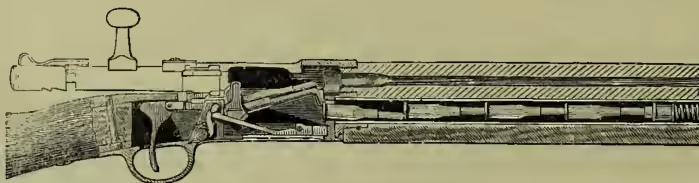
But the English government was not the first to adopt a small-bore magazine rifle for the general armament of the whole army, the French having adopted the Lebel rifle as early as the year 1887. It has been already stated that the French navy had for some time previously been armed with the Kropatschek repeating rifle, having the magazine in the fore end of the stock; and, like the Germans, the French had converted their single loading Gras rifle into a repeater on the Kropatschek model. The Lebel is an improved Gras repeating rifle; the bore of the barrel is .315 inches. The magazine (fig. 3) is in the fore end of the stock, and holds eight cartridges. The points of the bullets are flattened to lessen the chance of accidental explosions in the tube, which might be caused by the cap of one cartridge resting on the point of the bullet of the cartridge in rear of it. The cartridge-case is charged with about 35 grains of smokeless powder, and the bullet weighs about 215 grains. The muzzle velocity is about 2000 ft.-seconds. Great results were expected from this rifle when first introduced; but experience has shown that the smokeless powder adopted for the Lebel cartridge is not reliable, and that after being kept a year or so it greatly deteriorated.
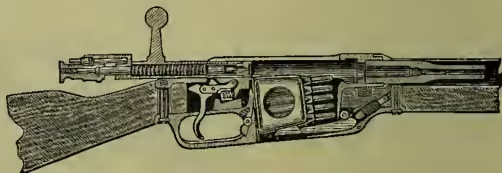
The Lebel rifle itself has proved inferior to one of a simpler construction, called the Berthier rifle after the name of the inventor. The breech mechanism is on the same principle as that of all other magazine arms—viz. the bolt containing the striking apparatus; but the magazine in the fore end of the stock is discarded, and the Mannlicher magazine adopted in its place. This consists of a light metal frame or clip holding five cartridges; the clip is dropped into a receptacle to hold it, but cannot drop through, as the bottom cartridge rests on a spring which forces the cartridges up, as in the case of the Lee magazine, and the clip is held up by the top cartridge, which presses against the turned-in sides of the clip. As soon as the last cartridge is fed into the barrel by the bolt there is nothing to hold up the clip, which then drops out, and on the withdrawal of the bolt another clip full of cartridges is inserted. There is a cut-off which enables the rifle to be used as a single loader. The bullet weighs 205 grains, and consists of a hardened lead core coated with a white metal envelope. The charge is 33 grains of smokeless powder. Ten cartridges weigh about 8½ oz. The bore of the barrel is .301", and weight of arm 8½ lb. The muzzle velocity is 2070 ft.-seconds. The extreme simplicity in the mechanism of the bolt of this rifle is one of its chief recommendations. In Germany the original Mauser rifle, which had been converted into a magazine arm as a temporary measure, as already described, was, in 1889, superseded by one, also the invention of Mauser, having a barrel with a bore of .315 inches, and in which the magazine is filled from a metal clip containing five cartridges, somewhat like the Mannlicher; but the clip or cartridge-holder does not itself pass into the receptacle made for the cartridges, as in the Mannlicher; but, being held over the receptacle or magazine, the cartridges are pushed out of it by the thumb, and the clip itself falls off. The magazine rifles of other nations are all modifications of one or other of those already described; but there is a peculiarity in the construction of the Mauser and Mannlicher rifles which must be mentioned. This peculiarity consists in the barrel proper being encased in a barrel jacket or light steel cylinder, both being screwed into the body of the breech, and the nose end of the barrel passing loosely through a thimble at the end of the barrel jacket. The sights are fixed to the barrel jacket. There is a very slight air-space between the barrel and the jacket, and the advantages claimed for the compound barrel are chiefly that the barrel proper is protected and is less liable to injury from a blow, and that the outer coating does not heat so rapidly as a barrel constructed in the ordinary way, and that therefore a handguard, such as is used with the English rifle, is not necessary. The Mannlicher and the Mauser both have a calibre of .315", and fire a bullet weighing 216 grains, the charge of smokeless powder being about 35 grains, and the muzzle velocity about 2000 ft.-seconds. The value of the Mauser in capable hands was well demonstrated throughout the South African war of 1899-1901.
Sporting Rifles have already been dealt with under the head of Breech-loading and Firearms (q.v.). But it may be as well to observe that the same principle or law governs the ammunition for the sporting as for the military rifle, only it is differently applied. In the military rifle a high
LIST OF RIFLES IN THE BRITISH SERVICE FROM THE YEAR 1800 TO PRESENT DATE.
| Description of Arm. | Without Bayonet. | Barrel. | Bayonet. | Ammunition. | Value of D2 W. | |||||||||
|---|---|---|---|---|---|---|---|---|---|---|---|---|---|---|
| Weight. | Length. | Weight. | Length. | Diameter of Bore. | Number of Grooves. | Twist of Rifling. | Sighted up to yards. | Weight. | Length beyond Muzzle. | Charge of Powder. | Lubricator. | |||
| Weight. | Length. | |||||||||||||
| Baker's..... | 8 lb. 9 oz. | 3 ft. 9 1/2 in. | 3 lb. 14 1/2 oz. | 2 ft. 6 in. | .705 in. | 7 | 1 in 136" | .. | 1 lb. 0 oz. | 1 ft. 6 1/2 in. | 2 1/2 dr. | gr. | Grease patch. | 5886 |
| Brunswick..... | 9 lb. 6 1/2 oz. | 3 ft. 10 1/2 in. | 3 lb. 13 1/2 oz. | 2 ft. 6 1/2 in. | .630 in. | 2 | 1 in 28" | .. | 2 lb. 0 1/2 oz. | 1 ft. 9 1/2 in. | 2 1/2 dr. | gr. | " | 4356 |
| Minie..... | 9 lb. 13 oz. | 4 ft. 7 in. | 4 lb. 13 1/2 oz. | 3 ft. 3 in. | .703 in. | 3 | 1 in 64" | 1000 | 1 lb. 0 1/2 oz. | 1 ft. 5 1/2 in. | 2 1/2 dr. | gr. | Tallow and beeswax on paper. | 4356 |
| Enfield, Long..... | 8 lb. 14 1/2 oz. | 4 ft. 6 1/2 in. | 4 lb. 4 1/2 oz. | 3 ft. 3 in. | .577 in. | 3 | 1 in 78" | 900 | 0 lb. 13 1/2 oz. | 1 ft. 5 1/2 in. | 2 1/2 dr. | gr. | " | 4356 |
| " Short..... | 8 lb. 11 1/2 oz. | 4 ft. 0 1/2 in. | 4 lb. 4 1/2 oz. | 2 ft. 9 in. | .577 in. | 5 | 1 in 48" | 1200 | 0 lb. 11 1/2 oz. | 1 ft. 10 1/2 in. | 2 1/2 dr. | gr. | " | 4356 |
| Snider..... | 9 lb. 5 oz. | 4 ft. 7 1/2 in. | 4 lb. 12 1/2 oz. | 3 ft. 3 in. | .577 in. | 3 | 1 in 78" | 950 | 0 lb. 13 1/2 oz. | 1 ft. 5 1/2 in. | 70 gr. | gr. | Three cannoures with wax. | 4356 |
| Martini-Henry, Mark III..... | 9 lb. 0 oz. | 4 ft. 1 1/2 in. | 3 lb. 5 1/2 oz. | 2 ft. 9 1/2 in. | .450 in. | 7 | 1 in 22" | 1300 | 1 lb. 1 oz. | 1 ft. 10 1/2 in. | 85 gr. | gr. | Wax-paper round bullet and beeswax-wad. | 2953 |
| Enfield-Martini..... | 9 lb. 5 oz. | 4 ft. 1 1/2 in. | 3 lb. 13 oz. | 2 ft. 9 1/2 in. | .402 in. | 7 | 1 in 15" | 2000 | 1 lb. 8 oz. | 1 ft. 6 1/2 in. | 85 gr. | gr. | Cardboard beeswax-wad. | 2917 |
| Lee-Metford, Mark I..... | 9 lb. 6 oz. | 4 ft. 1 1/2 in. | .. | 2 ft. 6 in. | .303 in. | 7 | 1 in 10" | 3500 | 0 lb. 15 oz. | 1 ft. 0 in. | 70 gr. | gr. | Nil. | 2975 |
| Lee-Metford, Mark II..... | 9 lb. 6 oz. | 4 ft. 1 1/2 in. | .. | 2 ft. 6 in. | .303 in. | 7 | 1 in 10" | 3500 | 0 lb. 15 oz. | 1 ft. 0 in. | cordite. | gr. | " | 2975 |
MILITARY RIFLES IN USE IN THE PRINCIPAL ARMIES OF EUROPE AND IN THE UNITED STATES IMMEDIATELY PRECEDING THE ADOPTION OF MAGAZINE RIFLES.
| Country. | System. | Breach-closing Mechanism. | Without Bayonet. | Barrel. | Charge. | Approximate Proportion of Powder to Bullet. | Value of D2 W. | Velocities. | Heights of Trajectories. | Country. | |||||||
|---|---|---|---|---|---|---|---|---|---|---|---|---|---|---|---|---|---|
| Weight. | Length. | Calibre. | Length. | Powder. | Bullet. | Muzzle. | 500 yards. | 1000 yards. | 1500 yards. | ||||||||
| lb. oz. | ft. in. | in. | ft. in. | gr. | F.S. | F.S. | F.S. | F.S. | feet. | feet. | |||||||
| Austria..... | Wepndl. | Falling hinged block. | 9 lb. 13 1/2 oz. | 4 ft. 2 in. | .433 in. | 33 1/2 in. | gr. | 370 gr. | 1 to 4 1/2 | 3:547 | F.S. 1439 | F.S. 630 | F.S. 449 | 8:252 | 49:41 | 169:6 | Austria. |
| England..... | Martini-Henry. | 9 lb. 0 oz. | 4 ft. 1 1/2 in. | .45 in. | 33 1/2 in. | gr. | 480 gr. | 1 to 5 1/2 | 9:953 | 839 | 664 | 508 | 6:704 | 47:90 | 147:1 | England. | |
| " | Enfield-Martini. | Bolt. | 9 lb. 5 oz. | 4 ft. 1 1/2 in. | .40 in. | 32 1/2 in. | gr. | 384 gr. | 1 to 4 1/2 | 2:917 | 947 | 719 | 553 | 6:704 | 39:00 | 122:0 | " |
| France..... | Gras. | 9 lb. 4 oz. | 4 ft. 3 1/2 in. | .433 in. | 32 1/2 in. | gr. | 386 gr. | 1 to 5 | 3:416 | 878 | 643 | 471 | 7:769 | 46:6 | 151:8 | France. | |
| Germany..... | Mauser. | Bolt. | 10 lb. 4 oz. | 4 ft. 4 1/2 in. | .453 in. | 32 1/2 in. | gr. | 380 gr. | 1 to 5 | 3:453 | 859 | 629 | 439 | 8:249 | 48:68 | 159:2 | Germany. |
| Italy..... | Vetterli. | 9 lb. 9 oz. | 4 ft. 5 1/2 in. | .408 in. | 33 1/2 in. | gr. | 310 gr. | 1 to 5 | 3:759 | 835 | 595 | 422 | 8:527 | 53:17 | 176:3 | Italy. | |
| Norway and Sweden. | Jarnmann. | Bolt. | 10 lb. 1 1/2 oz. | 4 ft. 4 1/2 in. | .397 in. | 32 1/2 in. | gr. | 337 gr. | 1 to 5 1/2 | 3:222 | 908 | 675 | 504 | 7:235 | 42:97 | 137:6 | Norw. and Swed. |
| Russia..... | Berdan. | 9 lb. 12 1/2 oz. | 4 ft. 5 1/2 in. | .42 in. | 32 1/2 in. | gr. | 370 gr. | 1 to 4 1/2 | 3:836 | 873 | 645 | 476 | 7:995 | 47:01 | 151:7 | Russia. | |
| United States..... | Springfield. | Turnover block. | 9 lb. 5 1/2 oz. | 4 ft. 3 1/2 in. | .45 in. | 32 1/2 in. | gr. | 500 gr. | 1 to 7 | 2:834 | 1301 | 676 | 523 | 8:574 | 46:88 | 142:3 | United States. |
velocity and great accuracy are required at moderately long ranges; it is therefore necessary to have a heavy bullet in proportion to its diameter. But in sporting rifles long range shooting is not required; the bullet can therefore be made very much lighter in proportion to its diameter. And as the shock of recoil from a light bullet is comparatively slight, the powder charge may be very large; by this means a very high muzzle velocity is obtained and great accuracy at short ranges. As an example of the above we may take the '450' bore Express rifle and compare it with the Martini rifle having the same bore. The charge of powder for the Martini-Henry cartridge is 85 grains, and weight of bullet 480 grains—proportion of powder to bullet, 1 to 5; muzzle velocity, 1320 ft.-seconds; highest point of trajectory at 100 yards, 2 inches; at 150 yards, nearly 7 inches. In the '450' Express the powder charge is 120 grains; weight of bullet, 260 grains; proportion of powder to bullet, 1 to 2; muzzle velocity, over 2000 ft.-seconds; highest point of trajectory at 100 yards, 1 inch; at 150 yards, under 3 inches. In the year 1891 the troops of the countries enumerated below were either armed or were in process of being armed with magazine rifles; but at that time in Norway and Sweden and in Russia the pattern to be adopted had not been finally decided on. In the United States of America the original Lee rifle is still in use, but the Winchester and other small-bore repeaters are also in the hands of a part of the United States army.
MAGAZINE RIFLES IN USE.| Country. | Rifle. | Weight. | Calibre. | Magazine. | No. of Rounds in Magazine. | |
|---|---|---|---|---|---|---|
| lb. oz. | inches. | |||||
| Austria..... | Mannlicher. | 10 2 | .315 | Fixed box. | 5 | |
| England..... | Lee-Metford. | 9 6 | .303 | Detachable. | 8 | |
| France..... | Lebel. | 9 4 | .315 | Tube. | 3 | |
| Germany..... | Mauser. | 9 8 | .310 | Fixed box. | 5 | |
| Italy..... | Vetterli. | 10 10 | .409 | Fixed box. | 5 | |
For a more detailed account of the arms referred to in above article the reader is referred to 'Armes à feu portatives,' by Schmidt, in Engineering, Nos. of February 6, March 6, April 3, and May 15, 1891, and Treatise on Military Small-arms and Ammunition, by Lieut.-colonel Bond, R.A. See also the articles in this work on FIRE-ARMS, GUN, GUNNERY, PROJECTILE, VOLUNTEERS, &c.