Pipes are made of various materials and for various purposes. Thus, we have draining-pipes for agricultural and sanitary purposes, made of earthenware, wood, and metal (see DRAINAGE, SEWAGE), pipes of various kinds of metals for a great variety of purposes, and Tobacco-pipes (q.v.) of various materials. Earthenware pipes are now made of almost every size, from an inch or two in diameter up to the enormous size of 54 inches. They are usually made of fireclay, and are glazed like common Pottery (q.v.). Caoutchouc vulcanised and gutta-percha are also extensively used for making pipes. Leather pipes are used chiefly for the conveyance of water temporarily, as in the case of fire-engines (see FIRE). Metal pipes are made of iron, lead, tin, or an alloy of tin and lead, copper, brass, &c. Iron pipes, as for water and gas, are usually cast, and the manufacture is one of enormous extent. See WATER-SUPPLY.
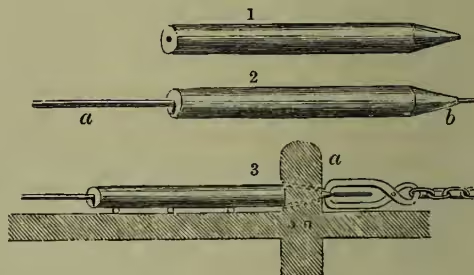
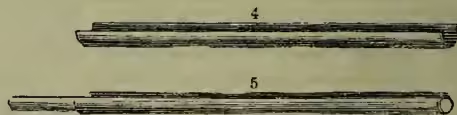
Pipes of ductile metal, such as brass, copper, and tin, are made by first casting an ingot into the shape shown in fig. 1, with a hole through its length of the same diameter as the bore of the pipe is intended to have. Into this is placed an iron rod, called the mandrel (a, fig. 2), which exactly fits, and which projects slightly at the tapered end (b, fig. 2). It is then brought to the drawing-table, and here the small end with its projecting mandrel is put into a funnel-shaped hole, drilled through a steel post (a, fig. 3), so as to allow the point to be gripped on the other side by a pair of pincers, at the end of a strong chain; the machine-power is then applied to the other end of the chain, and the soft metal and its mandrel are drawn through, the former being extended equally over the surface of the latter, which is then removed, and the length of pipe is complete. Some metals require repeated drawing through holes, getting gradually smaller, and have to be softened or annealed at intervals, as the metal hardens under repeated drawing. In this way brass, copper, tin, and pewter pipes are made; and a patent has also been taken out for making steel pipes; but lead pipes are made of great lengths by squeezing the soft metal through a hole in a steel plate in which there is a fixed core or mandrel projecting, which forms and regulates the size of the bore of the pipe. Pipes are also made from copper, brass, and malleable iron by rolling out narrow strips of metal, and then passing them successively through rollers, which are deeply grooved, and which turn up the edges (fig. 4). A mandrel is then laid in it, as in fig. 5, and it is next passed through double-grooved rollers, which turn the edges in, and thus form a complete tube round the mandrel. The edges, however, require hard soldering—i.e. soldering with a fusible brass alloy, or welding, if of iron. All boiler-tubes used to be made in this way; but the method of drawing has lately been so much improved that copper and brass pipes, or tubes, as they are frequently called, are now drawn of considerable thickness and diameter.