Refraction. When a beam of light, travelling in a transparent medium, impinges obliquely upon the surface of another transparent medium, what occurs in the vast majority of cases is that a part of it is reflected (see REFLECTION) and a part of it enters the second medium, but in so doing is refracted or bent out of its former course. If, for example, the light travel in air and impinge obliquely upon glass, the course of the refracted portion is bent so that the refracted light travels more directly or less obliquely through the glass; and, conversely, if the light travel in glass and impinge upon an air-surface, the portion which is refracted into the air will travel through the air more obliquely with respect to the refracting surface than the original light had approached it. The law of refraction was discovered by Snell in 1621, and is the following: the refracted ray is in the same plane with the incident and the reflected ray, and is therefore in the plane of incidence (see REFLECTION); and the sine of the angle of incidence bears to the sine of the angle of refraction a ratio which remains constant, for any two media, whatever be the angle of incidence.
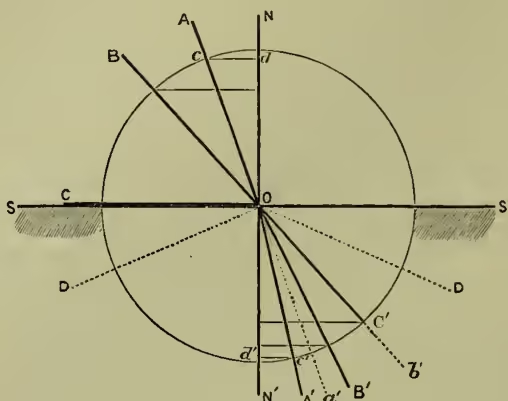
In fig. 1 a ray, AO, impinges on a denser medium at O; the angle of incidence is AON (ON being at right angles to the refracting surface); the refracted ray, instead of going on towards , is bent so as to pass through A'. Draw a circle cutting AO and OA' in and ; draw and at right angles to NN'; these lines, and , are, for the radius O, the sines of the respective angles AON and A'ON'. These sines bear to one another a certain proportion, ascertained by measurement; let it be 3:2; then Snell's law is that any other ray, say from B, will be so refracted that the sines, similarly drawn, will bear to one another the same proportion of 3:2. Between air and water the ratio of these sines is almost exactly 4:3; between air and crown-glass it is nearly 3 : 2. Now observation shows that light passing from water into crown-glass is so refracted that the sines have the ratio , or 9 : 8, so that the rays are less bent than when they pass from air into any of these media.
The ratio of these sines when air is one of the pair of media involved is called the refractive index of the other medium; thus, water has, for sodium monochromatic light and at 18° C., a refractive index of 1.3336, and crown-glass one of 1.5396; and the ratio of these refractive indices, ascertained with respect to air, governs the ratio of the sines, whether air be one of the pair of media experimented on or not. A direct consequence of this is that, if light pass successively, say, through air, glass, and water, the ultimate deviation will be the same as if the glass had been absent; and so for any number of intervening terms, it being always assumed that the bounding surfaces are parallel to one another; and if a parallel beam of light, passing through air, come to traverse any number of parallel refracting-surfaces, and if it regain the air, it will be found to travel parallel to, if not directly in, its original course.
The observed fact that light is differently bent in its course by different refracting media shows that there is a difference between bodies in their power of receiving light through their bounding surfaces. Newton, in accordance with his corpuscular theory (see LIGHT), interpreted this as showing that when the luminous corpuscles come very near the surface of a denser substance they are as it were jerked or made to swerve out of an oblique path and hurried in by the attraction of the denser substance so as to enter that substance more directly; and that when the light quits the denser substance it is retarded by a similar attraction. The consequence of this would be that light would travel in the denser medium perhaps not appreciably faster than in air, but with a mean velocity certainly not less. On the undulatory theory, however, refraction is a necessary consequence of a slower travel of ether-disturbances in the denser medium.
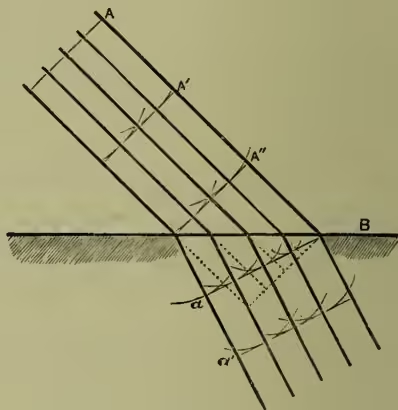
In fig. 2 A is a plane wave-front, advancing obliquely towards B, the surface of a denser medium. At the end of a certain time the wave-front is at A'; after an equal interval it is at A''. During the next equal interval a gradually diminishing breadth of the wave is traversing the original medium with the original velocity; but a steadily widening portion of the wave-front enters the denser medium and is there hampered. At the end of the interval the aggregate disturbance, that is to say, the wave-front, will be found to have swung round into the position and direction represented by a, just as a line of soldiers would tend to do on obliquely entering more difficult ground. During the next equal interval the wave-front advances parallel to itself, but traverses smaller distances in equal times, so that aa' is less than AA'. To this explanation it is essential that in optically denser media light should travel more slowly: and it has been absolutely established that this is the case. Optical density, so called, does not, however, always coincide with mass-density: bisulphide of carbon, which is lighter than glass, has for sodium light a refractive index of 1.63, while crown-glass has an index about 1.5, and flint-glass one about 1.6. If the course of any ray between any two points in the two respective media be studied, it will be found that no other path between the two points could have been traversed in so short a time.
If we go back to fig. 1, and assume the rays to pass from A', B', &c. towards O, we find the rays emerging from the denser medium more nearly parallel to SS'; a ray from C', so far as it is refracted at all, emerges parallel to SS'; and for rays approaching O from points between C and S' the construction for the refracted ray becomes impossible. The angle C'ON' is the critical angle, beyond which there is no refraction, but total reflection (see REFLECTION). This angle is such that its sine is equal to , where is the ratio between the refractive indices of the denser and the rarer medium. For water and air it is, for sodium monochromatic light, 48° 27' 40". Where this ratio (the 'relative index of refraction') is high, this critical angle is small and total reflection is well marked, as in the sparkle of the diamond.
When a spherical wave impinges on a plane surface it is modified into a hyperboloid, the centre of curvature of the central portion of which is farther away than or nearer than the centre of the sphere in the ratio of the refractive index of the second medium to that of the first. An eye within a rarer medium will thus see the image of a point situated within the denser medium as if it were nearer than it really is; hence a stick appears bent when partly immersed obliquely in water; and, owing to differences in the amount of refraction at different angles, the bottom of a tank looked down upon appears sunk in the middle.
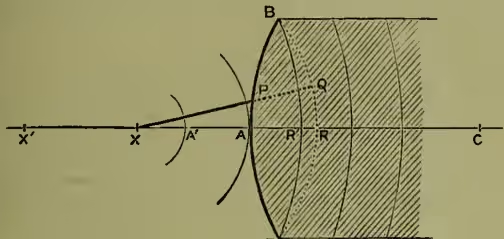
In fig. 3 light starts from a point X, and impinges directly upon a spherical surface of a denser medium; the centre of curvature of the spherical surface is at C. During a certain interval of time the front of the wave advances from A' to A; during the next equal interval it would, but for the denser medium, have been at BRD. It has not, however, got so far as R in the time; the central part of the wave-front has only got as far as R', where . Any non-axial ray, such as XP, which would have reached Q, can only have originated a disturbance at P, which would have travelled from P in some direction to a distance not equal to PQ, but to PQ reduced in the same ratio of . We might then, knowing , the relative index of refraction of the denser medium, draw, with centre P and radius , an arc of a circle; the disturbance will have got to some point on that circle. Doing the same for all the P's, we have a series of circular arcs which may be connected by a line drawn so as to touch them all. This line will be a curve; and it will, for some distance from the axis, coincide very nearly with the arc of a circle whose centre is at X', so that the wave-front will travel in the denser medium approximately as if it had originally come from X'. The relation between the distances AX, AX', and AC is given by the formula , where is the refractive index of the original, and that of the refracting medium. For example, let (air) and (crown-glass); inches; inch (i.e. the source of light is one inch to the left of A); then ; whence , or the light travels in the denser medium as if it had come from a point 2 inches to the left of A. If the wave-front be plane as it approaches A, that is equivalent to or ; whence is equal to , or the light converges on a point in the denser medium 6 inches to the right of A. If, however, a plane wave-front approach A in the denser medium, that is equivalent to ; but, as the original medium is now the denser one, and ; whence, by the formula, , and the convergence is on a point 4 inches to the left of A. These distances of the points of convergence for plane waves, at and from A, are the Principal Focal Distances for the curved surface and the media in question; and they bear numerically the same ratio to one another as the refractive indices do; from which, together with the previous equation, we get ; which shows, still keeping to our numerical example, that when the object lies at a greater distance than 4 inches to the left or 6 inches to the right of A, the image is a real one on the opposite side of A; whereas when it is at a less distance from A, X and X' are on the same side of A, and the image is virtual. X and X', thus determinable when one of them is known, are conjugate foci; and they are interchangeable, so that an object at either will produce an image, real or virtual as the case may be, at the other.
The refracting medium may not be of indefinite extent, but may be bounded in the path of the light by another surface. If this be symmetrical with respect to the first spherical surface we have a Lens (q.v.); and, by repeating our calculations of the refraction at the second surface as if the image produced by the first were itself an object, we arrive at the formulae given in the article on LENSES.
If a parallel beam of light enter one plane surface and be there refracted and emerge by another which is not parallel to the first, we have the essentials of a Prism. Assume the incident light to be monochromatic; then fig. 4 shows the incident beam SP taking the course SPQR.
The elements of the problem are, being the relative index of refraction of the prism: (1) ; (2) ; (3) angles angle A, by the geometry of the figure; and (4) angles angles , this last being the Deviation produced by the prism. These four equations contain seven terms;
Fig. 4.
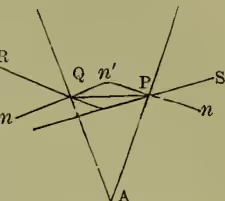
and it is sufficient to measure three of these, say the angles A, SPn, and , in order to ascertain the rest, including , the relative refractive index of the prism for the particular monochromatic light employed. If, however, the light employed be not monochromatic but mixed, as ordinary daylight, we find that the prism sends each wave-length—each colour-sensation-producing component of the daylight (see COLOUR)—to a different place, and thus produces a Spectrum (q.v.). Each wavelength has its own and its own deviation; the more rapid, shorter waves being the more refrangible by a given piece of glass.
If in fig. 4 the prism be turned so that S and R lie symmetrically with reference to the angle A, the deviation is then a minimum; and in that position of minimum deviation a monochromatic beam, divergent from S, will come to focus at R. In examining the spectrum of light from a source S it is necessary to turn the prism so as to ensure sharpness by producing this minimum deviation for each part of the spectrum in succession. When the deviation is a minimum everything is symmetrical; ; ; whence, by equations above, , and ; whence , which determines , when A (the angle of the prism) and (the deviation) have been measured. The refractive indices of liquids and of gases are determined by enclosing them in hollow prisms of glass whose walls are made of truly parallel glass; the parallel glass produces no deviation. In liquids the angle of total reflection or 'critical angle' may also be readily measured; then the sine of this angle . The refractive index varies with changes of density, being approximately proportional to the density; and it bears certain intimate relations with the molecular constitution of the refracting matter.
Why ether-disturbances of differing wave-lengths are differently refracted in such a medium as glass is not yet perfectly clear. The fact that ether-disturbances of greater frequencies are propagated more slowly through optically denser matter may be fairly inferred to arise from a mutual interaction of the ether, periodically stressed and released, and the matter amid whose molecules the disturbance is propagated. The question is complicated by the downright absorption or non-transmission of many particular wave-lengths, and by the peculiar behaviour of some particular transparent substances which produce anomalous dispersion: for example, iodine vapour refracts red light more than blue, and blue more than violet; and fuel-sine refracts blue and violet light less than it does red, orange, and yellow, while it absorbs the rest. Further, it is found that in these cases of anomalous dispersion the substance generally has in the solid form a surface-colour different from that seen through its solution; and there are always absorption-bands, on the red side of which the refrangibility is increased, while on the other side it is diminished, as if the molecules themselves took up oscillations of particular periods and hurried on the propagation of slightly slower or retarded that of slightly more rapid oscillations of the ether. It appears as if this kind of action were never wholly absent; the spectrum produced by a prism never wholly coincides with the diffraction spectrum in which the deviation for each wave-length depends directly upon the wave-length itself; and the spectrum produced by a prism say of crown-glass does not exactly coincide in its visible distribution of colours with a spectrum of equal length made by a flint-glass prism. This is called the Irrationality of Dispersion. If now we take two prisms, such as C (crown-glass) and F (flint-glass) in fig. 5, and pass
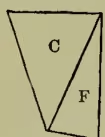
a beam of light through; then, if the angles of these prisms be suitable, the rays dispersed by the one will be collected by the other, and there will on the whole be deviation without dispersion; but not absolutely so, on account of the irrationality of dispersion of both prisms, the effect of which is that a calculated ratio of angles and refractive indices which will cause deviation without dispersion for any given pair of wave-lengths will, to a very slight extent in most cases, fail to do so for the other wave-lengths present in the mixed light transmitted through the system. By the use of three prisms three wave-lengths may similarly be achromatised.
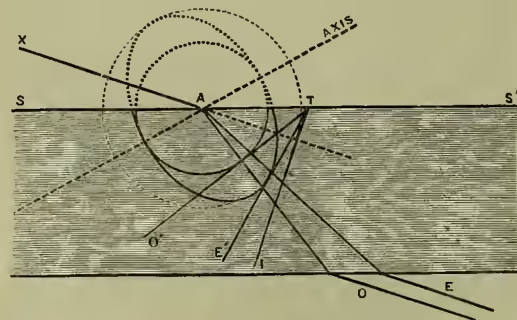
DOUBLE REFRACTION.—The wave-surface developed when a disturbance originates at a point in a homogeneous medium, such as glass, is spherical in form. In uniaxial crystals (see CRYSTALS) the disturbance travels with two wave-fronts, one spherical, the other ellipsoidal; and the two wave-fronts are coincident along the direction of the optic axis. Of such crystals some are positive, such as quartz and ice, and in these the sphere encloses the ellipsoid; in negative crystals, such as Iceland spar and tourmaline, the ellipsoid encloses the sphere. If then a beam of light, plane-fronted, fall upon a slice of Iceland spar, the disturbance at any point such as A (fig. 6) is transmitted from that point in two portions; one portion is refracted, according to the principles of fig. 2 in article REFRACTION, as an ordinary refracted ray, O; the other is refracted in a way determinable by using in the construction, instead of the spheroid or arcs of a circle, the corresponding ellipsoid, or arcs of the appropriate ellipse, and it gives rise to the extraordinary refracted ray, E. The radius of the smaller circle is to that of the greater as ; the tangent to the greater circle, at right angles to XA, cuts SS' in T; tangents TO' and TE to the smaller circle and the ellipse are also drawn so as to pass through T; the ray XA is deflected so as to pass through the points at which these tangents touch these curves; and thus there are two refracted rays, and an eye towards OE will see two images of X. The light in the ordinary ray O is found to be polarised (see POLARISATION) in a plane containing both the incident ray and the crystalline axis: the extraordinary ray E is polarised in a plane at right angles to this. In binaxial crystals the three optical axes are dissimilar, and the wave-surfaces become complex: there are two refracted rays. If a doubly refracting substance be put between two crossed Nicol's prisms (see POLARISATION), light passes; and by this means it is found that many substances ordinarily not double refracting become so when exposed to unequal stress, as by pressure, heat, or rapid cooling.
CONICAL REFRACTION.—In certain cases light, passing as a single ray through a plate of a biaxial crystallised body, emerges as a hollow cone of rays; and in others a single ray, falling on the plate, becomes a cone inside the crystal, and emerges as a hollow cylinder. These extraordinary appearances were predicted from the wave theory of light by Sir W. R. Hamilton (q.v.), and experimentally realised by Lloyd. See Preston's Theory of Light (1890).
Refrigerants 'are remedies which allay thirst and give a feeling of coolness,' although they do not in reality diminish the temperature of the body. The following are the refrigerants in most common use for internal administration: water, barley-water, dilute phosphoric or acetic acid, citric and tartaric acids taken in combination with bicarbonate of potash as effervescing draughts, ripe grapes, oranges, lemons (in the form of Lemonade, q.v.), tamarinds, chlorate of potash (ten grains dissolved in water, and sweetened with syrup, to be taken every third or fourth hour), and nitrate of potash, which may be taken in the same manner as the chlorate, or as nitre-whey, which is prepared by boiling two drachms of nitre in a pint of new milk; the strained milk may be given in frequent doses of two or three ounces.
Refrigeration. In refrigerating machines there is a transference of heat from the substance which is to be refrigerated to the cooling agent, which is evaporating fluid, expanding gas, or a material which promotes evaporation of the liquid to be cooled. If 80.025 pound-Centigrade units of heat be withdrawn from a pound of water at C. it will become a pound of ice at the same temperature. If this heat be withdrawn from the water by an evaporating liquid there are two conditions which must be fulfilled; the evaporating liquid must evaporate very rapidly, and the latent heat of evaporation (i.e. the heat absorbed from outside during evaporation) must be as great as possible. Ether boils at C. ( F.), and has at C. ( F.) a vapour-pressure of 18.4 cm. (7.36 inches) of mercury; at C. it requires 94 lb.-Centigrade units of heat to evaporate a pound of it; and at that temperature its evaporation ought accordingly to be able, if the whole of the heat required for evaporation were withdrawn from water, to freeze times its weight of water at C., so that a ton of ice (2240 lb.) would be produced by the evaporation at C. of a minimum of 1907 lb. of ether. Alcohol is more advantageous than ether in respect of its higher specific heat, but is preponderatingly less so in respect of its lesser volatility. Liquid ammonia boils at C. ( F.), and has at C. a vapour-pressure of 318 cm. (127·2 inches), or more than four atmospheres : it is thus extremely rapidly volatilised at 0° C.; and, as its latent heat of evaporation is as much as 294, the production of a ton of ice would thus only demand the evaporation of a minimum of 610 lb. of liquid ammonia. Liquid sulphurous acid (boiling-point, -10·8° C. or 12·6° F.; vap. pr. at 0° C., 116·5 cm. or 46·6 inches, or about 1½ atm.; lat. h. of evap. 94·56) is also a volatile liquid presenting considerable advantages. Machines for using ether have been constructed by Siebe, Siddeley and Mackay, Duvalon and Lloyd, Mühl, and others. The ether is caused to evaporate rapidly by an air-pump or pumps worked by steam; it cools brine or a solution of calcium chloride, and this cools the water to be frozen or the air to be refrigerated; the ether vapour is condensed by pressure and cold and used over again. Ammonia was first used by Carré in 1860; ammonia gas driven off by heat from its solution in water is condensed in a cooled vessel under its own pressure; the original ammonia vessel is now cooled, and the liquid ammonia rapidly evaporates (its vapour being absorbed), chilling its surroundings. Anhydrous liquid ammonia has been used by Reece and others. M. Raoul Pictet of Geneva has used sulphurous acid, the evaporation of which is hastened by an air-pump. The greatest difficulties in machines of this nature are (apart from chemical action of the liquid employed) the difficulty of making joints to withstand great pressures, and the cost of condensing the evaporated refrigerant. Messrs Tessié du Motay and A. I. Rossi have introduced a solution of 300 times its volume of sulphurous acid gas in ordinary ether; the sulphurous acid and the ether are readily evaporated off together by the air-pump, and on condensation the ether settles down first, absorbing the sulphurous acid; so that there are no pressures to deal with, and no sulphuric acid produced which may corrode the metal, but only ethyl-sulphuric acid, which does no great harm.
The air-pump or sulphuric acid has also been employed to promote the evaporation of the liquid itself which is to be refrigerated. In Mr A. C. Kirk's apparatus (British patent 1218 of 1862), and in the Bell Coleman apparatus, greatly employed for producing cold dry air for use in the refrigerating chambers of dead-meat-carrying steamers, the principle is that compressed and cooled air will, when allowed to expand against an external resistance, so that it does mechanical work during expansion, lose heat equivalent to the energy which it has expended. In the former the same air is alternately compressed in one place and expanded against some resistance in another.
Porous jars, used to keep water cool, are amongst the simplest kinds of refrigerating apparatus; the evaporation at the outer surface of the jar of the water passing through the porous earthenware taking latent heat from the water (see EVAPORATION).
For details as to refrigerating machines, consult Bondie's Ice-making Machinery (Spon, New York); Spon's Dictionary of Engineering ('Ice-making Machines,' p. 1996); Spon's Encyclopedia of the Industrial Arts ('Artificial Ice,' p. 1133). See also the articles COLD, FREEZING MIXTURES, ICE; and for the Refrigeration of the Earth, see EARTH, TEMPERATURE.