Renaissance is a comprehensive name for the great intellectual movement which marks the transition from the middle ages to the modern world; a movement including a very marked change in attitude of mind and ideal of life, as well as in philosophy, art, literary criticism, political and religious thought. Substantially a revolt against the barrenness and dogmatism of Medievalism, the new spirit claimed the entire liberation of reason, and, passionately recognising and studying the rich humanity of Greece and Rome, aimed at a complete rehabilitation of the human spirit with all the free activities and arts and graces which invested the classical age. It was an escape—at first hesitating, then triumphant—from a life regulated and confined on all sides by ecclesiastical tradition and intellectual tyranny into joyous freedom and unfettered spontaneity. Zeal for the Litteræ Humaniores brought forth a new ideal of culture, and the new view of life for which the name of Humanism (q.v.) is used. Renaissance, re-birth, was originally used as synonymous with the Revival of Letters, the revived study in a new spirit of the classical languages and classical literatures of Greece and Rome in all their depth and breadth, interpreted in their own spirit, and divested of the narrow traditional limitations. Greek in especial was practically a new discovery, and a vastly important one; but the knowledge of the classics was only one side of the movement which permeated and transformed philosophy, science, art, and religion. The new spirit powerfully aided in weakening the power of the papacy, in the establishment of Protestantism and the right of free inquiry. Under its impulse astronomy was eventually reformed by Copernicus and Galileo, and science started on its modern unfettered career; by it, too, feudalism was abolished, and the demand for political liberty began to be raised. Reverence for the Holy Roman Empire and for its ancient rival the papacy was alike decaying; a new sense of nationality was springing up, and national languages began to flourish. To the same general impulse, as causes or effects, belonged also the invention of printing and multiplication of books, new methods of paper-making, the use of the mariner's compass, the discovery of America, and the exploration of the Indian Sea. The fall of the Eastern Empire in 1453 sent swarms of Greek scholars to promote the revival of scholarship already in progress in western Europe. From the nature of the case, it is impossible to fix a definite date for the beginning of the Renaissance; long before the close of the dark ages there were isolated scholars and thinkers who anticipated the new light. In its main elements, however, the movement originated in Italy towards the end of the 14th century, and, attaining its full development there in the earlier half of the 16th, the Renaissance communicated itself throughout the whole of the rest of Europe; France, Germany, England, and other countries participating later in the movement, which in each of them took a somewhat different shape. But Italy was specially the nursing-mother of the Renaissance.
For the first herald of the Renaissance we may go as far back as Dante (1265-1321), who, with all his mediævalism of conception, yet by the pristine energy and fullness of his poetry was no unworthy follower of his chosen master, Virgil. The first positive impulse, however, in that direction was imparted by Petrarch (1304-74). Besides suggesting in his Italian Rime the old Roman grace, he awoke enthusiasm for the classics by his Latin epic Africa and numerous epistles and dissertations. In his old age he tried to imbibe a little Greek at the extremely sorry sources within his reach, and on receiving Homer from Constantinople urged Boccaccio to translate the supreme poet into Latin. Boccaccio did not rest till he had piously, though very imperfectly, rendered into Latin both the Iliad and Odyssey. A secretary of Petrarch, Giovanni Malpighino, commonly called da Ravenna, was the most accomplished Latinist of his day, and, wandering as he did all over Italy, communicated the new impulse to distinguished pupils, Barbaro, Strozzì, Poggio, Bruni, who in their turn propagated it anew from Venice, Rome, Mantua, and elsewhere. Luigi Marsigli's house became a private academy of the new doctrine, a resort of all the promising neophytes of Florence. Caluccio de Salutato, who translated Dante into Latin, having been made chancellor of Florence in 1375, introduced into public documents the stately sonorous periods of the classic style, and so rendered it imperative on all princes and popes of the next age to have trained stylists as their secretaries. A like classic transformation was effected in epistolary correspondence by Gasparino da Barzizza, who made a special study of Cicero's letters. The glory of having been the first Florentine to visit Byzantium for the sake of learning the sacred Greek belongs to Giacomo da Scaparia. To Salutato and Palla degli Strozzì is due the foundation of a Greek chair at Florence; and in 1396 Mannel Chrysoloras, a genuine Greek in the flesh, began his instructions from the Greek chair. Chrysoloras planted schools also at Rome, Padua, Milan, and Venice. In the earlier period of the Renaissance Florence leads the van. The president of the republic, Cosimo de' Medici, himself a scholar, theologian, philosopher, musician, financier, a connoisseur in painting, sculpture, and architecture, figures as the magnificent Mæcenas of the new learning, founding the Platonic academy, and opening his hospitable house to all the wits at home and all the distinguished visitors attracted thither. The son of his physician, Marsilio Ficino (q.v.), Cosimo educated for the express purpose of interpreting Plato. Strozzì, perhaps the richest after Cosimo of the merchant-princes of Florence, sent to Greece for countless volumes of MSS., and constantly kept copyists employed. Niccolo de' Niccolì spent his whole fortune in buying MSS. or procuring copies. Poggio Bracciolini, one of the most eminent of the scholars of his time, rescued Quintilian from a 'foul prison' and transcribed him, and copied with his own hand MSS. of Lucretius and Columella, while he also unearthed Italicus, Manilius, and Vitruvius. Though for fifty years chancellor in the Roman Curia, he directed the most poignant satires against the church. Vespasino da Bisticci (1421-98) was perhaps the last of the mediæval scribes, and the first of modern booksellers; he was agent of Cosimo, Nicholas V., and Frederick of Urbino, supplier of MSS. to Hungary, Portugal, Germany, and England, and the largest employer of copyists in Europe, whom, too, he personally superintended.
The second period in the history of the Renaissance is distinguished by indiscriminate avidity for everything classic. As its most representative scholar may be cited Francesco Filelpho (1398-1481). Having studied rhetoric and Latin at Padua, he learned Greek at Constantinople, became professor at Venice, Bologna, and Florence, and gained the admiration of all Italy for erudition. In the third period of the Renaissance the leading figures are Lorenzo de' Medici and Politian at Florence, Boiardo at Ferrara, and Sannazaro at Naples. President of Florence from 1469, and himself of the most versatile talent, Lorenzo de' Medici was, like his grandfather Cosimo, his son Giovanni (Leo X.), and his nephew Giulio (Clement VII.), a munificent patron of learning. By the consent of all, the most consummate of the humanists is Politian, whose Manto, Ambra, and Nutritia display almost as spontaneous a command of the classic languages as do his Orfeo, Stanze, and Rime of his native Italian. Towards the end of the 15th century mere erudition began to sink in credit, and the accomplished personages who adorn the fourth period are of a somewhat more independent type—the historians, Guicciardini and Machiavelli, the handsome Bembo, the splendid Alberti, Castiglione, the author of Il Cortegiano, and Ariosto, author of Orlando Furioso, the Cinque Canti, and the polished cynical Satires.
Some of the faults of the Renaissance clung to it in all its periods. At one time pedantry threatened to check originality and spontaneity; the worst ancient works were prized more than the best written in any new European tongue. Petrarch valued himself mainly for his Latin works, and thought lightly of his Italian poems. The tendency was established to regard the classics as the one standard of learning and the one instrument of education. A worse fault was it that the revolt against mediæval religious tradition was accompanied to a very large extent by absolute and anti-Christian immorality and license. Literary and artistic refinement placed no check on brutal lusts and savage passions; though in a few men of high character, Michael Angelo, Raphael, Pico della Mirandola, Ficino, and others, in whom Humanism did not extinguish the principles of Christianity and morals, a singularly noble and complete humanity was displayed. The culmination of the Renaissance in Italy may be regarded as having fallen within the half century 1456-1500; and its close for the land of its birth may be fixed at the sack of Rome in 1527 by the Constable de Bourbon, followed by the transference of Humanism in its later developments to France, England, and the rest of Europe.
In Germany the change was as marked as in Italy, but the Humanism of Germany and the Low Countries was very different in spirit from that of Italy. Not less tinged by a revived love for ancient learning, it was never divorced from morality nor hostile to Christianity; and its most important direct outcome was the Reformation. Biblical and Oriental studies were strenuously cultivated. Amongst the noted leaders were Erasmus, Melanchthon, Reuchlin, and Von Hutten. In the Netherlands and Flanders the new school of painting was a notable development. In France the movement had rich results in art and letters. Villon, Marot, Ronsard, but above all Rabelais are types of the French Renaissance in pure literature; while within the sphere of scholarship and religious reform we have here the names of the Scaligers, Dolet, Muretus, Cujacius, Salmasius, Casaubon, Beza, Calvin.
In England Wyclif and Chaucer may be regarded as the forerunners of the Reformation and the Renaissance; but the main streams of both these movements reached England contemporaneously. In scholarship the great names are Grocyn, Lincacre, Colet, Ascham, and More; but the fullest English outcome of the Renaissance was the glorious Elizabethan literature, with Spenser and Shakespeare, and in philosophy Bacon, as its most noted representatives.
RENAISSANCE, in Architecture, the style which succeeded the Gothic, and preceded the rigid copyism of the classic revival in the first half of the 19th century. Under the heading ITALIAN ARCHITECTURE we have traced the rise and progress of the Renaissance in the country of its birth. The spread of classical literature during the 15th and 16th centuries created a taste for classic architecture in every country in Europe. France, from her proximity and constant intercourse with Italy, was the first to introduce the new style north of the Alps. Francis I. invited Italian artists to his court during the first half of the 16th century. The most distinguished of these were Leonardo da Vinci, Benvenuto Cellini, Primaticcio, and Serlio. These artists introduced Italian details, and native architects applied them to the old forms to which they were accustomed, and which suited the purposes of their buildings, and thus originated a style similar to, though diverse from, that of Italy.
The Italian buildings, besides many palaces and domestic structures, comprised a large number of churches, St Peter's being the great model. In France (as in the other countries north of the Alps) the stock of churches was greater than was required. The grand domestic buildings of Florence and Rome were constructed for defence externally, and were founded in design on the old mediæval castles, which the nobles occupied within the cities. The domestic architecture of France is rather taken from the luxurious residences of the monks, and the pleasant open villas in the country; so that, although very graceful in outline and in detail, its buildings want the force and grandeur of the Italian palaces.
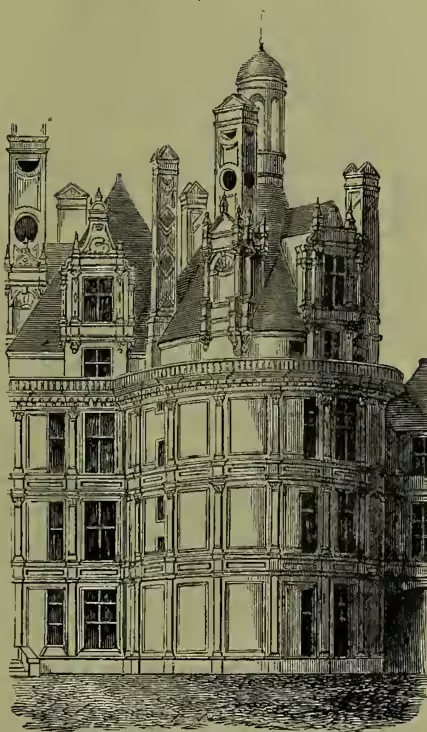
In the French Renaissance so much are the old Gothic forms and outline preserved that the buildings of Francis I. might at a short distance be mistaken for Gothic designs, although on nearer approach all the details are found to be imitated from the classic. Such are the palaces of Chambord (q.v.) and Chenonceaux (q.v.) on the Loire, Fontainebleau, and many others. The churches of this period are the same in their principles of design. Gothic forms and construction are everywhere preserved, while the details are as nearly classic as the designers could make them. St Eustache, in Paris, is one of the finest examples of this transitional style.
From the middle of the 16th to the middle of the 17th century a style prevailed which may be said to exhibit all the varieties of the Renaissance. This style, usually known as that of the time of Henry IV., may be distinguished by the constant use of pilasters, broken entablatures, curved and contorted cornices, architraves, &c., all applied so as to conceal rather than to mark and dignify the real uses of the features of the buildings. The Tuileries, wrecked by the Commune, showed all these defects.
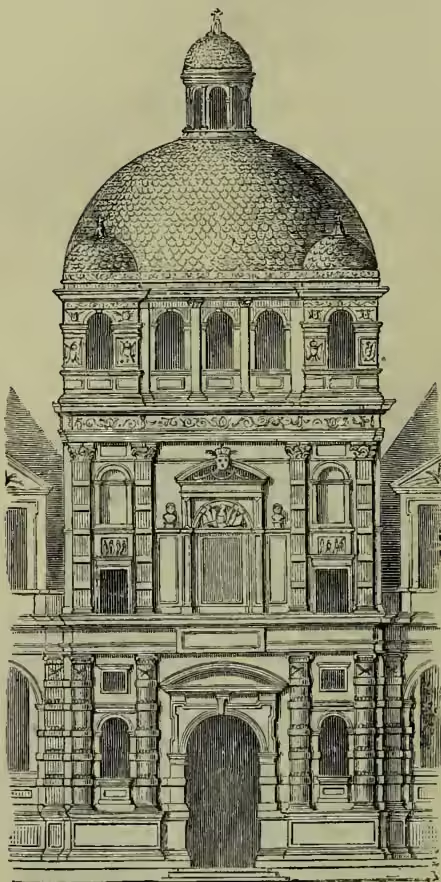
as designed by De Lorme.
Many of the features of this period are imitated in the so-called 'Queen Anne style' of the present time (see below). From this debased style architecture gradually recovered, and during the 18th century a style more becoming the dignity and importance of the Grand Monarque was introduced. The classic element now began to prevail, to the entire exclusion of all trace of the old Gothic forms. Many very large palaces are built in this style; but, although grand from their size, and striking from their richness and luxuriance, they are frequently tame and uninteresting as works of art. The palace of Versailles (q.v.) is the most prominent example. The two Mansards, one of whom designed Versailles, had great opportunities during this extravagant epoch. Their invention of giving a row of separate houses the appearance of one palace, which has ever since saved architects a world of trouble, was one of the most fatal blows which true street-architecture could have received. The east front of the Louvre, designed by Perrault, is one of the best examples of the style of the age. Many elegant private hôtels and houses in Paris were erected at this period. A peculiarity of the style of Louis XIV. is the ornament then introduced, called Rococo (q.v.).
The classic Renaissance was completed in the beginning of the 19th century by the literal copying of ancient buildings. Hitherto, architects had attempted to apply classic architecture to the requirements of modern times; now they tried to make modern wants conform to ancient architecture. In the church of the Madeleine, Paris, for instance, a pure peripteral temple is taken as the object to be reproduced, and the architect has then to see how he can arrange a Christian church inside it! Many buildings erected during the time of the Empire are no doubt very impressive, with noble porticoes, and broad blank walls; but they are in many respects mere shams, attempts to make the religious buildings of the Greeks and Romans serve for the conveniences and requirements of the 19th century. This has been found an impossibility—people have rebelled against houses where the window-light had to be sacrificed to the reproduction of an ancient portico, and in which the height of the stories, the arrangement of the doors, windows, and, in fact, all the features were cramped, and many destroyed, in order to carry out an ancient design. The result has been that this cold and servile copyism is now entirely abandoned. The French are working out a free kind of Renaissance of their own, which promises well for the future, and is, at the present moment, as the streets of Paris testify, the liveliest and most appropriate style in use for modern street-architecture.
In Spain the Renaissance style early took root, and, from the richness of that country at the time, many fine buildings were erected; but it soon yielded to the cold and heavy 'Greco-Romano' style, and that was followed by extravagances of style and ornament more absurd than any of the reign of Louis XIV. The later Renaissance of Spain was much influenced by the remnants of Saracenic art which abound in that country.
In England, as in the other countries of Europe, classic art accompanied the classic literature of the period; but, the fountain-head being at a distance, it was long before the native Gothic style gave place to the classic Renaissance. It was more than a century after the foundation of St Peter's that Henry VIII. brought over two foreign artists—John of Padua and Havenius of Cleves—to introduce the new style. Of their works we have many early examples at Cambridge and Oxford, in the later half of the 16th century. Longleat, Holmby, Wallaton, and many other country mansions, built towards the end of the 16th century, are fine examples of how the new style was gradually adopted. The course of the Renaissance in England was similar to its progress in France; it was even slower. Little classical feeling prevailed till about 1620. The general expression of all the buildings before that date is almost entirely Gothic, although an attempt is made to engraft upon them classical details. The pointed gables, mullioned windows, oriels and dormers, and the picturesque outlines of the old style are all retained long after the introduction of quasi-classic profiles to the mouldings. This style, which prevailed during the later half of the 16th century, is called Elizabethan (q.v.), and corresponds to the somewhat earlier style in France of the time of Francis I. This was followed in the reign of James I. by a similar but more extravagant style called Jacobean, of which Heriot's Hospital at Edinburgh is a good example; the fantastic ornaments, broken entablatures, &c., over the windows, being characteristic of this style, as they were of that of Henry IV. in France.
The first architect who introduced real Italian feeling into the Renaissance of England was Inigo Jones. After studying abroad he was appointed superintendent of royal buildings under James I., for whom he designed a magnificent palace at Whitehall. Of this only one small portion was executed (1619-21), which still exists under the name of the Banqueting House, and is a good example of the Italian style. Jones also erected several elegant mansions in this style, which then became more generally adopted. In the later half of the 17th century a splendid opportunity occurred for the employment of the Renaissance style after the great fire of London. Sir Christopher Wren rebuilt an immense number of churches in that style, of which St Paul's (see LONDON) was the most important. The spire of Bow Church and the interior of St Stephen's, Walbrook, are also much admired.
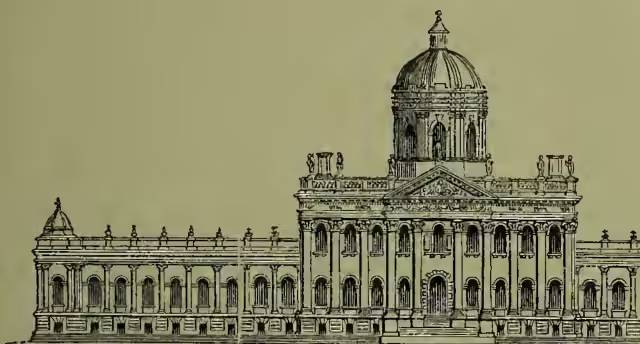
During the 18th century classic feeling predominated, and gradually extended to all classes of buildings. In the early part of the century Vanbrugh built the grand but ponderous palaces of Blenheim and Castle Howard, which have a character and originality of their own. To these succeeded a vast number of noblemen's mansions, designed by Campbell, Kent, the Adamses, and others. Many of these, like the contemporaneous buildings of France, are of great size and magnificence; but they are usually tame and cold in design, and a sameness pervades them all. They generally consist of a rustic basement-story, with a portico over the centre, and an equal number of windows on either side. The portico is considered essential, and, although it is perfectly useless, the light and convenience of the house are invariably sacrificed for it.
The further study of the buildings of Greece and
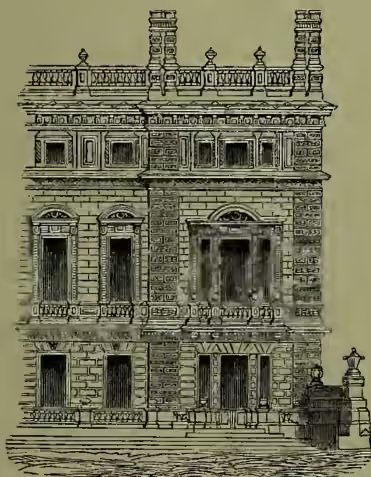
Rome led, in the beginning of the 19th century, to the fashion of reproducing them more literally. All important public buildings were now required to be absolute copies of ancient buildings, or parts of them, or to look like such, and then the architect had to work out the accommodation as best he might. St Pancras' Church in London is a good example. It is made up of portions from nearly every temple in Greece! Many really successful buildings, such as St George's Hall, Liverpool, the High School and Royal Institution in Edinburgh, have been erected in this style; but they owe their effect not to their being designs well adapted to their requirements, but to the fact that they are copies from the finest buildings of antiquity. We have thus two different styles included under the head of Renaissance—viz. one in which the classic elements are subordinated to the Gothic dispositions, and which is now generally understood by the expression 'Renaissance;' and the other that in which the classic elements distinctly predominate, and which is commonly known as 'Classic.'
Sir Charles Barry was the first to break away from this thralldom, and to return to the true system of designing buildings—namely, by so arranging their general features as not only to express the purposes they are intended to serve, but in so doing to form the decorative as well as the useful elements of the edifice. The Travellers' Club-house and Bridgewater House in London are admirable specimens of his design. There are no superfluous porticos or obstructive pediments, but a pleasing and reasonable design is produced by simply grouping the windows, and crowning the building with an appropriate cornice.
As already noticed, a similar style of domestic architecture is now being worked out in France; but both there and in England there was a reaction against everything classic, and a revival of mediæval architecture superseded that of classic, especially in ecclesiastical buildings. The most magnificent examples of this style are the Palace or Houses of Parliament at Westminster, and the new Law Courts.
The so-called Queen Anne style, common in recent years, is supposed to be founded on the class of design prevalent at the beginning of the 18th century. The buildings erected at that period were of a very plain and simple order, with classic cornices and details, and frequently with large windows, sometimes divided by mullions. There is occasionally a certain picturesqueness in the arrangements which has been made the most of in the modern revived style. The latter, although taking the name of Queen Anne, is far from adhering to the style of her reign, but is rather a free use of the elements of the early Renaissance or Elizabethan style. It thus combines much of the freedom of the late Gothic with classic detail, to which is added a copious use of features borrowed from the Renaissance of France and Germany. Many large structures have been erected in this style, such as the Royal Colonial Institute in London, and the new Law Courts at Birmingham. In these buildings the peculiar features of the style are visible—viz. large windows, divided by plain mullions, and a mixture of classic details and Gothic forms. The style adapts itself well to villas and smaller structures, in which the curved gables of the dormers form prominent features.
In Germany, Russia, and every country of Europe the Renaissance came to prevail in a manner similar to that above described in other countries. The picturesque castle of Heidelberg is an early example, and the Zwinger and Japanese palace at Dresden are edifices of the beginning of the 18th century. In the domestic buildings of Nuremberg,
Dresden, and other towns of the north of Germany many instances occur of the picturesque application of classic detail to the old Gothic outlines. One of the most striking examples of the revival of classic art occurred in Bavaria during the first half of the 19th century, under the auspices of King Louis. He caused all the buildings he had seen and admired in his travels to be reproduced in Bavaria. Thus, the royal palace at Munich is the Pitti Palace of Florence on a small scale; St Mark's at Venice is imitated in the Byzantine Chapel Royal; and the Walhalla, on the banks of the Danube, is an exact copy (externally) of the Parthenon. The finest buildings of Munich are the Picture-gallery and Sculpture-gallery by Klenze, both well adapted to their purpose, and good adaptations of Italian and Grecian architecture. In Vienna and Berlin there are many examples of the revived Classic and Gothic styles, but the Germans have always understood the former better than the latter. The museums at Berlin, and many of the theatres of Germany, are good examples of classic buildings. The domestic architecture of Berlin is well worthy of notice, many of the dwelling-houses being quite equal in design to those of Paris. Of the other countries of Europe the only one which deserves remark for its Renaissance buildings is Russia. St Petersburg is of all the cities of Europe the one which best merits the title of a city of palaces. From the date at which the city was founded, these are necessarily all Renaissance in character. They are nearly all the works of German or Italian architects, and are unfortunately, for the most part, in the coldest and worst style. The ornaments of the palaces are chiefly pilasters running through two stories, with broken entablatures, &c., and ornaments of the flimsiest rococo. The New Museum, by Klenze, is, however, a marked exception. In America nearly all the new buildings of importance are carried out in the Renaissance style. Many of these are of great size and striking design. The town-hall of Boston may be referred to as one of the most imposing and effective. Another conspicuous example is the town-hall of Philadelphia (q.v.).
Along with architecture, during the period of the Renaissance Painting and Sculpture and all the other arts took their models from the classic remains which were so carefully sought for and studied. All ornamental work, such as carving, jewellery, and metal-work of every kind, followed in the same track. Medieval niches and pinnacles gave place to the columns and entablatures of the classic styles, and the saints of the middle ages yielded to the gods and goddesses of ancient Rome.
See Burckhardt, The Renaissance in Italy (Eng. trans. 1878; new ed. 1890); Pater, The Renaissance (1873; new ed. 1888); Michelet's Histoire de France, tome ix.; John Owen's works on the sceptics of the Renaissance; Symonds, The Renaissance in Italy (7 vols. 1875-86); Voigt, Die Wiederbelebung des Klassischen Alterthums (1859; 2d ed. 1881); Ludwig Geiger, Renaissance und Humanismus (1881); Villari's Machiavelli (Eng. trans. 1890) and Savonarola (Eng. trans. 1889); Lecky's History of Rationalism and his European Morals; Draper's Intellectual Development of Europe; Guizot's History of Civilisation; Lady Dilke, The Renaissance of Art in France (1879); Vernon Lee, Euphorion (1884); Leader Scott, The Renaissance of Art in Italy (1883), and books by Berenson (1894) and W. F. Anderson (1896); Müntz, Histoire de l'Art pendant la Renaissance (1895); books on Renaissance Architecture in England by Goch and Brown (1892 et seq.), and Blomfield (1897); and the articles REFORMATION, HUMANISM, PAINTING, ITALIAN ARCHITECTURE, and works there cited; as also those on ARIOSTO, BOCCACCIO, BRUNO, CAMPANELLA, ERASMUS, HUTTEN, MACHIAVELLI, MEDICI, PETERARCH, POLITIAN, RABELAIS, RAPHAEL, SAVONAROLA, &c.