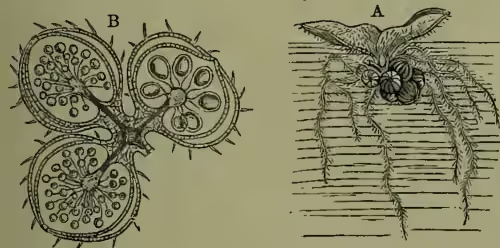
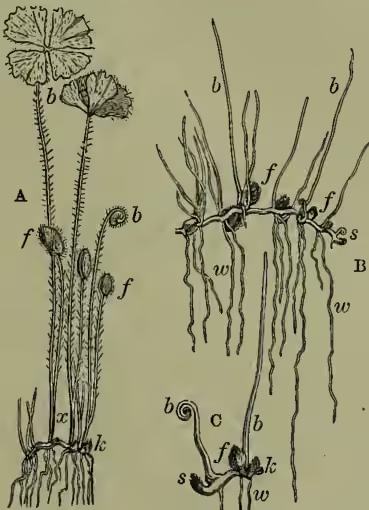
Salvinia, a genus of the order of plants formerly called Rhizocarpeæ or Peppercorns, now known as the Heterosporous Ferns. They are 'ferns' because, amongst other reasons, the development of the embryo is similar to that process in the common ferns, and 'Heterosporous' because the sporophyte bears two kinds of spores instead of one. To understand these plants it is necessary to know the structure of Ferns (q.v.). The order includes two families, the Salviniaceæ and the Marsiliaceæ. The former consists of two genera, Salvinia and Azolla, the latter also of two genera, Marsilia and Pilularia. The spore-bearing generation of Salvinia is a plant that floats on the surface of water. The stem bears on its upper surface four rows of aerial leaves, and on its under surface two rows of submerged aquatic leaves, which have the outward form and functions of roots; there are no true roots at all. The stem of Marsilia creeps along the surface of marshy land, or on the bottom below the water. The upper surface of the stem bears two rows of leaves with long stalks, the under surface bears roots. Pilularia has peculiar narrow leaves. In Salvinia the sori or groups of sporangia are placed upon the aquatic leaves near the insertion, whence the old name Rhizocarpeæ. The coverings or indusia form small berry-like objects. In Marsilia the sori are borne upon fertile leaves which branch from infertile leaves just above their insertion. The fertile leaves are folded in like pea-pods, and each of them encloses several sori. The sori of Pilularia are similar, but globular. The sori of Salvinia and of Azolla are of two kinds. Some contain numerous long-stalked microsporangia with male spores; others contain fewer (in Azolla only one) short-stalked female macrosporangia with female spores. In Marsilia and Pilularia the macrosporangia and microsporangia occur within the same sori. The microspores develop into rudimentary filamentous male prothallia. The antherozoids are formed in two cells at the apex of the filament, which represent the antheridium. The macrospores develop into female prothallia which never grow more than to project a little from the spores; they bear archegonia. The oosphere within an archegonium is fertilised by an antherozoid, and produces an embryo. The Heterosporous Ferns are interesting as showing a stage in that reduction of the prothallium as an independent plant which reaches its climax in the Seed Plants. See FERNS, OVULE, and PHANEROGAMIA.