Sculptured Stones, a general name given in Britain to a class of monuments of the early Christian period, many of them being mere unhewn stones, with sculpturings of rude inscriptions, or symbols, or ornamental designs, corresponding in style and patterns to the illuminated decorations of Celtic manuscripts of the Gospels. The rude stones erected for memorial purposes in pagan times (unless under Roman influence) are uninscribed and unornamented (see under STANDING STONES). The sculptured stones of Britain may be divided into two classes—those that are simply incised and those that bear sculpture in relief, the former being the earlier method. Sculptured stones of the incised or earlier class may be subdivided into two sections, inscribed or uninscribed, irrespective of their bearing symbols and ornamentation. The advantage of this division is that the inscribed monuments can be arranged in chronological order by their palæographical characteristics, and the uninscribed examples bearing similar symbols and ornamentation to those found on the inscribed examples will follow the same sequence. We know from palæographical data that the earliest lapidary inscriptions in Britain are in Roman capital letters, and that the minuscules, or small letters, do not make their appearance till about the 6th century. Hence we have a means of dividing the inscribed stones into an earlier and a later group according as they are written in capitals or minuscules, while those that are mixed or partly in capitals and partly in minuscules will represent the middle or transition period. But many of the inscribed monuments bear inscriptions which are written in a character peculiar to the British Isles, and known as Ogam (q.v.). Sometimes the Ogam inscription is associated with an inscription in Roman letters on the same stone, sometimes the monument bears an Ogam inscription only. In the latter case it is frequently associated with sculptured ornamentation in relief of the most advanced type, and therefore we have another means of dividing the inscribed stones into two groups, one of which is demonstrably later than the other. Of these four groups, which are (1) inscribed in Roman capitals only; (2) inscribed in Roman letters and in Ogam, or bilingual and biliteral; (3) inscribed in Ogam only; and (4) inscribed in Roman minuscules or small letters, the first and second have their chief development in Wales, and the third and fourth in Ireland.
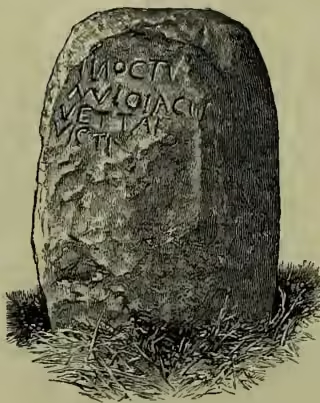
Of the first group of sculptured stones there are sixty in Wales, twenty-three in England, six in Scotland, and none in Ireland. They are in general rude undressed pillar-stones or oblong boulders from 4 to 9 feet in height, the inscriptions generally incised vertically. They are always in the Latin language, and usually consist of the name of the deceased, preceded by one or other of the varieties of the distinctively Christian formula 'Hic jacet,' &c. The greater number of these stones are found in association with ancient ecclesiastical sites, and some bear also incised crosses of the earliest known type. A well-known example is the Cat Stane near Kirkliston, Midlothian (fig. 1), which stands in a cemetery of early Christian graves, and bears the inscription, IN [H]OC TVMVLO JACIT VETTA F[ILIUS] VICTI. One of a group of three at Kirknadrine in Wigtownshire commemorates two priests, Viventius and Mavorius, probably of the church founded there by St Ninian in the 5th century. The greater purity of the forms of the letters and the style of the Latin of the inscriptions of this group indicates their closer proximity to the period of the Roman occupation. The characteristic of the second group of inscribed stones is that they bear two inscriptions, one in the Latin language and in Roman letters (capitals as a rule), and the other in the vernacular in Ogam letters, one inscription being always an echo of the other. Of these bilingual monuments there are eighteen in Wales, two in England (both in Devon), two in Ireland, and one in Scotland, at Newton of Garioch in Aberdeenshire. Two examples will show the general character of their inscriptions. One in Pembrokeshire has, in debased Latin capitals, SAGRAMNI FILI CVNOTAMI, reading from the top of the stone downwards on one face, and on one edge the answering inscription in Ogam letters, SAGRANI MAQI CVNOTAMI, maqí being the usual form in these inscriptions for son. Another in Carmarthenshire reads in Latin AVITORIA FILIA CVNIGNI, while the answering Ogam has AVITORIGES INIGINA CUNIGNI—inígina standing for daughter, and answering to the modern Gaelic ingen, as maqí answers to mac. The third group of inscribed monuments, those bearing Ogam only, lies chiefly in Ireland, where there are 186 examples. There are only twenty-two in Britain, of which twelve are in Scotland, six in Wales, and four in England. Twenty-three of the Irish examples are associated with early forms of the cross incised on the same stone. In Scotland six occur on stones bearing crosses or Celtic ornamentation of a late type, and in Wales six are on stones bearing incised crosses. From their nature these Ogam inscriptions are peculiarly difficult to decipher; but when the reading is clear they are usually of the same brief character as the bilingual inscriptions of the group previously described. The fourth group of inscribed monuments comprises those in minuscules or small letters of the Roman alphabet, chiefly in the forms of those letters adopted by the Irish scribes. Of such inscribed stones there are about 260 in Ireland, forty-two in Wales, twelve in England, and only three or four in Scotland. The largest group in Ireland is in the ancient cemetery of Clonmacnois, where there are over eighty examples, many of which can be dated by the names of the persons commemorated. They are chiefly undressed slabs laid flat on the graves, and incised sometimes with the inscriptions only, sometimes also with crosses, and more rarely with Celtic ornamentation. Of the names which can be identified from the Irish annals four belong to the 7th century, six to the 8th, twenty-eight to the 9th, eighteen to the 10th, and the same number to the 11th century. The earliest bear nothing but the inscriptions and plain crosses. Ornamentation does not begin to be added till the 9th century. In Ireland the inscriptions are usually in the vernacular, with the formula oroit do — and its contractions, or oroit ar annmain — and its contractions, meaning 'pray for —' or 'pray for the soul of —.' In Wales, however, the inscriptions of this group are usually in Latin. Though the majority of these stones are sepulchral monuments, others have been erected for different purposes, commemorative or terminal, to mark the boundaries of church lands or sanctuaries. In the Anglo-Saxon parts of Britain the inscribed stones bear inscriptions in Anglian runes, and in the Isle of Man and the northern and western isles of Scotland, colonised from Scandinavia, the inscriptions are in Scandinavian runes. The monuments with Anglian runes are chiefly sepulchral slabs of small size, incised with a cross and the name of the deceased. In a few cases, however, they are great commemoration crosses, covered with sculptured ornamentation, and bearing elaborate inscriptions. The finest of these crosses are at Bewcastle (q.v.) in Cumberland and Ruthwell (q. v.) in Dumfriesshire. The shaft only of the Bewcastle cross remains, 14½ feet in height; the Ruthwell cross measures 17½ feet in height. Both are so similar in design and in style of ornamentation that they must be attributed to the same period. Both have long runic inscriptions—that on the Ruthwell cross being associated with a series of inscriptions in Roman capitals descriptive of the scriptural scenes carved on the panels of its two broad faces, while the runes are on the borders of the long panels on the sides of the cross, enclosing scrolls of foliage. They contain twenty-one lines of an Anglo-Saxon poem—‘The Dream of the Holy Rood’—which was not known to exist in any other form until a South Anglian version was discovered in a manuscript at Vercelli in 1823, and attributed to Cynewulf, though Professor Stephens of Copenhagen maintains that a line of runes on the top of the cross, now obliterated by exposure, gave the authorship to Cædmon. The inscription on the Bewcastle cross is less legible, and has been read as recording its erection in honour of Alcfrih, king of Northumbria, in the 7th century, though the opinion is gaining ground that the dates of both these crosses must be placed considerably later than his time.
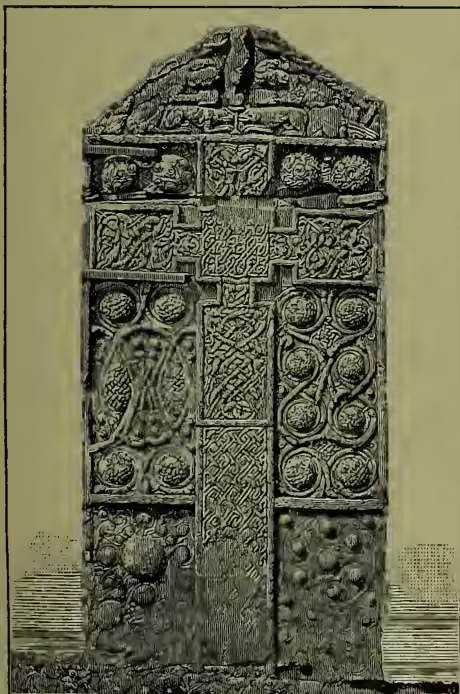
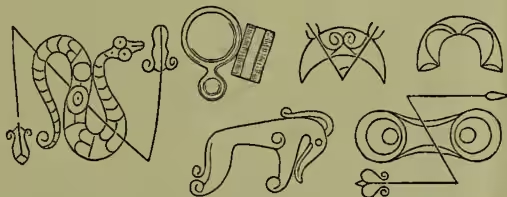
The monuments included generally under the name of the sculptured stones of Scotland are for the most part uninscribed. But they are profusely decorated (as will be seen from the annexed figure of one of the most ornate, at Nigg in Ross-shire), and their chronological place in the general group of the early Christian monuments of Britain falls to be determined partly from the relations of their general system of ornamentation to that of the illuminations of the Celtic manuscripts of the Gospels of the 7th to the 10th and 11th centuries, and partly by the characteristics of the few inscriptions they do bear. Taken by themselves, they exhibit peculiar characteristics, which show that, although they form part of the general group which is peculiar to the British Isles, they have been affected by strong local influence. They present a peculiar set of symbols, not one of which is known to have occurred beyond the Scottish area, while the special form of the erected cross-bearing slabs, and the partiality to the representation of conventional beasts as part of their decoration, distinguish them from the English, Welsh, and Irish groups. The Scottish sculptured stones, of which over 370 are known, are divided into three varieties: (1) rude undressed pillar-stones or oblong boulders incised with unexplained symbols; (2) erect shaped slabs of headstone form, sculptured generally in relief, with a cross on one face and figure subjects and symbols on the other; and (3) high crosses with figure subjects and Celtic ornamentation similar to those of the cross-bearing slabs, but without the symbols. The rude pillar-stones of the first variety occur chiefly along the eastern side of Scotland from the Firth of Forth to the Orkney and Shetland Isles, being most numerous in the district between the Tay and the Spey. Outlying examples, however, occur as far south as Dumfriesshire and as far west as the outer Hebrides. The unexplained symbols incised on these stones are more easily represented than described. Those of most common occurrence are represented in fig. 3. Some of these are arbitrary symbols, to the development and meaning of which there is no clue. Others—such as the serpent, and the mirror and comb—are representations of existing objects, apparently used with a symbolic meaning. Some of the arbitrary symbols occur also on silver ornaments of the same period. On stones of the second variety, sculptured in relief, and presumably of later date, these symbols are associated with well-known symbols of the Christian faith, such as the cross and the fish, and with the ornamentation so characteristic of the illuminated pages of Celtic manuscripts of the Gospels. The figure subjects on the stones of this variety are partly scriptural and mostly related to the general cycle of early Christian symbolism. Among the scriptural subjects are the Temptation of our First Parents by the Serpent, Daniel in the Den of Lions, the Destruction of Pharaoh's Host in the Red Sea, the Raising of Lazarus, Jonah disgorged by the Whale, the Virgin and Child, &c. Along with these are hunting scenes, including the chase of the stag, wild boar, &c., and groups of animals evidently taken from the Bestiaries of the early middle ages, a species of natural history spiritualised, in which the characteristics of the various animals, real and fabulous, were set forth as symbolising the spiritual condition of man as related to the scriptural plan of salvation (see BESTIARY). Of the third class of sculptured stones, the high crosses, there are but few in Scotland, and they are nearly all characterised by the presence of scriptural subjects. There are no data by which the age of the stones of the first variety, bearing only the incised symbols peculiar to Scotland, can be estimated. But there seems no reason for assigning to them a higher antiquity than that of the inscribed stones of the first and second classes, which seldom bear ornamentation or symbols, except the early form of the cross. The style of the ornamentation of the second variety, sculptured in relief and arranged in panels, is similar to the decoration of the illuminated Celtic manuscripts of the Gospels of the period ranging from the 7th to the 10th century. The third variety, consisting of high crosses with pure Celtic ornamentation, may range from the 10th to the 12th century. This form of monument—a high cross—with local variations and a remarkable development of foliaceous ornamentation common to the recumbent sepulchral slabs of the same district, continued in the West Highlands from the 13th to the 16th century.
See Stuart, Sculptured Stones of Scotland (Spalding Club, 1856-67); Westwood, Lapidarium Wallace (1879); Stokes, Christian Inscriptions in Ireland (1878); Anderson, Scotland in Early Christian Times (1881); Romilly Allen, Early Christian Symbolism (1887); and Monumental History of the Early British Church (1889). See also the article CUP-MARKINGS.