Sun, the star which warms, governs, and illuminates the earth and the other bodies forming the Solar System. By the patient efforts of astronomers and physicists a vast body of knowledge, of which here we can but give the outline, has been gained regarding it. For convenience we condense such of this information as admits of the treatment into the subjoined table.
| Equatorial horizontal parallax..... | 8"794 |
| Mean distance..... | 92,965,000 miles |
| Diameter..... | 867,000 miles |
| Diameter (apparent angular)..... | { Max. 32' 36"4 Min. 31' 32"0 |
| Mass..... | 330,000 |
| Density..... | Earth's as unity { 0.25 |
| Volume..... | 1,305,000 |
| Force of gravity at surface..... | 27.6 |
| Period of rotation on axis..... | 25 days 7 hours 48 minutes |
| Inclination of axis to plane of ecliptic (1850)..... | 82 45' |
| Velocity of rotation at equator..... | 4407 miles per hour |
| Longitude of node of equator (1850)..... | 73 40' |
| Surface in square miles..... | 2,283,621,466,000 |
| Energy radiated from each square foot of this surface (Stokes) | |
| = 12,000 horse-power. |
Early observations of the sun were necessarily confined to records of its motions and eclipses, of which a very fair mastery was gained even in Chaldaean and Egyptian times, as well as early in the history of China (see ASTRONOMY). The apparent motions of the sun, determining as they do what part of our world shall at any time receive his heat and light more or less abundantly, are so regular and so important to our life that they naturally give us our principal time measures (see DAY, YEAR, SEASONS). For long the observation of these formed perhaps the chief part of astronomy. But when Copernicus showed that the sun was really the centre of our system, and Galileo discovered the moons of Jupiter, the idea of a community of nature between the sun and our world—the earth circling around the sun as the moons around Jupiter—began to take firm root in men's minds. Newton's extension of the law of gravitation to the heavenly bodies greatly aided this process. The idea that the sun shone because composed of mysterious fiery elements faded away, and men began to ask after its real constitution, and seek the secret of its stores of energy. But to answer this question required much preliminary investigation, and to trace this, so far as it has gone, is to track some of the best and purest triumphs of human patience and skill.
(1) The sun's distance was the first problem to be attacked. In ancient times Aristarchus of Samos tried to solve this by measuring the angle between the sun and moon when the latter was in her quarters (see MOON). This method, even if accurately followed, would give no absolute measure, but only the relation between the distances of the sun and moon. From his attempts Aristarchus concluded the sun to be eighteen times as far from us as the moon. In reality his method is one which can give no accurate result, though it represents a great step in astronomical investigation. As instruments improved, and especially when the telescope was invented, new measures were made, only to result in the conviction that the sun was so far away that accurately to measure its distance appeared impossible. The distance of celestial objects is found by the measurement of their Parallax (q.v.). If an observer changes his own position, all the objects around him appear also to shift their relative positions, those nearer shift more than distant ones, and by the amount of shift for a known change of the observer's place their distance may be calculated. The greater the distance between the observer's two positions the greater (and therefore more easily measurable) is the apparent shift of the objects before him. It was found ere long that no change of place possible on our small earth, 8000 miles in diameter, was sufficient to produce a definitely measurable change in the sun's position on the celestial sphere. By an opposition of Mars (see below) observed in 1672 by Richer at Cayenne and Cassini at Paris this angular change of place (or parallax) was given at = a distance of 87,000,000 miles. Flamsteed, by the same method, reached a parallax of = 81,700,000 miles, Picard's measure was parallax = 41,000,000 miles, and Lahire's 136,000,000 miles.
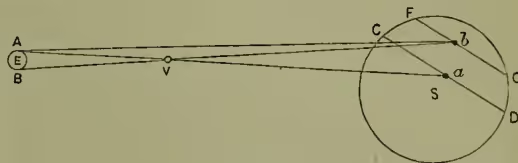
At last, in 1716, the English astronomer Halley proposed a method of employing the transits of Venus. Accordingly the transits of 1761 and 1769 were observed in a variety of places; but the results at first deduced were discordant and unsatisfactory, until in 1824 the German astronomer Encke 'discussed' the observations of 1769, and arrived at a distance of about 95,300,000 miles; and this number held its place in books of astronomy for a good many years. A transit can occur only when the planet is in or near one of her nodes at the time of inferior conjunction, so as to be in a line between the earth and the sun. The coincidence of these two conditions follows a rather complex law. There are usually two transits within eight years of one another, and then a lapse of 105 or 122 years, when another couple of transits occur, with eight years between them. The transit of 1874 had for its successor that of 1882, and there will not be another until June 2004. The way in which a transit is turned to account may be understood by the help of fig. 1, where E represents the earth, V Venus, and S the sun. It is to be premised that the relative distances of the planets from the sun are well known. Their periodic times can be observed with accuracy, and from these by Kepler's (q.v.) Law we can deduce the proportions of the distances, but not the distances themselves. It is thus known that, if the distance of the earth from the sun is taken as 100, that of Venus is 72. In the fig., then, AV is 28, or about one-third of Va or Vb. An observer at a station, A, on the northern part of the earth will see the planet projected on the sun as at a, while a southern observer will see it at b. The distance of the sun from Venus being about three times her distance from the earth, it is obvious that the distance ab will be three times the distance AB; and it is a great advantage to have the stations A, B, as far apart as possible, as the interval ab is thus increased, and its measurement rendered more accurate.
But how is it measured? For each observer sees only one of the spots, and does not know where the other is; and there are no permanent marks on the sun's surface to guide us. The difficulty is got over in the following way. Each observer notes the exact duration of the transit—i.e. the time the spot takes to travel from C to D, or from F to G. Now as we know the rate of Venus' motion in her orbit, this gives us the length of the lines CD and FG in minutes and seconds of arc. Knowing then the angular diameter of the sun () and the lengths of two chords CD and FG, we can easily, by the properties of the circle, find the distance ab between them. This gives us the angle aAb. In the triangle AVb, then, we know the angle at A and the proportion of the sides AV and Vb, and from that we can find the angle AbV and AbB. Now this is the quantity sought, being the parallax of the sun as seen from two stations on the earth. Whatever the distance AB actually is, the angle is reduced to correspond to a distance equal to the earth's semi-diameter. The parallax deduced by Encke, as above referred to, was only . The advantage of this roundabout procedure is that a comparatively large angle (aAb) is measured in order to deduce from it a smaller (AbB), so that any error in the measurement is diminished in the result.
Meanwhile during the later part of the 18th century efforts had been made by Dr Stewart of Edinburgh (1763) and Mayer of Göttingen to determine the sun's distance by the lunar 'parallactic inequality' (see MOON). These amounted to little until Laplace (q.v.) solved the problem and gave a result hardly different from Encke's. In 1854 and 1858, however, Hansen and Leverrier found reason to doubt its correctness. A favourable opposition of Mars in 1862, observed by Stone and Winnecke, justified their doubts, fixing the distance somewhere between 91 and million miles. The method employed so far resembled that of the transits of Venus that it depended on measuring the distance of a nearer object than the sun—viz. the planet Mars in opposition. From this, the proportions of the planetary distances from the sun being accurately known, the solar distance was easily calculated.
Meanwhile, by a most ingenious method, another measure of this was obtained. Römer (1675), Delambre (1792), and Glasenapp (1874) had ascertained (the last with great accuracy) by observation of Jupiter's Satellites (q.v.) that light takes 500.84 seconds to cross the earth's orbit from side to side (Glasenapp's result). Also the amount of the Aberration of Light (q.v.) had been carefully measured. If the velocity of light were known these would afford a means of estimating the sun's distance. This velocity was measured by Fizeau and Foncault in 1862. The result confirmed the later and smaller estimate of solar distance given above. A rediscussion of the transit observations of 1769 by Ponalky (1864) and Stone (1868) also confirmed it.
The transit of Venus in 1874 was impatiently awaited, as with modern instruments and methods a final settlement of the question was anticipated. But, although about eighty posts of observation were provided all over the world and many observers carefully trained, little or no progress was made. Atmospheric effects and photographic defects left an uncertainty estimated by Professor Harkness of Washington, D.C., at million miles.
Dr Gill in 1877 observed a favourable opposition of Mars, which gave a result of 93,080,000 miles. Observations of minor Planets (q.v.) were also utilised, and a number of expeditions sought a value from the transit of 1882. Michelson of the United States navy anew determined (in 1879) the velocity of light, and Professor Harkness used his value for it in another estimate. The amount of accuracy obtainable at present in such discussions may be judged by the various estimates given by the best authorities as follows: Professor Harkness, 92,365,000 miles; Professor Young, 92,885,000; Dr Ball, 93,000,000; Mr Stone, 92,000,000; M. Faye, 92,750,000. These various values will explain the varying estimates of the size, mass, density, &c. of the members of the solar system, as the sun's distance enters as a factor into all such calculations. The table at the beginning of this article is based on a solar parallax of . In it the reader will find the results as to the sun's size, mass, density, and gravitational power of this conclusion as to his distance.
(2) The sun's true motion in space is ascertained from the comparison of observed stellar proper motions (see STARS). It is directed to a point on the line joining the stars and Herculis. Its velocity is 1.623 radii of the earth's orbit per annum.
(3) The investigation of the physical structure and chemical constitution of the sun has been in modern times most successful. A long series of efforts by many workers has brought us to something like definite ideas as to its radiating power, which is a fundamental factor in this investigation (see HEAT). In 1837 Pouillet measured the amount of solar radiation. His result was that 1.76 calories per minute were received on every square centimetre of our earth's surface. Much of the sun's heat is absorbed by the terrestrial atmosphere. Hence Forbes ascended the Faullhorn in 1842 and obtained there the greater value of 2.85 calories. Violle on Mont Blanc in 1875 got 2.54. Professor
Langley, probably the most accurate observer, gives very nearly 3.00. Computations of the sun's temperature in degrees Cent. have varied from a few hundreds to many millions. They are essentially misleading, as the condition of matter in the sun is not yet known sufficiently well to enable us to calculate its temperature from its radiation. We know, however, with certainty that the most refractory substances are vaporised long before the solar temperature is reached. And the sun's surface, seen by Langley through the then smoke-laden air of Pittsburgh, appeared 5300 times as bright as the molten metal in the fierce heat of a Bessemer converter. At the temperature indicated by this all known substances would exist as tenuous vapour, were the pressure bearing on them that of our terrestrial atmosphere. But in the interior of the sun, under pressures inconceivable to our minds, such vapours would behave very differently. Under such conditions the usual distinctions between solid, liquid, and gaseous forms of matter to which we are accustomed would be obliterated. In fact, how matter would behave in such a state science at present cannot tell. Of the sun's surface, however, we have learned much. According to the researches of Professor Rowland of Johns Hopkins University, Baltimore, in 1891, the following elements are present there. The list is in order, according to the number of spectral lines in the elements identified in the solar Spectrum (q.v.), iron coming first with more than 2000 lines identified, potassium last with 1 only. Iron, nickel, titanium, manganese, chromium, cobalt, carbon, vanadium, zirconium, cerium, calcium, scandium, neodymium, lanthanum, yttrium, niobium, molybdenum, palladium, magnesium, sodium, silicon, strontium, barium, aluminium, cadmium, rhodium, erbium, zinc, copper, silver, glucinum, germanium, tin, lead, potassium, and possibly iridium, osmium, platinum, ruthenium, tantalum, thorium, tungsten, uranium.
These as vapours form a layer upon the solar surface, which is in fact the solar atmosphere. Immediately beneath this is the photosphere, which marks to the eye the boundary of the sun's disc. Above this layer of vapours rise vast jets and clouds called variously flames, prominences, or protuberances. Above these again is the bright and curiously shaped solar corona, extending along the ecliptic, as once seen, to a distance of twelve solar diameters.
The photosphere presents to the telescope of low power an apparently even surface. Under higher powers its structure is seen to be complex. The whole surface is granulated, resembling a gravel heap seen from a little distance. These granules have been described as like 'willow leaves' and 'rice grains.' A multitude of minute dark points or pores, black in comparison with the granules, serve to emphasise their outline. This may be said to be the normal condition of the photosphere. There are always, however, some portions of the surface which show an indistinctness of granulation, sometimes so marked that they are named 'veiled spots.' Bands of this indistinctness in less marked form spread over the whole photosphere as a kind of network called by French observers the risseau photosphérique. They are continually in a state of fluctuation, and are most probably due to the currents of varying density in the solar atmosphere. The granules and spores are due to intense convection currents, the tops of ascending masses of vapour glowing white with the heat derived from the solar interior. These show as 'granules,' while the descending masses, having radiated their energy, return to be again heated below the surface, and in their descent show as the comparatively dark 'pores.' The appearance of the surface of a large mass of molten iron in an open mould gives a fair idea of this process. It must always be remembered, when vapour or gas is spoken of as at the sun's surface, that the enormous temperatures and pressures there prevailing, with the scale on which these must vary in short intervals of time, will make vapours behave much more like terrestrial solids than like gases as we know them. The impact of a small jet of solar 'vapour' would in fact be far more powerful than that of a projectile from a 100-ton gun. The rapidity of these convection currents must therefore be enormous, and a little careful watching soon shows that the whole solar surface is in a state of constant change.
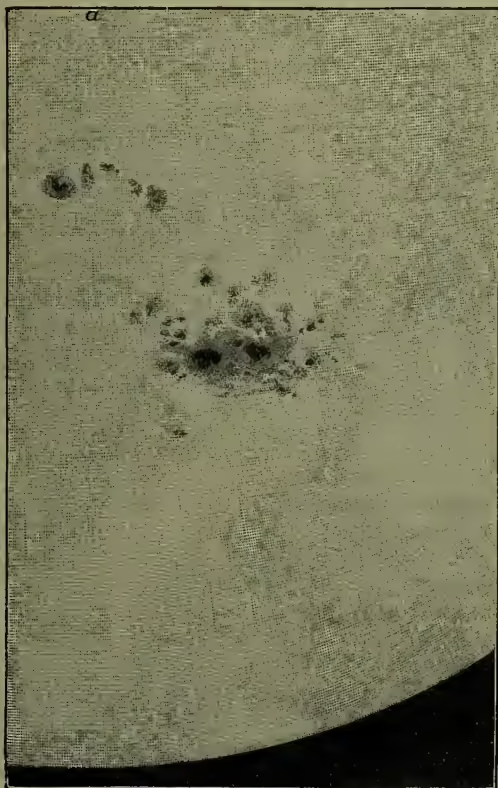
In certain regions of the photosphere, between and solar latitude, both north and south of the solar equator, large black spots are frequently observed. In size these vary from 150,000 miles in largest diameter to small black dots approaching in appearance the 'pores.' The largest are easily seen by the naked eye when fog or dark glass protects it from the excessive solar glare. The activity of their producing cause is subject to a considerable variation. Schwabe of Dessau in 1843 announced the discovery of this important fact, giving about ten years as its period. Wolf in 1852 corrected this to 11·11 years. This is generally accepted as the mean period, but individual periods may vary from it considerably. The shortest periods are the most intense. There is an undoubted connection between this period and that of terrestrial magnetic phenomena. Aurora and sun-spots wax and wane together, even in their smaller fluctuations. But the theory that sun-spots depend for their frequency on the influence and position of the planets has had to be abandoned. These spots usually have three well-marked areas, distinguished by their different degrees of blackness. The penumbra forms the outer border of the spot, and is only grayish compared with the general white of the solar surface. Within this is a much darker area called the umbra, and within this a still blacker spot, the nucleus. While sometimes persisting for months, spots frequently vanish or form in a few days, sometimes even in a few hours. They are the theatre of constant changes. Long filaments are often extended from the penumbra across the umbra, forming 'bridges.' In fact the whole penumbra appears filamentary in structure, being composed of the 'granules' drawn inwards from the edge by the force in the spot. Cyclonic movements have been observed in spots, but are not usual. The spot is most probably a cavity formed in the photosphere by the pressure of a vast descending mass of vapour. In spot latitudes, for some unknown reason, these masses collect in unusual size, not descending by the minute 'pores,' but requiring larger openings. Both spots and pores appear dark, not because the uncovered lower solar layers are cooler than those above, but because the cool masses of vapour pressing on them from above absorb their light, and prevent it reaching us. In reality their blackness or grayness is only such as compared with the intensely white photosphere. It is almost certain that these absorbing vapours are considerably cooler than the neighbouring surface. Great differences of pressure, as well as of temperature, exist in spots. Hence they are accompanied by (or accompany) great disturbances and fierce vapour currents. These affect even the earth, and cause simultaneous disturbances in our magnetic needles. White ridges (called faculæ) are raised in the neighbourhood of spots, indicating enormous pressures, and spreading often over a wide area of the solar surface. The spectra of sun-spots are most complex. Their meaning cannot yet be said to be fully understood. But they give certain evidence of vapour movements of enormous rapidity, and of pressures on a like scale. One example of this occurred in the great spot of June 1889, when a dark spectral line of iron was widened to five times its usual thickness, indicating an immense pressure. Displacements of lines from their normal position have also been observed, indicating vertical vapour movements at a velocity as high as 320 miles per second.
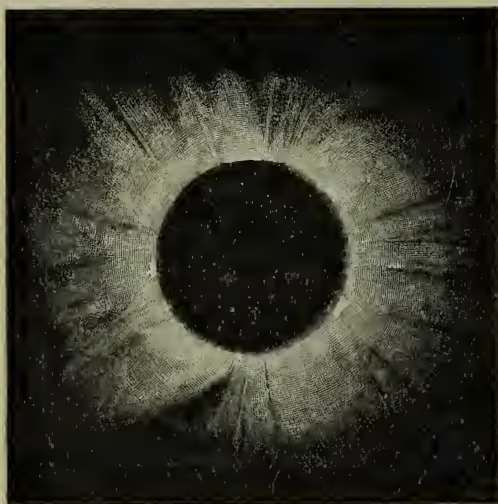
During total solar eclipses certain solar phenomena become visible, which bear closely on the problem of the sun's physical condition. Chief among these are the corona, prominences, and chromosphere. The last (sometimes called the sierra) surrounds the sun completely. It consists of a layer of vapours covering the entire photosphere. Its depth varies at different times and in different parts, ranging from about 6000 to 2000 miles. As seen in eclipses it is of a beautiful rosy hue, and its surface, seen in profile at the edge of the solar disc, appears sharply jagged and broken into waves or spear-like jets of varied altitude. It consists chiefly of hydrogen and an element, till 1895 unknown in our laboratories, called 'helium.' (See the article ARGON.) Sometimes heavier vapours, as of iron, calcium, titanium, magnesium, and others, are projected into it from the true solar atmosphere below. There is indeed no marked border between these groups of gases other than a fluctuating one due to their varied weight. The chromosphere rises often in local jets of rosy gas to an enormous altitude. These form the prominences, first recorded as seen at an eclipse by Captain Stannyan, who observed at Bern, Switzer- land, the total eclipse of May 12, 1706. Since recorded at many Eclipses (q.v.), they are now daily studied through the open slit of the spectroscopic, a method devised by Lockyer and Janssen in 1868, and improved in 1869 by Zöllner and Huggins. They form two well-marked classes, 'Cloud' and 'Flame' prominences. A 'Cloud' prominence resembles a terrestrial cloud, but, as seen by this method, of an indescribably delicate rosy hue, often connected by slender stems to the chromosphere. Such are relatively permanent, lasting usually a few days. 'Flame' prominences are eruptive, often connected with spots, and subject to violent changes even in the space of a few minutes. Delicate clouds of hydrogen are sometimes seen to form and disperse, in situ, in and close above the prominence region, exactly as clouds in our air, pointing out the fact that not even here is to be found the limit of matter ejected from or retained by the sun. The existence of the corona confirms this. Its appearance during a total eclipse may be gathered from fig. 3. Its shape varies, while yet a general agreement in form is preserved. In periods of sun-spot maximum it is more fully developed than at minimum periods, and differently shaped. At a spot minimum it is smaller and most developed towards the solar poles. At a maximum it gathers in great rays above the spot-region of the surface. As yet only to be studied during the short period of a total eclipse, the true nature of the corona is not determined. On one theory it has been thought to be like the Zodiacal Light (q.v.); on another it was supposed to consist of streams of meteorites; on yet another of cometary matter; and in a fourth it was regarded as chiefly terrestrial atmospheric glare. It is now generally admitted to consist of tenuous gas, hydrogen, and helium, possibly also some hydrocarbon and clouds of finely-divided dust, while electric discharges similar to an aurora play an important part in its illumination. It is hoped that yet a method may be devised of studying it independently of eclipses, when more definite knowledge of its structure will speedily be obtained.
See G. F. Chambers' Descriptive Astronomy (4th ed. 1889-90); Miss Clerke's Hist. of Ast. in the 19th Cent.; The Sun, by Professor Young (1881; new ed. 1888);
Le Soleil, by Secchi; Herschel's Outlines of Astronomy; Proctor, The Sun (1871); Lockyer, Chemistry of the Sun (1887); Sir R. S. Ball, The Story of the Sun (1894); for the age of the sun and the probable duration of its heat, Siemens' Conservation of Solar Energy (1883); Lord Kelvin's Mathematical and Physical Papers (1882-90), &c.; for the assumed connection of the cycles of sun-spots with Indian famines, papers in Nature, vol. xlii., &c.; and for the connection of volcanic dust with the phenomena of sunsets and afterglows, see the works cited at KRAKATOA.
SUN-WORSHIP.—In early philosophy throughout the world the sun and moon are regarded as alive and credited with sex, as brother and sister or husband and wife; but their worship cannot be said to be universal among the lower races, being more especially characteristic of the higher levels of savage religion, of tillers of the soil rather than nomads, of temperate rather than torrid climates. Thus, it was the main worship of the old pastoral Aryans, as may still be seen in Brahman rites, and it appears in the Persian Mithra, the Greek Helios, the Egyptian Ra. It flourished in Tartary, in the fullest development in ancient Peru, and widely among the North American Indians, while in Africa it is hardly found except in Egypt, and in Australia and Polynesia it is seen much more plainly in myth than in religion. And the rites of worship of earthly Fire lead naturally upwards to the religion of heavenly Fire in its great personification, the Sun. But while we give its place to the great nature myth of the Sun staying the Darkness of Night and Winter, we need not read it into everything in mythology after the fashion of the ingenious vagaries of professed solar mythologists like Max-Müller, Cox, and A. de Gubernatis. The worship of the sun lingered long even under the shadow of Christianity, which was skilful to turn its rites to profit. Thus, these survive disguised in the Easter bonfires, as do its great Festivals in the Yule Log bonfires of Christmas Day—Dies Natalis Solis Invicti—the Roman winter solstice-festival, identified as early as the 4th century with the birthday of Jesus, but on no adequate historical evidence, and in its pendant at Mid-summer, with its fire-wheels and bonfires. See APOLLO, BELTANE, CHRISTMAS, FIRE-WORSHIP, FOLKLORE, MYTHOLOGY, PARSEES, SOLAR MYTH, and ZOROASTER.