Amphibia (Gr., 'double-lived,' as living on both land and water), a class of Vertebrates between fishes and reptiles. The term was used by Linnaeus to include reptiles, amphibians, and some fishes, and by Cuvier as synonymous with the title 'reptiles,' which he applied to all animals between fishes and birds. The content of the term was soon narrowed, and the amphibia were separated on the one hand from the reptiles which never breathe by gills, and on the other from the fishes which, with the exception of the Dipnoi, never breathe by lungs. And since the amphibia are more nearly related to fishes than to reptiles, Huxley united them in 1863 with the former in the general division of Ichthyoids, afterwards changed to Ichthyopsida, while reptiles and birds were included under the contrasted title of Sauroids or Sauropsida.
General Characters.—The amphibia, such as the common newts and frogs, are readily distinguished from higher vertebrates by the gills borne by the embryo, and sometimes persisting throughout life, by the absence of an Amnion (q.v.), and of an Allantois (q.v.) save in so far as this is represented by the urinary bladder, by the two Condyles (q.v.) of the skull, and by other peculiarities in the skeleton. On the other hand, they closely approach the double-breathing fishes (see DIPNOI), and are strictly distinguishable from the fish class only in the absence of fin rays, and in the general possession of fingered limbs like those of higher animals.
Divisions of the Class.—The amphibia include four orders, three of which are represented by the newt, the frog, and the vermiform Cæcilia; while the fourth includes the Labyrinthodonts (q.v.), now wholly extinct. (1) Forms like the newt and salamander, with long smooth bodies and persisting tails, are termed Urodela (Gr., 'tail distinct'). They always have one or two pairs of limbs, and the bones of the forearm and of the lower leg are not fused as they are in the frog. The lower jaw is toothed, and, with one exception, the larvæ never have a horny beak. The young form has external gills, and these disappear more or less completely. In one section (Perennibranchiate), the gills persist throughout life—e.g. in Proteus and Menobranchus; in a higher division (Caducibranchiate), the gills disappear but the clefts remain—e.g. in Amphiuma and Menopoma; while in the highest set the gills are lost and the clefts closed—e.g. in Salamandra and Triton. Besides the types just mentioned, Siren, Proteus, and Axolotl (q.v.) may be noted. They are distributed throughout the temperate northern countries, but their headquarters are in North America. The British species are Triton cristatus, T. bibronii, Lissotriton punctatus, and L. palmipes. Fossil Urodela occur in the miocene deposits. One large form is of historic interest, because its remains, discovered by Scheuchzer in the beginning of the 18th century, were mistaken for the remains of man, and enthusiastically adduced by their discoverer as a proof of the deluge. He christened it Homo diluvii testis, but Cuvier detected its amphibian character, and recorded the fancy and name of the discoverer in the title Andrias scheuchzeri. (2) Forms like the frog and toad, with short, broad, naked bodies, and without tails in adult life, are included in the order Anura (Gr., 'without tail'). There are never more than nine distinct vertebræ, the lower jaw is almost always toothless, and there are always two pairs of limbs in which the bones of the forearm and of lower leg fuse at an early stage. Two bones of the ankle are unusually elongated, and the hand, which in the newt order had never more than four fingers, has here a rudiment of a fifth. The tadpole larvæ have first external, and then internal gills, which in the adult forms are wholly replaced by lungs. The common frog (Rana), the Surinam toad (Pipa), the common toad (Bufo), and the tree-frog (Hyla), are familiar representatives of Anura. They are roughly divided into forms with or without tongues. They are of world-wide distribution, though absent, like other amphibians, from all oceanic islands except New Zealand, New Caledonia, and two or three others. The British forms are Rana temporaria, Bufo vulgaris, and B. calamita. Rana and Bufo, which occur everywhere else, are absent in the Australian region, which is, however, rich in tree-frogs. Both adult and tadpole Anura have been found in the miocene deposits of France and Germany. (3) The third order of amphibia includes the few snake-like, limbless forms technically known as Gymnophiona. The skin is usually provided with cross rows of imbedded scales, the vertebræ are very numerous, the lower jaw is toothed. The newly-born Cæcilia has external bladder-like gills, but these are immediately lost. The small but well-developed eyes are covered with skin, in adaptation to the subterranean life of these animals. They must not be confused with the blind or slow worms, which are lizards. The four known genera are Cæcilia, Epicrium, Siphonops, and Rhinatrema. The latter two, and most of the Cæcilia, are confined to the warmer parts of the American continent south of Mexico; the other Cæcilia are East Indian; and Epicrium occurs in Java and Ceylon. Some fossil amphibians have a striking resemblance to these Gymnophiona. (4) The numerous extinct Labyrinthodonts (q.v.) of the Trias, Permian, and Carboniferous periods, mostly resembled the Urodela in form, but some were snake-like. They were well provided with skin armour on the breast and ventral surface, and sometimes attained a large crocodile-like size. The name refers to the complex pattern of the teeth. Compared with these, the modern amphibia are a diminutive race, though a length of two feet has been recorded in one or two cases.
General Structure.—The skin is smooth and viscid, except in the scaled Cæcilias. Some of the blood is distributed in the skin, which thus discharges an important respiratory function. An Axolotl can, in fact, live after both lungs and gills have been removed, and many amphibians can survive in very unfavourable conditions. There are numerous glands in the skin, and the secreted fluid is irritating and poisonous. The inner skin contains colour-cells, by the contraction or expansion of which the animal may in some cases (e.g. frog) very considerably change its colour. The influence of surrounding colour affects the eye, then the sympathetic nervous system, then the peripheral nerves, and through them the colour-cells (see CHROMATOPHORES). The outer skin is continually being renewed, and is sometimes shed in large patches. Certain changes in the skin are not unfrequently associated with sexual maturity. The skeleton consists of backbone, skull, limb-girdles, limbs, breastbone, &c., and is generally comparable to that of higher animals, while its peculiarities would involve more details than are possible within the limits of this article. The Nervous System (q.v.) is represented as usual by brain and brain nerves, by spinal cord and spinal nerves, by a chain of sympathetic ganglia lying beside the backbone on each side, by the usual three sense-organs, and by sensory cells. The small brain is remarkable for the reduction of the hind portion, or cerebellum, to a mere band. In the cave-inhabiting Proteus, and in the subterranean Gymnophiona, the eye is covered over by the skin. In the higher Anura, the ear is provided with a complete tympanum, with Eustachian tubes (see EAR), and a columella or rod between the external drum behind the eye and the internal ear. In regard to the alimentary system, teeth and tongue vary greatly in form and occurrence, and are sometimes altogether absent; in most Anura, the insect-catching tongue is fixed in front and free behind; in the males of the same order, the lining of the mouth is often pushed outwards into a pair of resonating sacs. The nature of the gut is quite normal. The adult heart consists of a muscular ventricle and two auricles; but during the gill-breathing stage, the circulation resembles that of fishes, and there is only one auricle. The changes associated with the appearance of lungs are exactly comparable to those observed in the double-breathing fishes. The Lymphatic System (q.v.) is well developed. The temperature of the blood is low, and little above that of the water with which the majority are surrounded. The lungs are two comparatively small sacs, on the walls of which the capillaries are spread out. The air, which is pumped in through the nostrils by the dilatation of the mouth-cavity, and prevented by valves from going out again, passes through the glottis on the floor of the pharynx into the larynx, and thence to the lungs. In the Anura, the larynx forms a powerful croaking organ. In the Urodela, with both gills and lungs, the latter may predominate if the conditions demand aerial respiration, as has been experimentally proved in the case of Proteus. The metamorphosis of Axolotls (q.v.) is especially instructive in this connection. The paired kidneys and reproductive organs hardly demand special notice. The males and females often differ in size and colour. The males may be distinguished in some cases by their vocal sacs, swollen thumbs, and skin frills. The Axolotl and Triton alpestre become sexually mature in the prolonged larval stage.
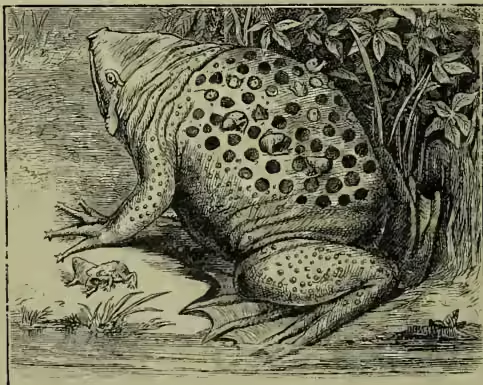
Habit of Life.—The majority of amphibia are much more at home in water than on land, though in some cases the adaptation to terrestrial life is very complete, and has even modified the ordinary course of development. For while the larval form which escapes from the egg is usually aquatic and gill-breathing, in Salamandra atra of the Alps two fertilised eggs develop within the body of the mother, nourish themselves on the remaining unfertilised ova, and in the absence of damp surroundings, are born as air-breathing forms. If they are prematurely removed from the body of the mother and put into water, they develop a fresh set of gills, and are normal tadpoles. S. maeulosa is also viviparous, and the young remain a whole year within the mother, but are born with external gills. In the tree-frog, Hyloides, which is found in certain volcanic islands, where the porous soil involves the absence of water-pools, the whole development, except the loss of the tail, is completed within the egg, and the young escape as air-breathing forms. It has been suggested that in the embryo, the broad tail must do most of the respiratory interchange of gases, for there appears to be an entire absence of gills. In this and in certain other features there is an approach to reptile development. Even among exclusively lung-breathing forms, the majority prefer to remain in the vicinity of water. Many live alone, and only assemble in crowds for the satisfaction of reproductive impulses. Both in their love and hunger they are especially active in the twilight. The food of the adults consists mostly of insects, slugs, and worms, but the larval forms are mainly vegetarian, 'though not despising animal food, even in the shape of the weaker members of its own family.' Their life is generally at a comparatively low potential, and they save themselves from cold of winter or heat of the dry season by falling into a lethargic state. They are able to remain without food for long periods, and though the tales of toads within stones are to a large extent doubtless mythical, and the results of careless observation, there are some authentic instances of considerably prolonged imprisonment, both in nature and by experiment. Amphibia have considerable power of regenerating lost parts. Some habits connected with the care of the young deserve notice. Thus, in the Surinam Toad (Pipa americana), the fertilised eggs, placed by the male on the back of the female, form small pits in the soft skin, and in each of these cradles a young form is developed. In another case (Nototrema marsupiatum), there is a large pocket on the back of the female for similar purposes; while in Rhinoderma darwini, the male carries the young in a large laryngeal pouch about its throat. The male obstetric frog (Alytes obstetricans) winds the eggs round his thighs, buries himself in damp earth till the young are almost ready to be liberated, and then plunges into a pool, where he is soon freed from his living burden.
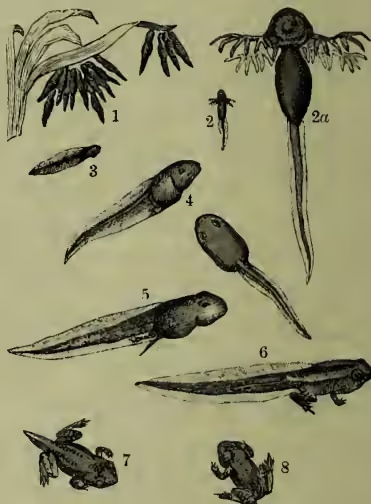
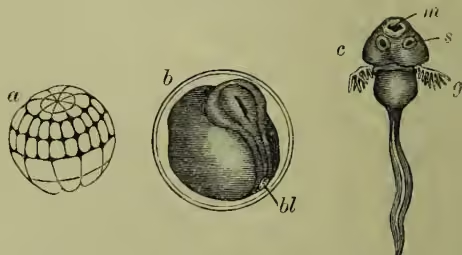
Development.—The life-history of a form like the frog is of considerable interest as an abbreviated recapitulation of the history of the race, and may be briefly noted. As in many other amphibia, the upper pole of the egg is covered with a 1, recently hatched tadpoles about natural size; 2, with external gills; 2a, same enlarged; 3 and 4, inclosure of gills; 5, hind-limbs visible; 6, after skin-casting, both pairs of legs visible; 7, atrophy of tail; 8, young frog. (From Mivart.) black pigment. In the Anura, the eggs are fertilised by the male as they leave the oviduct; while in others, such as salamanders, the fertilisation is internal. They are laid in gelatinous masses in water. A number of interesting exceptions to the normal mode of egg-laying have been already noticed. The total but unequal division of the ovum, and the subsequent changes by which backbone, spinal cord, gut, &c. appear, cannot be discussed here (see EMBRYOLOGY). When the tadpole is hatched, it is at first inclosed in the gelatinous débris of the egg-case. It grows for a short while longer at the expense of the yolk, which in a few forms is seen as a distinct external sac. Soon, however, the tadpole acquires a mouth and arms, and begins to feed. There are a pair of sucking discs behind the mouth. Shortly after hatching, the external gills are covered over by a fold of skin, leaving a posterior aperture for the exit of the water which enters by the mouth. The gills rapidly disappear, only, however, to be replaced by a fresh internal set. The mouth is armed with horny beak and teeth, and is not unlike that of the lamprey. The whole larva is in a decidedly fish-like stage. As the tadpole grows, the suckers behind the mouth disappear, the gut becomes much longer, and the lungs appear as outgrowths from the œsophagus. The metamorphosis into the adult form now slowly begins. The limbs appear as minute buds, but the front pair become free first. A skin-casting occurs, during which the gills, the beak, and the suctorial form of the mouth wholly disappear, while the eyes are uncovered, and the circulation becomes modified in association with the increasing importance of the lungs. The tail is absorbed, the gut is shortened, and the mainly vegetarian tadpole gradually assumes all the characters of the carnivorous frog.
The article Amphibia in the Encyclopædia Britannica, by Professor Huxley, and Professor St George Mivart's book on The Frog (Nature Series, London), may be profitably consulted for further details.